Indonesia's Corrugated Packaging Sector Surges on 20% E-Commerce Growth: The USD 9 Billion Race | Ken Research
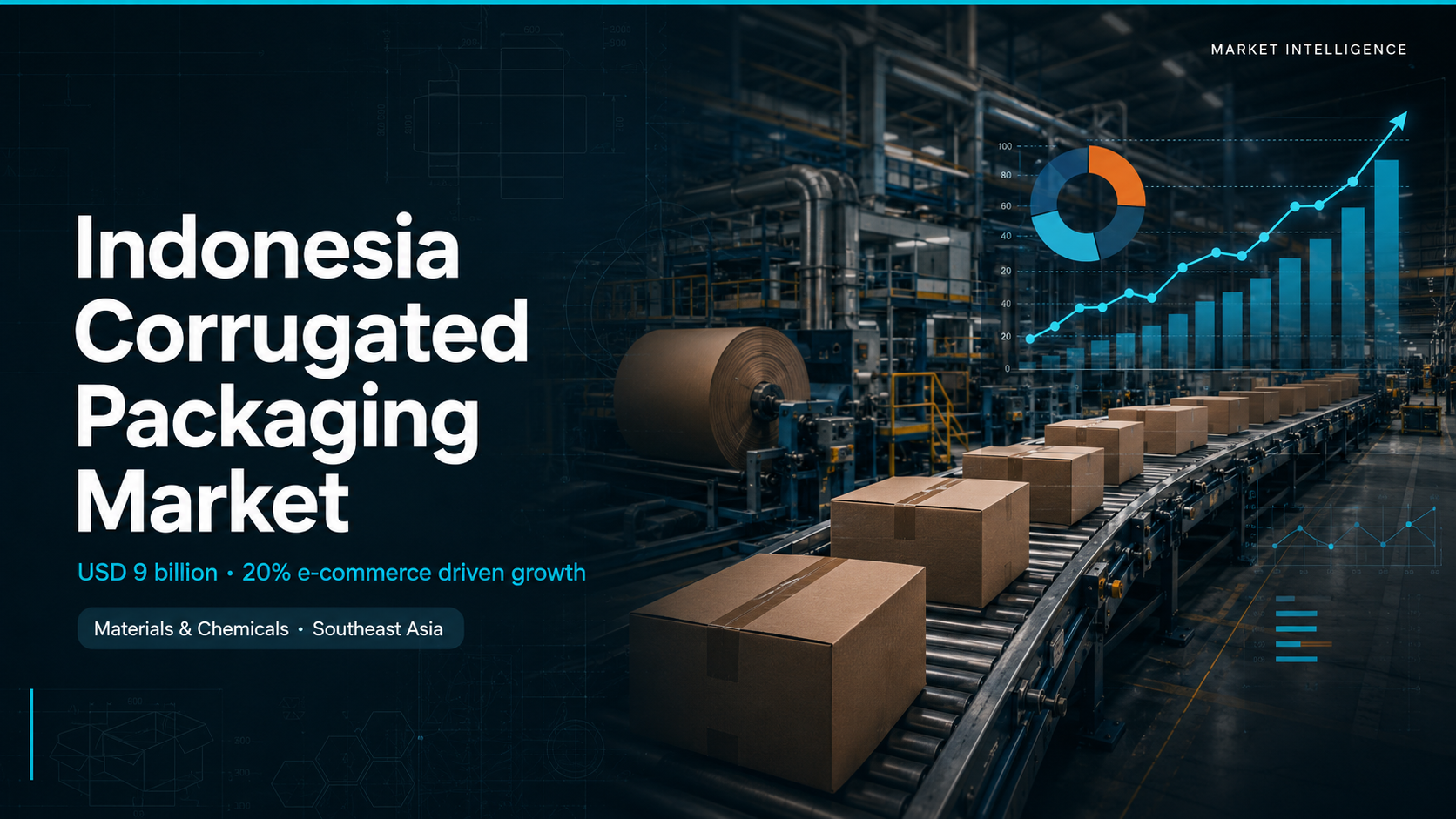
Indonesia's USD 9 Billion Corrugated Packaging Market Is Being Reshaped by E-Commerce: Ken Research Maps the Shift
Indonesia's corrugated packaging market has reached USD 9 billion in 2026, propelled by an e-commerce sector expanding at 20% annually and a regulatory environment that is demanding fundamental changes in how packaging is produced and recovered. This is not a cyclical uptick driven by one season of demand. It is a structural reordering of the supply chain, with food and beverage, FMCG, and digital retail all converging on corrugated board as the substrate of choice for protective, recyclable, and cost-competitive packaging. For a detailed breakdown of segments, players, and forecasts, see the Indonesia Corrugated Packaging Market Report. This analysis is published by Ken Research, a leading market intelligence firm covering packaging and industrial materials across Southeast Asia.
This analysis is based on Ken Research market modelling, operator production disclosures, packaging-sector indicators, and third-party packaging-sector estimates.
USD 9 Billion and Climbing: How Single-Wall and Food and Beverage Dominate the 2026 Baseline
The segment composition of Indonesia's corrugated packaging market reveals where value is concentrated today, and the picture is more nuanced than headline growth suggests. Single-wall board is the dominant format, accounting for the largest share of production volume, while the food and beverage vertical is the largest end-use category, reflecting Indonesia's USD 9 billion market scale and the country's massive consumer goods manufacturing base. According to Ken Research, 65% of current production already incorporates recycled fiber, a figure that places Indonesian producers ahead of many regional peers on circularity metrics. Comparable dynamics in adjacent ASEAN consumer goods industries can be tracked through the Indonesia Paint Market and in broader consumption trends analyzed in the Global FMCG Market research. For operators, the implication is clear: the base market is large, the recycled-content baseline is already established, and the question now is which producers can sustain margin as compliance costs layer in.
- Single-Wall Board: The dominant production format, capturing the highest volume share in a market valued at USD 9 billion
- Food and Beverage: The largest end-use segment, anchoring corrugated demand across Indonesia's sprawling consumer manufacturing base with 65% recycled fiber content already standard
- Double-Wall Board: Serves heavy industrial applications, providing higher compression strength for export and industrial goods shipments across the archipelago
- Recycled Content: 65% of production uses recycled materials, positioning local producers as regionally competitive on sustainability benchmarks ahead of the 2029 EPR deadline
E-Commerce at 20% Annual Growth Is Forcing a 30% EPR Compliance Reckoning by 2029
The tension at the heart of Indonesia's corrugated packaging market is a collision between two powerful forces moving in opposite directions on the cost curve. E-commerce is generating demand at 20% annually, creating the fastest-growing application segment in the entire corrugated board value chain and pulling volume toward lighter, more customized single-wall solutions. At the same time, the government's Extended Producer Responsibility mandate is requiring a 30% reduction in packaging waste by 2029, which imposes design, collection, and recovery obligations that add compliance costs across the producer base. Ken Research finds that players like Sinar Mas Group, PT Indah Kiat Pulp and Paper, Smurfit Kappa Indonesia, and DS Smith Indonesia are navigating this dual pressure by accelerating investment in recycled fiber infrastructure. The hospitality and tourism sectors that share Indonesia's logistics infrastructure are tracked separately in the Indonesia Hotel Market analysis, while food supply chain pressures shaping packaging specifications are covered in the Global Food Market research. For investors, the EPR mandate is not just a regulatory risk; it is the filter that will separate well-capitalized producers from under-resourced ones within the next three years.
- E-Commerce Growth Rate: 20% annual demand expansion, making digital retail the fastest-growing end-use application in the corrugated packaging segment
- EPR Mandate: 30% waste reduction required by 2029, imposing new design and recovery obligations across the producer base
- Fiber Raw Material Costs: Rising input costs for virgin and recycled fiber are compressing margins as producers scale up capacity to meet e-commerce demand
- Flexible Packaging Competition: Lightweight flexible formats are competing for share in the fast-moving consumer goods segment, pressuring corrugated producers to demonstrate cost and sustainability advantages
Want to see exactly how Indonesia's corrugated packaging producers are managing the EPR compliance cost curve while scaling for e-commerce? Download Sample Report and review segment-level data before committing to a sourcing or investment decision.
Which Players Are Winning in a USD 9 Billion Market Where 65% Recycled Content Is Already Standard?
The competitive landscape in Indonesia's corrugated packaging market is anchored by a small number of vertically integrated producers who control fiber supply, board manufacturing, and converting capacity simultaneously. Sinar Mas Group and its affiliate Asia Pacific Resources International (APRIL) sit at the top of the integration chain, with pulp and paper assets that give them structural cost advantages over standalone converters. PT Indah Kiat Pulp and Paper, another Sinar Mas entity, reinforces this integrated position and accounts for a significant share of the country's corrugated substrate supply. Ken Research notes that multinational players like Smurfit Kappa Indonesia and DS Smith Indonesia bring global design and sustainability capabilities, positioning them well for e-commerce clients who require certified, lightweighted, and EPR-compliant solutions. The digitization of supply chains enabling these players is analyzed in the Indonesia AI CCTV Market, and the last-mile logistics infrastructure that corrugated packaging flows through is benchmarked in the Philippines E-Commerce Logistics Market study. With 65% of production already using recycled fiber and the EPR mandate requiring a further 30% waste reduction by 2029, the window for undifferentiated commodity producers is closing rapidly and the premium tier is consolidating around sustainability credentials.
Indonesia Corrugated Packaging Forecast to 2029: What the EPR Deadline and 20% E-Commerce Growth Mean for Investors
The forward trajectory of Indonesia's corrugated packaging market is shaped by three concurrent forces that Ken Research has mapped across the forecast period. First, e-commerce volume growth at 20% annually will continue to pull demand toward smaller, customized, single-wall formats suitable for last-mile delivery. Second, the EPR mandate requiring a 30% reduction in packaging waste by 2029 will accelerate capital investment in fiber recovery, recycled pulp processing, and take-back infrastructure across the sector. Third, rising competition from flexible packaging will force corrugated producers in the food and beverage space, the largest end-use segment in a USD 9 billion market, to sharpen cost positioning or shift toward value-added structural designs. For regional investors benchmarking Indonesia's packaging sector against other capital-intensive manufacturing markets across Southeast Asia, the Malaysia Automotive Aftermarket Service Market provides a comparable lens on industrial consolidation dynamics in the region.
- E-Commerce Segment Outlook: Fastest-growing application category, with 20% annual demand growth set to outpace all other corrugated end-uses through 2029
- EPR Compliance Timeline: 30% waste reduction required by 2029, creating a hard investment deadline for fiber recovery infrastructure across the producer base
- Recycled Content Position: 65% of production already using recycled materials gives Indonesian producers a compliance head start relative to other Southeast Asian markets
- Food and Beverage Anchor: The largest end-use segment will remain the volume backbone of the USD 9 billion market even as e-commerce accelerates its relative share growth
Need a complete competitive, segment, and forecast view of Indonesia's corrugated packaging sector before your next procurement or investment cycle? Access the Indonesia Corrugated Packaging Market Report and get the full Ken Research data model.
Conclusion
Indonesia's corrugated packaging market is not simply benefiting from a commodity demand cycle. At USD 9 billion in 2026, with e-commerce driving 20% annual demand growth and an EPR mandate enforcing a 30% waste reduction requirement by 2029, the sector is undergoing a structural reconfiguration that rewards producers who are vertically integrated, recycled-fiber capable, and EPR-compliant. The 65% recycled content baseline already in production is a competitive asset, not merely a regulatory checkbox, and the players who can lower their compliance cost per unit while scaling digital-retail-ready formats will capture disproportionate share through the end of the decade. For the full competitive intelligence, segment-level data, and player benchmarking that supports these findings, access the Indonesia Corrugated Packaging Market Report from Ken Research.
Frequently Asked Questions
Q1: What is the current size of the Indonesia corrugated packaging market?
Indonesia's corrugated packaging market stands at USD 9 billion in 2026, making it one of the largest packaging substrates markets in Southeast Asia. The market is supported by a broad industrial base spanning food and beverage manufacturing, FMCG distribution, and a rapidly scaling e-commerce logistics sector growing at 20% annually. Ken Research's market modelling confirms that single-wall board dominates production volume while the food and beverage vertical remains the largest end-use segment by value.
Q2: What is driving demand growth in Indonesia's corrugated packaging market?
The primary growth driver is e-commerce, which is expanding at 20% annually and converting demand toward lightweight, customized single-wall corrugated formats suited to last-mile delivery. Secondary drivers include FMCG sector growth, export packaging demand, and the sustainability shift that has made corrugated board, with its 65% recycled content baseline, the preferred alternative to plastic-dominant formats. Investors tracking similar demand dynamics in adjacent markets can refer to the Vietnam Paint Market for a parallel view of ASEAN industrial goods demand shifts.
Q3: What is the EPR mandate and how does it affect corrugated packaging producers?
Indonesia's Extended Producer Responsibility mandate requires a 30% reduction in packaging waste by 2029, placing direct design, collection, and recovery obligations on producers and brand owners. This is driving investment in recycled fiber processing and take-back infrastructure across the corrugated board supply chain. Producers who have already achieved a 65% recycled content rate in production are better positioned to absorb incremental compliance costs without margin erosion. For context on how sustainability mandates are reshaping other Indonesian industrial sectors, see the Indonesia Biogas Market analysis from Ken Research.
Q4: Who are the key players in the Indonesia corrugated packaging market?
The leading players identified by Ken Research include Sinar Mas Group, Asia Pacific Resources International (APRIL), PT Indah Kiat Pulp and Paper, Smurfit Kappa Indonesia, and DS Smith Indonesia. The Sinar Mas ecosystem holds a structural cost advantage through vertical integration across pulp, paper, and corrugated converting, covering a market valued at USD 9 billion. Multinational players including Smurfit Kappa Indonesia and DS Smith Indonesia are competing on sustainability certifications and e-commerce-ready design capabilities to serve the 20% annually growing digital retail segment.
Q5: How does Indonesia's corrugated packaging market compare to other Southeast Asian packaging markets?
Indonesia's USD 9 billion scale and 65% recycled content production baseline position it as one of the more advanced corrugated markets in the ASEAN region, both in size and in circularity metrics. The EPR mandate requiring a 30% waste reduction by 2029 is stricter than comparable policies in several neighboring markets, signaling that Indonesia is moving faster on packaging regulation than the regional average. For broader intelligence on Indonesia's investment and industrial landscape, the Indonesia Wealth Management Market from Ken Research provides insight into the capital flows underpinning industrial expansion across the archipelago.
For the full competitive benchmarking, segment-level forecasts, and regional breakdown, access the Indonesia Corrugated Packaging Market Report from Ken Research, a leading market intelligence firm covering packaging and industrial materials across Southeast Asia.

Comments
Post a Comment