Philippines Wastewater Sector Surges to USD 46.5 Mn on DENR Compliance Drive | Ken Research
Philippines Industrial Wastewater Sector Hits USD 46.5 Mn as DENR Mandates Reshape Compliance: Ken Research Maps the Growth
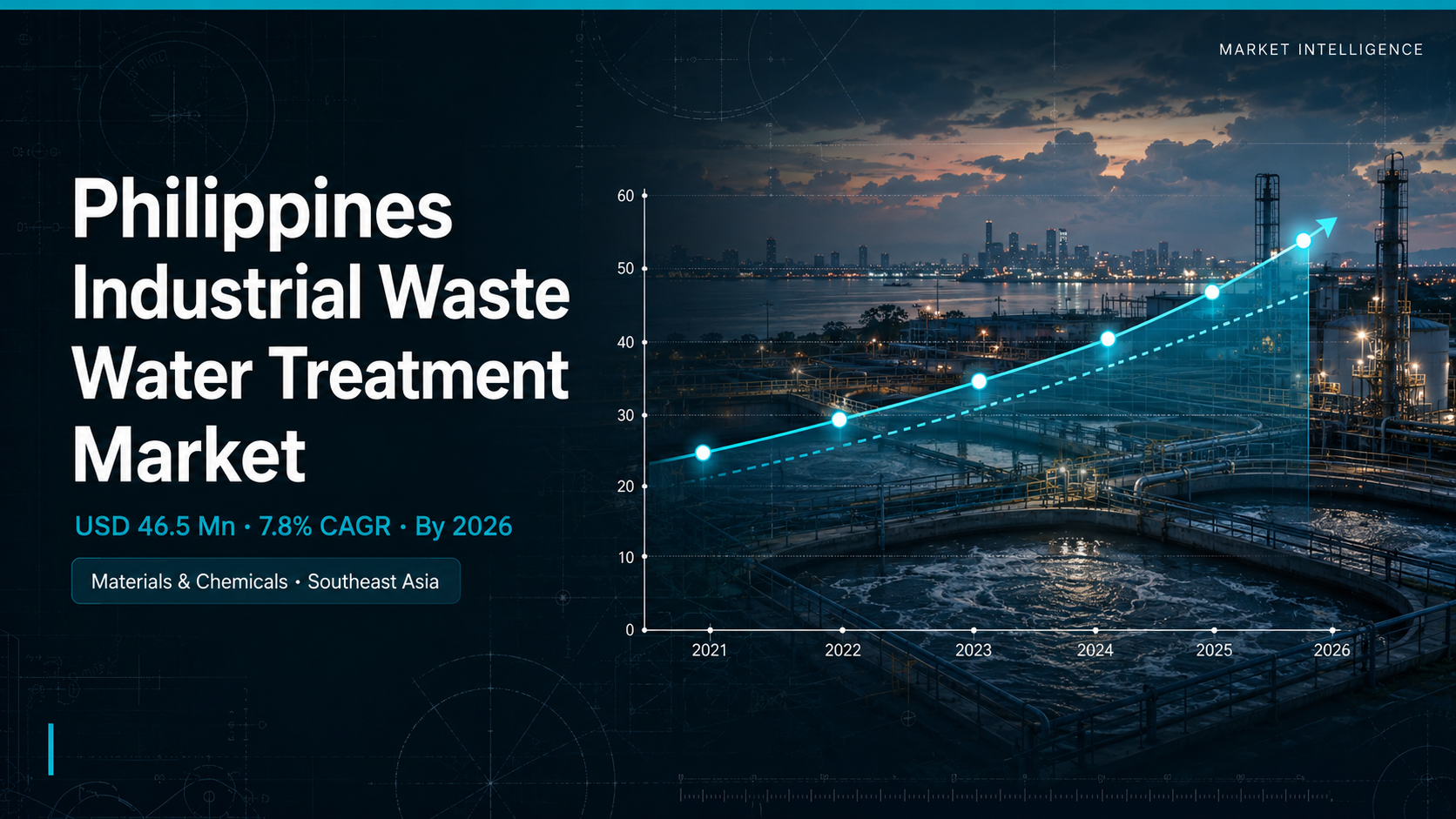
The Philippines industrial wastewater treatment sector is undergoing a structural shift, driven by mandatory DENR compliance upgrades and rapid industrialisation across Luzon manufacturing corridors. As per Ken Research market modelling, the market reaches USD 46.5 Mn by 2026 at a 7.8% CAGR through 2029, as enforcement of discharge standards accelerates EPC contract awards nationwide. For the full market breakdown, see the Philippines Industrial Waste Water Treatment Market Report. This analysis is published by Ken Research.
This analysis is based on Ken Research market modelling, DENR compliance data, and industrial-sector estimates.
USD 46.5 Mn by 2026F and 7.8% CAGR: The Growth Trajectory Reshaping Philippines Treatment Infrastructure
Industrial wastewater treatment in the Philippines is no longer a compliance footnote but a capital-intensive infrastructure priority as manufacturing output scales and enforcement intensifies. As per Ken Research market modelling, the sector reaches USD 46.5 Mn by 2026 at 7.8% CAGR through 2029. Industrial wastewater output grew 8% in 2023, creating a structural demand surge operators cannot absorb without facility upgrades. For ASEAN benchmarking, the Indonesia Industrial Water and Treatment Market offers a direct parallel, where manufacturing-led demand has driven double-digit infrastructure investment.
- EPC Size: Average EPC contract approximately USD 0.36 million, creating a high-volume mid-cap pipeline
- Forecast: USD 46.5 Mn by 2026, driven by food, chemical, and semiconductor compliance upgrades
- Output Growth: Industrial wastewater grew 8% year-on-year in 2023, outpacing licensed treatment capacity
- CAGR: 7.8% through 2029 positions Philippines ahead of several Southeast Asia compliance market peers
RA 9275 and DENR Order No. 2021-19 Drive 70% Industry Compliance Across Food and Chemical Sectors
The regulatory architecture is the most consequential near-term growth driver. RA 9275, the Philippine Clean Water Act, requires all industrial dischargers to obtain Wastewater Discharge Permits from the DENR or Laguna Lake Development Authority. As per government compliance data, over 70% of industrial companies were mandated in 2023 to upgrade under DENR Administrative Order No. 2021-19, which sets stricter BOD, COD, and TSS thresholds than the 2016 predecessor. This compliance wave is serviced by 19 active providers. Operators in Gulf markets will find a structural parallel in the Saudi Arabia Industrial Waste Water Treatment Market, where permit enforcement has driven expansion at comparable velocity.
- RA 9275: Mandates Wastewater Discharge Permits with quarterly Self Monitoring Reports for all facilities
- DENR DAO 2021-19: Stricter effluent standards triggered 70% mandatory upgrade rate across industrial sectors
- Enforcement: DENR EMB and Laguna Lake Development Authority cover 45% demand concentration in Metro Manila and Calabarzon
- Providers: 19 licensed operators active across EPC and O&M segments
Is your facility compliant with DENR DAO 2021-19 while competitors are already upgrading? Download Sample Report for compliance data and EPC benchmarks.
Why Is Metro Manila Capturing 45% of Philippines Industrial Wastewater Demand by 2026?
Geographic concentration in the Philippines wastewater market is sharp and structurally persistent. Metro Manila and Calabarzon account for 45% of total national demand, driven by the highest density of food and beverage plants, semiconductor fabrication units, and chemical manufacturing facilities. Water reuse practices grew 10% year-on-year across Metro Manila industrial estates, signalling a shift from compliance-driven treatment to value-recovery models. geographic demand concentration is reshaping where EPC contracts and treatment investments flow across the archipelago. Operators evaluating water treatment chemicals spend will find benchmarking in the Philippines Water Treatment Chemicals Market, where Metro Manila concentration has driven premium-grade coagulant spend.
- Demand Hub: Metro Manila + Calabarzon = 45% of national demand from food, semiconductor, and chemical clusters
- Water Reuse: 10% year-on-year growth in industrial estates shifting investment toward circular economy models
- Regional Spread: Mindanao and Visayas gaining share as government redirects EPC contract flow beyond Metro Manila
- Food and Beverage: Highest wastewater volume by vertical, ahead of chemical, pharmaceutical, and paper and pulp sectors
Philippines Wastewater Treatment Outlook to 2029: USD 0.36 Mn EPC Contracts and What Drives Them
The forward market is bifurcated between EPC contracts and Operations and Maintenance agreements. As per Ken Research market modelling, the sector sustains 7.8% CAGR through 2029, with EPC contracts averaging USD 0.36 million per project across 19 licensed service providers. Key players including Eco-System Technologies Inc., Manila Water Company, Veolia Water Philippines, and KSB Philippines Inc. compete for compliance upgrades and greenfield industrial contracts. IoT-enabled effluent monitoring is entering O&M scope, extending service coverage and per-contract value. The Vietnam Industrial Water and Wastewater Treatment Market shows how EPC-to-O&M conversion rates drive revenue diversification at comparable scales.
- EPC Average: USD 0.36 million per project, accessible to domestic and international providers
- CAGR: 7.8% through 2029 sustained by wastewater volume growth outpacing treatment capacity
- Providers: 19 licensed operators including KSB Philippines, Yokogawa Philippines, and Subic Water
- Technology: IoT monitoring entering O&M contracts, extending value for digitally capable operators
Ready to benchmark Philippines wastewater EPC pipeline and competitor positioning? Philippines Industrial Waste Water Treatment Market Report delivers the full segment breakdown.
Conclusion
The Philippines industrial wastewater treatment market is entering a consolidation phase where regulatory pressure, manufacturing growth, and water reuse economics converge. With the sector at USD 46.5 Mn by 2026, a 7.8% CAGR through 2029, and Metro Manila commanding 45% of national demand, DENR DAO 2021-19 enforcement and greenfield EPC pipeline create compounding opportunities for compliant operators. Access the Philippines Industrial Waste Water Treatment Market Report for the full competitive benchmark.
Frequently Asked Questions
Q1: What is the projected market size of the Philippines industrial wastewater treatment sector?
As per Ken Research market modelling, the sector reaches USD 46.5 Mn by 2026 at 7.8% CAGR through 2029. Industrial wastewater output grew 8% in 2023, creating structural demand for greenfield construction and compliance upgrade contracts.
Q2: Which regulation drives industrial wastewater compliance in the Philippines?
RA 9275 and DENR Administrative Order No. 2021-19 mandate Wastewater Discharge Permits, triggering a 70% mandatory upgrade rate across 19 active providers in 2023. The Qatar Industrial Water Treatment Chemicals Market shows how similar discharge enforcement drives comparable treatment spend growth.
Q3: What are the key industry segments driving Philippines wastewater treatment demand?
Food and Beverage, Chemical and Pharmaceutical, Semiconductor and Electronics, and Paper and Pulp are the four primary segments. Metro Manila and Calabarzon account for 45% of national demand, water reuse grows at 10% per annum, and average EPC project size is USD 0.36 million.
Q4: Who are the key players in the Philippines industrial wastewater treatment market?
As per Ken Research, 19 licensed providers operate across EPC and O&M segments, including Eco-System Technologies Inc., Manila Water Company, Veolia Water Philippines, KSB Philippines Inc., and Yokogawa Philippines Inc. Average EPC size is USD 0.36 million.
Q5: How does the Philippines wastewater market compare with ASEAN peers?
At USD 46.5 Mn by 2026 and 7.8% CAGR, the Philippines is a fast-growing mid-tier ASEAN market with manufacturing-led surges above 8% per year. The Malaysia Industrial Water and Wastewater Treatment Market offers a direct ASEAN benchmark at a larger absolute scale.
For the full competitive benchmarking, segment-level forecasts, and regional breakdown, access the Philippines Industrial Waste Water Treatment Market Report from Ken Research, a leading market intelligence firm covering environmental and industrial sectors across Asia.


Comments
Post a Comment