Singapore Bunker Race: USD 22B Reshaped by Record 54.92 MT Sales and LNG Surge | Ken Research
Singapore Bunker Fuel Market Hits USD 22B on Record 54.92 MT Sales | Ken Research
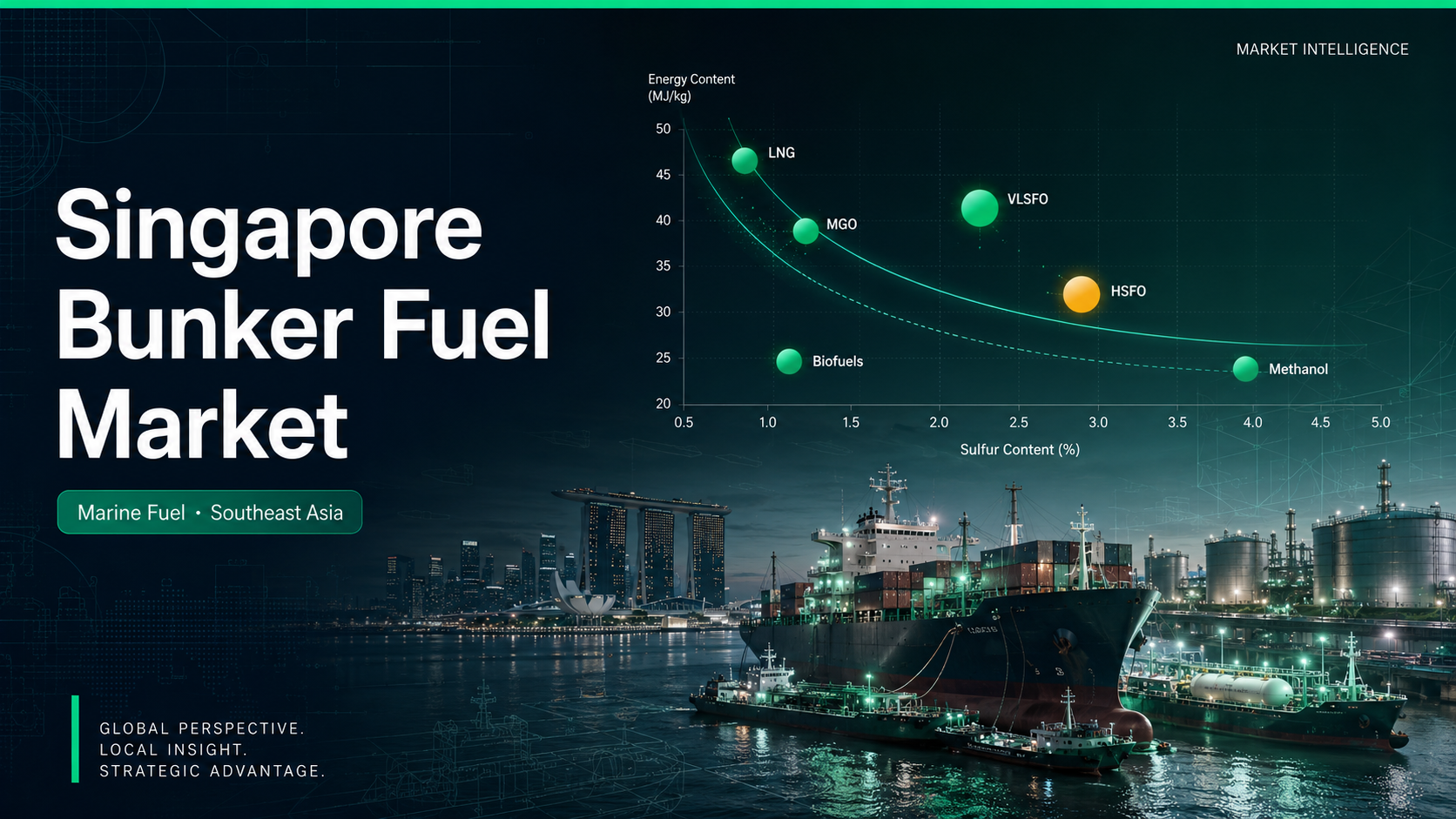
The defining shift in Singapore bunker fuel is not coming from routine VLSFO refuelling. It is coming from a record 54.92 million tonnes 2024 sales driven by Red Sea diversions, alongside LNG bunkering at 28.9% CAGR and TotalEnergies' B100 biofuel breakthrough. As per Ken Research market modelling, the Singapore Bunker Fuel Market is valued at USD 22 billion in 2024, with VLSFO at 55.3% share. The complete supplier share, segment forecast, and fuel-mix forecasts are in the Singapore Bunker Fuel Market Report.
This analysis draws on data from Ken Research market modelling, Maritime and Port Authority of Singapore (MPA) disclosures, eBDN mandatory digital records, and independent marine-fuel benchmarking.
USD 22B Market with VLSFO at 55% Share and 54.92 MT Record Volume Anchor
The structural anchor is global shipping demand combined with low-sulfur compliance. As tracked by Ken Research modelling, VLSFO dominates at 29.2 MT in 2025 (55.3% share), anchored by IMO 2020's 0.5% sulfur cap. Red Sea conflict adds approximately 8,500 nautical miles per voyage, lifting fuel demand. Parallel research projects Singapore bunker fuel at USD 22.1 billion 2024 to USD 33.3 billion 2034 at 4.2% CAGR. For investors mapping adjacent global natural gas markets, the Global Natural Gas Market shows the same energy-transition thesis driving LNG bunkering.
- Record sales: 54.92 MT bunker sales in 2024 reflect Red Sea diversion volume.
- VLSFO dominance: VLSFO at 29.2 MT (55.3% share) on IMO 2020 compliance.
- LNG growth: LNG bunkering at 28.9% CAGR through 2031.
ExxonMobil, Shell, Chevron, TotalEnergies and Singapore Petroleum Anchor Supplier Stack
The supplier map is dominated by global oil majors and Singapore-based traders. As estimated by Ken Research, Singapore Petroleum Company, ExxonMobil Asia Pacific, Shell Eastern Trading, Chevron Singapore, TotalEnergies Marine Fuels, Bunker One Singapore, KPI OceanConnect, Hartree Partners, Minerva Bunkering, World Fuel Services, Chemoil Energy, Bunker Holding, Panoil Petroleum, and Sinopec Fuel Oil together anchor the supplier stack. The MPA mandated electronic bunker delivery notes (eBDNs) from April 2025, per the Maritime and Port Authority of Singapore portal. TotalEnergies completed its first B100 biofuel bunker in August 2024.
- Oil major leaders: ExxonMobil, Shell, Chevron, TotalEnergies anchor Tier-1 supply.
- Biofuel breakthrough: TotalEnergies' 1,032,000-gallon B100 bunker in August 2024.
Need the fuel-mix split across VLSFO, HSFO, MGO, LNG, biofuels and supplier share map? Download Sample Report for MPA-linked compliance outlook and alternative-fuel pipeline.
Why Are eBDNs and B100 Biofuel Reshaping Singapore Bunkering by 2030?
MPA's April 2025 mandatory eBDN system compresses information asymmetry and narrows bid-ask spreads across Singapore bunker trading. According to Ken Research analysis, combined with TotalEnergies' B100 biofuel success and LNG bunker infrastructure, the digitization and decarbonization wave lifts Singapore's position as Asia's premier bunker hub through 2030.
Singapore Bunker Outlook to 2030: USD 22B Base, LNG Lift, and eBDN Anchor
Three drivers anchor the forward view. Per Ken Research modelling, IMO 2020 compliance, LNG bunkering growth, and eBDN digitization together compound the bunker book. For investors mapping adjacent solar and renewables, the Egypt Solar Energy Market shows the same energy-transition thesis compounding globally.
- LNG CAGR: LNG bunkering at 28.9% CAGR through 2031.
- eBDN digitization: Mandatory April 2025 electronic bunker delivery notes narrow spreads.
- Biofuel adoption: TotalEnergies B100 biofuel success signals low-carbon shipping demand.
What Suppliers, Shipowners, and Investors Must Do Before LNG Bunker Consolidation Closes
The combined effect of MPA eBDNs, IMO 2020 compliance, and LNG-biofuel transition creates a multi-year positioning window. Suppliers, owners, and capital allocators must move before ExxonMobil, Shell, Chevron, and TotalEnergies lock dominant Singapore positions.
- Suppliers: Build LNG and biofuel bunker capacity to capture 28.9% LNG CAGR.
- Shipowners: Adopt B100 biofuel and LNG dual-fuel for IMO compliance.
- Investors: Track LNG bunker infrastructure expansions and emerging methanol bunker plays.
Building a Singapore bunker fuel supply or LNG infrastructure investment? Access the Singapore Bunker Fuel Market Report for fuel mix forecasts, supplier share, and digital compliance outlook.
Conclusion
Singapore bunker fuel has entered a record-volume and energy-transition inflection where MPA eBDNs, LNG bunkering, and TotalEnergies B100 compound on the same supplier stack. The suppliers that build LNG and biofuel depth ahead of the 2030 reset will defend share rather than chase it. For shipowners and investors, the strategic question is no longer whether bunker fuel volume scales, it is who anchors the next LNG-or-biofuel category. Access the Singapore Bunker Fuel Market Report for the full landscape.
Frequently Asked Questions
Q1: What is the size of the Singapore Bunker Fuel Market?
The Singapore Bunker Fuel Market is valued at USD 22 billion in 2024 per Ken Research market modelling, with record 54.92 million tonnes of bunker sales in 2024.
Q2: Who are the key bunker fuel suppliers in Singapore?
Leading suppliers include ExxonMobil, Shell, Chevron, TotalEnergies, Singapore Petroleum, Bunker One, KPI OceanConnect, Hartree Partners, Minerva Bunkering, and Sinopec Fuel Oil. For comparable energy-and-power dynamics see the Middle East Renewable Energy Certificate Market.
Q3: Which fuel leads Singapore bunkering?
VLSFO leads at 29.2 MT in 2025 with 55.3% share per Ken Research estimates, with LNG growing fastest at 28.9% CAGR through 2031.
Q4: What is driving growth in Singapore bunker fuel?
Growth drivers include record 54.92 MT 2024 sales, Red Sea diversion lifting per-voyage fuel demand, IMO 2020 sulfur cap, MPA April 2025 mandatory eBDNs, and broader CAGR of 4.2% to USD 33.3 billion by 2034.
Q5: How does MPA's eBDN mandate affect Singapore bunkering?
MPA's April 2025 mandatory electronic bunker delivery notes (eBDNs) compress information asymmetry, narrow bid-ask spreads, and lift transparency across Singapore bunker trading.
For the full competitive benchmarking, supplier share, and fuel-mix forecasts, access the Singapore Bunker Fuel Market Report from Ken Research, a leading market intelligence firm covering energy and marine fuels across Asia Pacific.


Comments
Post a Comment