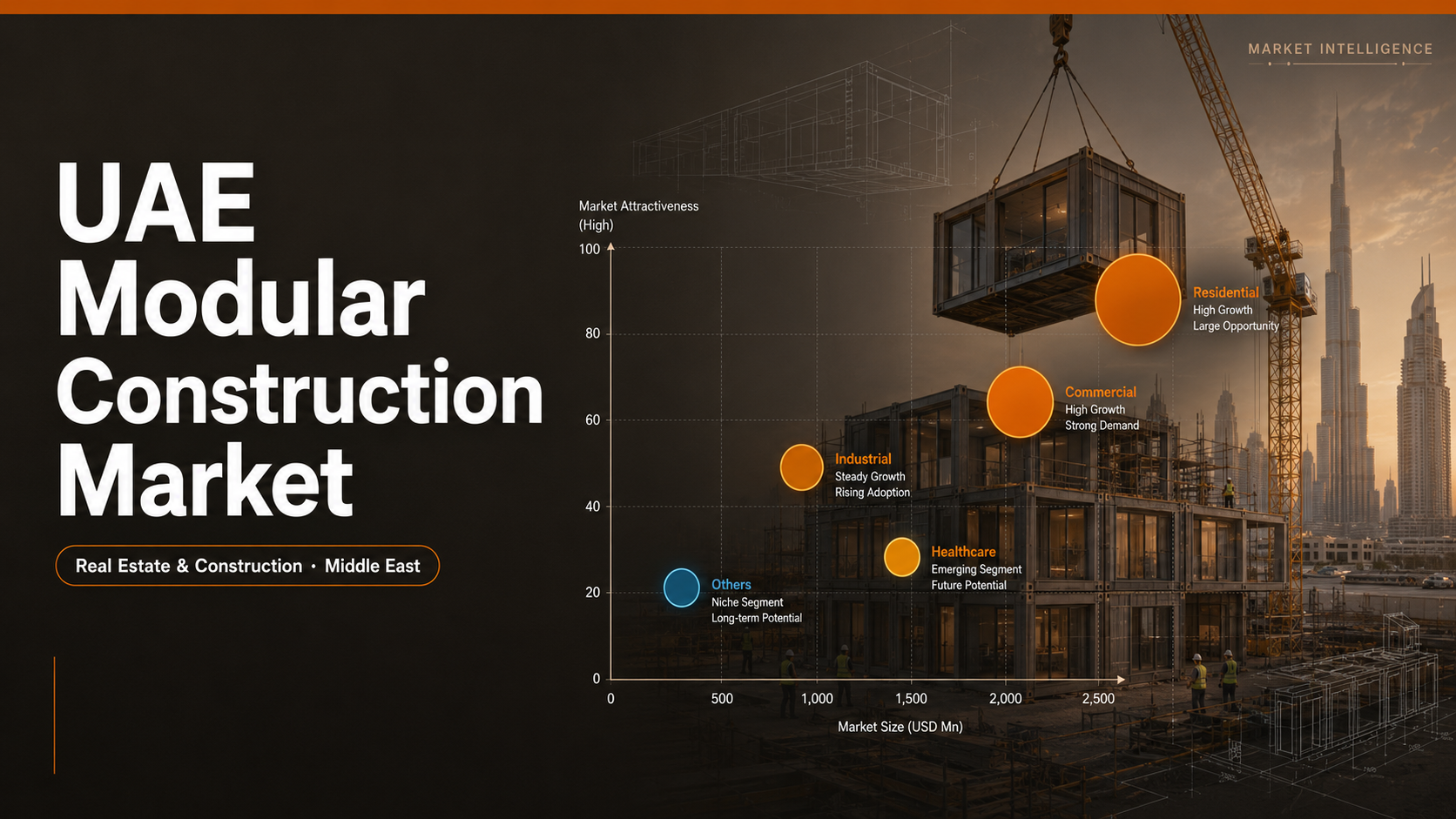
UAE's USD 1.6 Billion Modular Construction Market Races to Deliver 120,000 New Homes: Ken Research
The UAE modular construction market reached USD 1.6 billion in 2024, driven by a residential deficit requiring 120,000 new housing units by 2025 and the Dubai Urban Master Plan's USD 17.68 billion infrastructure investment program. Prefab and volumetric modular methods deliver projects up to 40% faster than conventional construction, saving AED 1.8 million per project and diverting 65% of construction waste from landfills. The UAE Modular Construction Market Report maps the full segment breakdown and competitive landscape, published by Ken Research, a leading GCC market intelligence firm.
This analysis is based on Ken Research market modelling, operator disclosures, government infrastructure data, and third-party construction-sector estimates.
How 120,000-Unit Housing Demand and USD 17.68 Billion Government Investment Drive UAE's Modular Construction Market
As per Ken Research market modelling, the UAE modular construction market is valued at USD 1.6 billion in 2024, underpinned by a residential pipeline requiring 120,000 housing units by 2025 and over 66,000 new units expected across Dubai and Abu Dhabi by 2028. The Dubai Urban Master Plan commits USD 17.68 billion in infrastructure investment, while Abu Dhabi's Ghadan 21 economic stimulus injects USD 13.6 billion, creating a multi-year pipeline that rewards the speed and cost advantages of volumetric modular delivery. Residential building accounts for 38.76% of total UAE construction spending, with Permanent Modular Construction and volumetric 3D modules dominating segment activity as the preferred delivery format for the residential pipeline.
- Market base: UAE modular construction at USD 1.6 billion in 2024, anchored by residential demand requiring 120,000 units by 2025.
- Speed advantage: Modular delivers projects up to 40% faster, saving developers AED 1.8 million per project in time and labour costs.
- Government pipeline: Dubai Urban Master Plan (USD 17.68B) and Ghadan 21 (USD 13.6B) sustain multi-year prefab demand.
How LINQ Modular, Emirates Building Systems and Leading Players Are Scaling UAE's Prefab Pipeline
As per operator disclosures and industry association data, LINQ Modular (ALEC's modular division), Emirates Building Systems, Emirates Precast Construction LLC, Dutco Balfour Beatty LLC, and Al-Futtaim Engineering and Technologies anchor the UAE competitive hierarchy. LINQ Modular operates a 31,000 sq m manufacturing facility in Dubai Industrial City, delivered 600+ modules in FY-2024, and holds 3 ISO certifications covering quality, environmental management, and occupational safety. In September 2024, ALEC was awarded an AED 1.8 billion construction contract for Como Residences on Palm Jumeirah, while LINQ's Sindalah Island project delivered 510 LEED Gold-certified modules for Marriott service apartments, proving hospitality-grade certification readiness across the GCC. The UAE Heavy Construction Equipment Market shows how parallel equipment demand at USD 2.1 billion in 2024 reflects the same mega-project construction surge driving modular adoption.
- LINQ scale: 31,000 sq m Dubai facility, 600+ modules in FY-2024, 3 ISO certifications across quality, environment, and safety.
- ALEC contract: AED 1.8 billion Como Residences contract (Sept 2024) confirms operator pipeline strength.
- LEED Gold proof: 510 modules delivered at Sindalah Island as hospitality-grade certified modular construction.
Want the full UAE modular construction competitive landscape, segment forecasts, and player benchmarking? Download Sample Report to access segment-level data and player analysis.
Why Dubai's G+20 Modular Approval Is a Regulatory Turning Point for UAE's USD 1.6 Billion Market
As tracked by Ken Research market modelling, Dubai Municipality has progressively extended modular construction approvals from G+6 and G+12 projects to now cover G+20 structures, removing the height ceiling that previously restricted modular to low-to-mid-rise developments. Despite this progress, only 30% of UAE construction firms are currently familiar with modular techniques, and an estimated 35% of modular projects encounter regulatory approval delays that compress project timelines. The Estidama Pearl Rating System mandates a minimum 2-pearl certification for government projects, driving adoption of modular's certified 31% energy reduction and 37% water use reduction performance outcomes. The UAE's carbon reduction target of 30% by 2030 and AED 12 billion in sustainable building investment reinforce policy tailwinds for modular methods that structurally reduce waste and energy use. The UAE Blockchain in Real Estate Transactions Market illustrates how digital compliance infrastructure is simultaneously being deployed to streamline regulatory certification across UAE construction projects.
UAE Modular Construction Outlook to 2030: MEA Market Grows to USD 9 Billion as GCC Penetration Scales
As per independent market estimates, the MEA modular construction market was valued at USD 5.98 billion in 2024 and is projected to reach USD 9.04 billion by 2030 at 5.97% CAGR, with UAE holding the dominant regional position. The broader GCC prefabricated buildings market is valued at USD 6.9 billion in 2024, growing to USD 11.21 billion by 2030 at 8.2% CAGR. Modular penetration across the GCC remains at barely 1% of total builds, signalling a major early-mover opportunity for UAE operators. The Indonesia Construction Equipment Market benchmarks how infrastructure-led economies transition to prefab-first strategies as urban demand outpaces conventional build capacity. The GCC Luxury Car Market data shows how GCC government spending is driving premium sustainable construction demand across the region.
- MEA context: MEA modular market at USD 5.98 billion in 2024, reaching USD 9.04 billion by 2030 at 5.97% CAGR.
- GCC scale: GCC prefab market growing from USD 6.9 billion to USD 11.21 billion by 2030 at 8.2% CAGR.
- Penetration gap: Modular at barely 1% of GCC builds in 2025, signalling massive runway for early-mover UAE operators.
Ready for the complete UAE modular construction segment forecasts and competitive intelligence? UAE Modular Construction Market Report from Ken Research has the full analysis.
Conclusion
The UAE modular construction market at USD 1.6 billion in 2024 sits at a structural inflection point: a residential deficit of 120,000 units, G+20 approvals in Dubai, AED 12 billion in sustainable building investment, and GCC penetration barely at 1% all signal the shift from conventional to modular is accelerating. LINQ Modular's 31,000 sq m facility and 600+ modules per year demonstrate that manufacturing scale is already in place to support this transition. Access the UAE Modular Construction Market Report from Ken Research for complete segment forecasts, player benchmarking, and green-building policy analysis.
Frequently Asked Questions
Q1: What is the current size of the UAE modular construction market?
As per Ken Research market modelling, the UAE modular construction market was valued at USD 1.6 billion in 2024, part of a broader MEA modular market at USD 5.98 billion. UAE holds the dominant regional share, driven by a residential deficit requiring 120,000 housing units by 2025.
Q2: Who are the leading players in the UAE modular construction market?
As per operator disclosures, LINQ Modular (ALEC), Emirates Building Systems, Emirates Precast Construction LLC, and Dutco Balfour Beatty LLC lead the competitive hierarchy. LINQ Modular's 31,000 sq m Dubai facility delivered 600+ modules in FY-2024, backed by a AED 1.8 billion ALEC contract for Como Residences (Sept 2024). The Australia Modular Construction Market shows comparable operators scaling to mainstream as residential demand drives adoption.
Q3: What government policies drive the UAE modular construction market?
Key policy drivers include Abu Dhabi's Estidama Pearl Rating System (minimum 2-pearl for government projects), the UAE's carbon reduction target of 30% by 2030, and AED 12 billion in committed sustainable building investment. Dubai Municipality's extension of modular approvals to G+20 structures removed the key height-restriction barrier.
Q4: What are the challenges facing the UAE modular construction market?
As per Ken Research market modelling, key challenges include: low industry familiarity (only 30% of UAE construction firms know modular techniques), regulatory bottlenecks (35% of modular projects face approval delays), and entrenched conventional supply chains that accounted for 90.5% of UAE construction activity in 2024.
Q5: What is the growth outlook for the UAE modular construction market?
The MEA modular market reaches USD 9.04 billion by 2030 at 5.97% CAGR; the GCC prefab market grows to USD 11.21 billion at 8.2% CAGR. With penetration at barely 1% of GCC builds, UAE operators face substantial runway through 2030.


Comments
Post a Comment