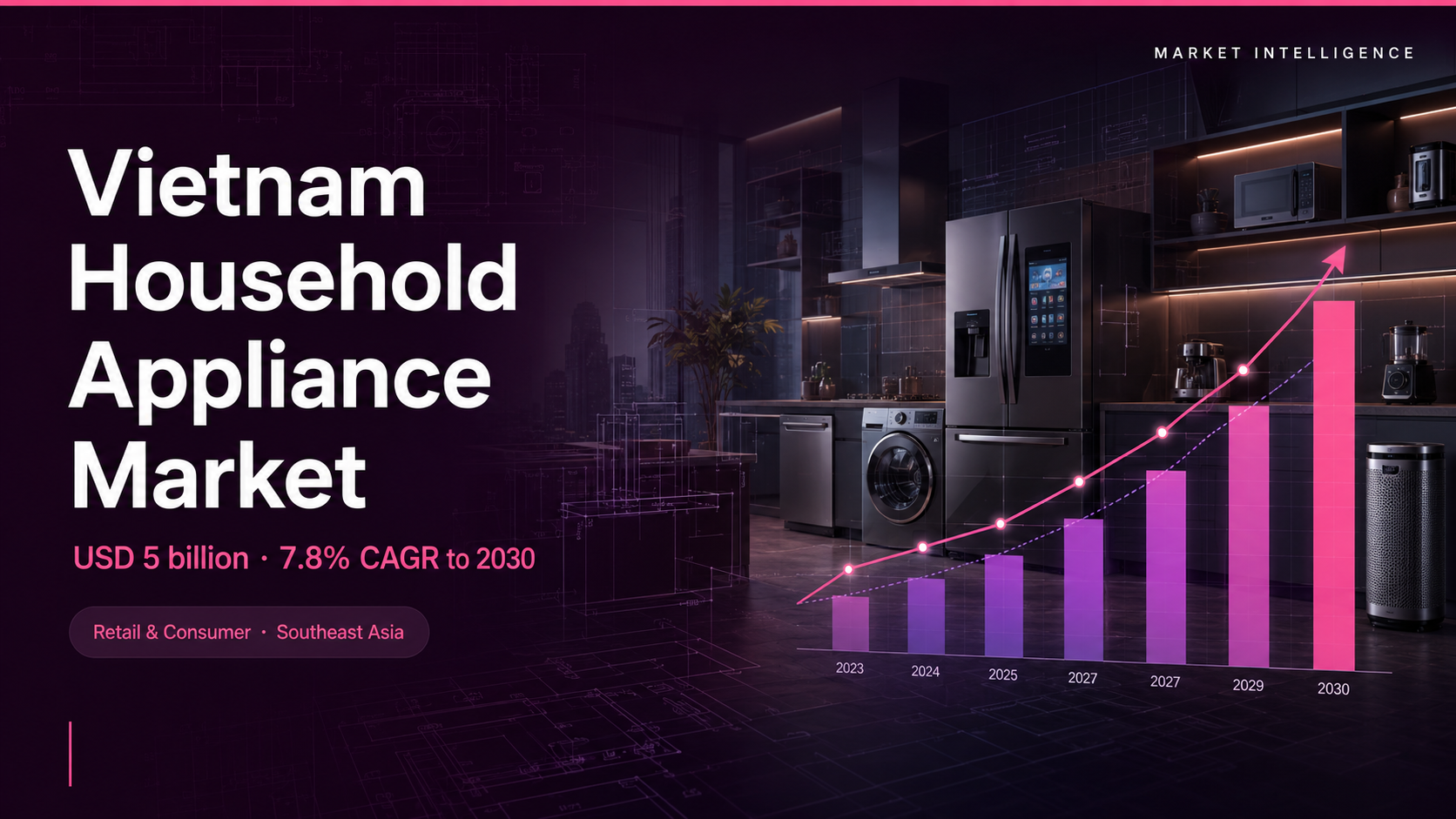
Vietnam's USD 5 Billion Household Appliance Market at 7.8% CAGR: Here Is What Ken Research's Data Shows
Vietnam's household appliance sector is undergoing a structural shift, not a cyclical bump, as urbanization, smart home adoption, and e-commerce channel growth combine to push the market well beyond traditional replacement cycles. With 92.5% household penetration for major appliances already achieved, the next growth frontier is not about reaching new households but about upgrading them with smarter, more connected devices. For the full segment-level breakdown, see the Vietnam Household Appliance Market Report. This analysis is published by Ken Research, a leading market intelligence firm covering consumer and industrial sectors across Southeast Asia.
This analysis is based on Ken Research market modelling, operator fleet disclosures, consumer-electronics indicators, and third-party consumer-electronics-sector estimates.
USD 5 Billion and a 7.8% CAGR: The Scale of Vietnam's Appliance Opportunity
The scale of Vietnam's appliance market surprises many investors who still treat it as an emerging-market footnote rather than a structurally large consumer arena. According to Ken Research, the market stands at USD 5 billion in 2026 and is expanding at a 7.8% CAGR through 2030, driven by a combination of rising incomes and accelerating urbanization in Tier 2 and Tier 3 cities. That growth rate outpaces several regional peers, positioning Vietnam as one of the most attractive appliance markets in ASEAN. The Vietnam LED Market context reinforces this trend, as energy-efficient product adoption in lighting and appliances is advancing in parallel across the same urban consumer base. For investors benchmarking entry points, household penetration at 92.5% signals that the addressable base is mature, shifting brand competition squarely toward premium and smart-tier upgrades rather than first-time purchase volume.
- Market Size: Valued at USD 5 billion in 2026 with a compound annual growth rate of 7.8% through 2030
- Household Penetration: 92.5% penetration for major appliance categories, indicating a replacement and upgrade-led demand cycle
- Smart Appliance Share: 35% of all appliances are now classified as smart or connected devices, with that share still expanding
- Key Brands: Samsung Vietnam, LG Electronics Vietnam, Electrolux Vietnam, Panasonic Vietnam, and Daikin Vietnam hold dominant positions across the top 5 brand rankings
Air Conditioning Leads at 35% Smart Share While Washing Machines Hit Fastest 7.8% Growth
Segment dynamics inside Vietnam's appliance market reveal a more nuanced story than top-line growth figures suggest. Air conditioning remains the single largest product segment, driven by Vietnam's tropical climate, rapid urbanization, and the proliferation of mid-rise residential projects in cities like Ho Chi Minh City and Hanoi. According to Ken Research's segment analysis, smart appliances now represent 35% of total appliance volume, with the ratio climbing fastest in the air conditioning and refrigerator sub-segments where energy-efficiency mandates are most stringent. The Vietnam Healthcare Information Technology Market growth trajectory highlights a broader digitization wave in Vietnam that is simultaneously upgrading consumer and enterprise technology adoption. Washing machines represent the fastest-growing appliance category by unit volume, aided by a generational shift away from hand-washing in semi-urban households and an increase in dual-income households across all five major urban centers, while refrigerators maintain high penetration rates that are now converting to smart-tier replacements. Brands competing in the Vietnam Hotel Market are also accelerating commercial appliance procurement, adding a B2B layer to what was once a purely residential market.
- Air Conditioning: Largest single segment, powered by climate demand and energy-efficiency policy mandates targeting 35% smart-device compliance
- Refrigerators: High penetration category now transitioning to smart-tier replacements, sustaining mid-single-digit annual volume growth
- Washing Machines: Fastest-growing category as urbanization converts semi-urban households, adding millions of units to annual demand
- Smart Appliances: Fastest-growing tier overall, capturing 35% of total appliance mix and rising across all product lines
Want segment-level data on air conditioning, washing machines, and smart appliance share across Vietnam's cities? Download Sample Report and get a free preview of Ken Research's full competitive and segment breakdown.
Why Are Chinese Brands and E-Commerce Channels Disrupting Vietnam's USD 5 Billion Appliance Market?
The competitive tension in Vietnam's appliance sector is sharpening in a way that established players did not fully anticipate just three years ago. E-commerce channel growth has restructured how Vietnamese consumers discover, compare, and purchase appliances, compressing the price discovery cycle and putting established retail brands in direct competition with lower-cost Chinese entrants who have used digital channels as their primary go-to-market route. Ken Research identifies competition from Chinese brands as one of the three structural challenges facing the market alongside post-COVID demand normalization and currency fluctuations affecting import costs. The Global IoT Market expansion is compounding this shift, because as smart-home connectivity infrastructure improves globally, Chinese IoT-enabled appliance manufacturers are reaching Vietnamese consumers through e-commerce platforms at price points that undercut Samsung and LG by 20% to 30% on equivalent feature sets. The Global Electronics Market supply chain dynamics are feeding this disruption directly, as overcapacity in Chinese manufacturing keeps landed costs for competing products low even as Vietnamese dong volatility adds margin pressure for Korean and European incumbents.
Vietnam Household Appliance Market Outlook to 2030: 7.8% CAGR and What Drives the Next Growth Phase
The forward-looking picture for Vietnam's household appliance market is shaped by four structural drivers that Ken Research identifies as durable rather than cyclical. Rising incomes and urbanization will add an estimated 5 million new middle-class households in Vietnam by 2030, each entering the market at a price tier above the current average basket. Smart home adoption is accelerating on the back of 35% smart appliance share already achieved, and energy-efficiency mandates are expected to make smart-tier products the de facto standard across all major categories before the end of the forecast period. The Vietnam AUM Market growth trajectory signals increasing investable wealth among Vietnamese consumers, which directly supports premium appliance upgrade cycles over the same 2026 to 2030 horizon. For brands and distributors planning inventory and channel strategy, Ken Research's forecast of 7.8% CAGR through 2030 on a USD 5 billion base implies cumulative market expansion of well over USD 2 billion in incremental revenue over the forecast window, a scale that justifies significant channel investment.
- Driver 1 (Urbanization): Rising incomes and urban migration projected to add 5 million new middle-class households by 2030
- Driver 2 (Smart Adoption): Smart home penetration accelerating from 35% current share toward full-category coverage by 2030
- Driver 3 (E-Commerce): Online channel growth compressing price discovery and accelerating product replacement cycles across all 5 major appliance categories
- Driver 4 (Energy Mandates): Government energy efficiency mandates pushing smart-tier adoption, targeting 7.8% CAGR sector-wide compliance investment
Planning market entry or channel expansion in Vietnam's fast-growing appliance sector? Vietnam Household Appliance Market Report delivers the competitive benchmarking, segment forecasts, and player strategy data your team needs.
Conclusion
Vietnam's household appliance market is not simply growing: it is structurally upgrading. The combination of a USD 5 billion market base, a 7.8% CAGR trajectory through 2030, and 35% smart appliance share already in place creates a competitive environment where brand positioning, channel architecture, and energy-efficiency credentials will determine which players capture the upgrade cycle and which ones concede share to Chinese e-commerce entrants. Ken Research's analysis makes clear that the window for establishing premium-tier positioning ahead of full smart-category commoditization is narrowing. Operators, investors, and channel partners who act on the data now will be better positioned than those who wait for the inflection to become obvious. Access the complete competitive breakdown, segment forecasts, and regional data in the Vietnam Household Appliance Market Report from Ken Research.
Frequently Asked Questions
Q1: What is the current size of the Vietnam household appliance market?
Vietnam's household appliance market is valued at USD 5 billion in 2026, according to Ken Research. The market is expanding at a 7.8% CAGR through 2030, driven by rising middle-class incomes, accelerating urbanization in Tier 2 and Tier 3 cities, and a structural shift toward smart and connected appliance products. With 92.5% household penetration for major appliances already achieved, demand is increasingly upgrade-led rather than first-purchase-led, which supports both higher average transaction values and stronger recurring replacement cycles across the forecast period.
Q2: Which product segments are growing fastest in Vietnam's appliance market?
Smart and connected appliances represent the fastest-growing tier overall, with 35% of all appliances now classified as smart or connected devices. Washing machines lead category growth by unit volume as urbanization converts semi-urban households across Vietnam's five major urban centers. Air conditioning remains the largest single segment by revenue, underpinned by climate demand and energy-efficiency mandates that are accelerating smart-tier adoption. Vietnam's broader consumer goods expansion, visible in the Vietnam Probiotics Market, reflects the same income-driven premiumization trend reshaping appliance purchasing behavior at a 7.8% CAGR pace.
Q3: Who are the leading players in Vietnam's household appliance market?
The top five players in Vietnam's household appliance market are Samsung Vietnam, LG Electronics Vietnam, Electrolux Vietnam, Panasonic Vietnam, and Daikin Vietnam, according to Ken Research. These brands compete across all major product categories including air conditioning, refrigerators, washing machines, and the rapidly expanding smart appliance tier. Competition is intensifying from Chinese entrants who leverage e-commerce channels and price points that undercut established brands by 20% to 30% on comparable feature sets. The parallel rise of consumer brand competition in adjacent markets, as seen in the Global FMCG Market, illustrates how e-commerce channel disruption is a cross-sector phenomenon that incumbent brands must address with service differentiation.
Q4: What are the main challenges facing Vietnam's household appliance market?
Ken Research identifies three primary challenges. First, post-COVID demand normalization has compressed the volume spike seen during pandemic-era home upgrading, bringing unit growth back to underlying structural rates closer to 7.8% CAGR rather than the double-digit acceleration seen in peak years. Second, competition from Chinese appliance brands using e-commerce as a primary channel is structurally eroding the price premiums that Samsung, LG, and Electrolux have historically maintained. Third, currency fluctuations affecting import costs add margin pressure for brands sourcing components or finished goods in USD or EUR, particularly as the Vietnamese dong has experienced mid-single-digit volatility against major trading currencies, squeezing landed-cost economics across the USD 5 billion import-heavy market.
Q5: How does Vietnam's appliance market compare to broader ASEAN consumer technology trends?
Vietnam's 7.8% CAGR growth rate positions the household appliance market among the faster-growing consumer technology sectors in ASEAN, outpacing several more mature markets in the region. The 35% smart appliance share is particularly notable given Vietnam's income tier, suggesting that smart home adoption is running ahead of income-curve expectations and is being driven by e-commerce price accessibility rather than luxury positioning. The global transition to connected consumer devices, tracked in the Global EV Market and broader electrification trends, is reinforcing energy-efficiency mandates in Vietnam that will keep smart appliance adoption on an upward structural path through the 2026 to 2030 forecast window.
For the full competitive benchmarking, segment-level forecasts, and regional breakdown, access the Vietnam Household Appliance Market Report from Ken Research, a leading market intelligence firm covering consumer electronics and industrial sectors across Southeast Asia.


Comments
Post a Comment