Brazil Real Estate and PropTech Market Crosses USD 60Bn : Ken Research Tracks Urbanization as the Growth Engine
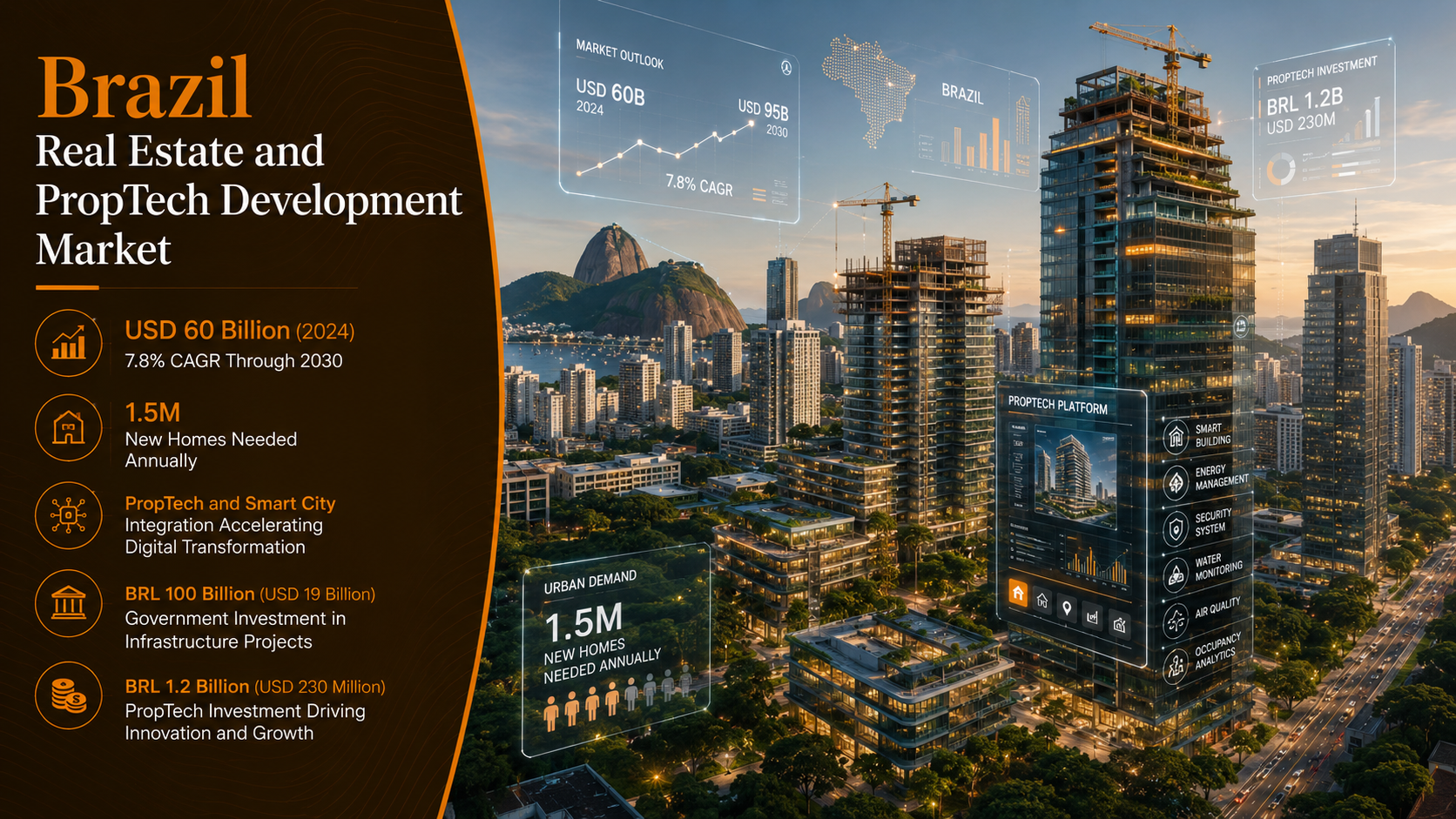
Brazil Real Estate and PropTech Market Reaches $60Bn: Urbanization, PropTech Drive Growth | Ken Research
Executive Summary
Brazil's real estate sector is undergoing a structural transformation, combining traditional property development with rapid digital disruption to create one of Latin America's most dynamic investment landscapes. Ken Research finds the Brazil Real Estate and PropTech Development Market valued at USD 60 billion in 2024, expanding at a 7.8% CAGR toward a projected USD 95 billion by 2030. The convergence of 87% urban population concentration, BRL 1.2 billion (USD 230 million) in PropTech investment, and the government's BRL 100 billion (USD 19 billion) infrastructure allocation has created a rare alignment of supply-side reform and demand-side acceleration. With 1.5 million new homes needed annually and a housing deficit that has persisted across administrations, Brazil's real estate market is no longer a slow-moving asset class but a high-velocity arena where digital platforms, smart city programs, and institutional capital are converging at scale.
Key Takeaways
- Market valued at USD 60 billion in 2024, growing at 7.8% CAGR to reach USD 95 billion by 2030
- PropTech investments reached BRL 1.2 billion (USD 230 million), signaling institutional confidence in digital real estate infrastructure
- Government committed BRL 100 billion (USD 19 billion) for infrastructure, catalyzing residential and commercial property pipelines
- Brazil requires 1.5 million new housing units annually, creating structural demand sustaining multi-decade market expansion
- Smart city investments totaling BRL 30 billion (USD 5.7 billion) are integrating PropTech into urban planning frameworks
- Urban population projected to reach 87% of total population, concentrating demand in Tier-1 and emerging Tier-2 cities
- Average construction permit approval time of 12 months in major cities represents a key bottleneck and reform opportunity
Market At A Glance
- Market Size (2024): USD 60 Billion
- CAGR (2024-2030): 7.8%
- Forecast Size (2030): USD 95 Billion
- Country: Brazil
- Sector: Real Estate and PropTech
- Key Segments: Residential Properties, Commercial Properties, Industrial Properties, PropTech Solutions, REITs
- Regulatory Framework: Minha Casa Minha Vida Program (Law No. 14,620/2023)
- Key Players: MRV Engenharia, Cyrela Brazil Realty, QuintoAndar, Loft, EmCasa, JHSF Participacoes
Urbanization as the Structural Engine of Demand
Brazil's urbanization trajectory is the primary structural engine reshaping its property market. With urban concentration projected to reach 87% of the total population by the decade's end, and an annual demand gap of 1.5 million new housing units against current supply, the country faces a supply shortfall that has sustained demand across both affordable and premium segments. This pressure is not isolated to Sao Paulo and Rio de Janeiro but extends into secondary cities including Fortaleza, Curitiba, and Belo Horizonte, where population inflows are outpacing residential construction by 12 to 18 months in permit processing timelines.
- Urban housing demand outpaces supply in 14 of Brazil's 27 states, creating sustained investment corridors in emerging metropolitan zones
- Mixed-use developments are capturing 22% of new project registrations, as developers respond to land scarcity by combining residential, commercial, and retail functions
- Secondary city residential markets in the Northeast and Central-West regions are recording growth rates 35-40% above national averages, driven by internal migration and government relocation incentives
- Real Estate Investment Trusts (Fundos de Investimento Imobiliario) have seen assets under management grow by USD 8 billion over a three-year period, reflecting institutional channeling of capital into the residential gap
- Construction cost inflation, which peaked at 18% in recent years, has moderated to 6-8%, improving developer margin visibility and project viability across affordable housing tiers
PropTech Disruption: Digital Platforms Redefining Property Transactions
Brazil's PropTech ecosystem has matured from a cluster of listing platforms into a full-stack digital infrastructure layer that is reengineering property search, financing, valuation, and post-sale management. With BRL 1.2 billion (USD 230 million) invested in PropTech ventures, Brazil now ranks among the top 5 emerging markets globally for real estate technology adoption, producing platforms replicated across Latin America. Developers operating with 12-month permitting delays are deploying AI-driven workflow tools to compress internal timelines and reduce capital carry costs during regulatory processing periods.
- Digital property marketplaces now handle USD 4 billion in annual transaction value, processing over 2 million property searches per month across mobile and web platforms
- AI-powered valuation tools are reducing property appraisal timelines from 15 days to under 48 hours, enabling faster mortgage approvals and higher transaction velocity across mid-market segments
- Blockchain-based title verification pilots, active in 3 major metropolitan registries, are compressing closing processes by 40% relative to traditional registry procedures
- Smart building technologies embedded in commercial projects are delivering 20-25% energy cost reductions, making ESG-compliant assets preferred by corporate tenants and institutional buyers
- PropTech lending platforms have originated USD 1.5 billion in home purchase loans, targeting the underserved segment of 40 million Brazilians with informal income profiles excluded from traditional bank mortgage products
Government Programs and Regulatory Catalysts
Brazil's legislative framework has evolved from passive observer to active market architect in the real estate cycle. Law No. 14,620/2023, anchoring the Minha Casa Minha Vida program revival, has allocated USD 1 billion specifically for affordable housing subsidies, targeting families earning below BRL 8,000 per month. Simultaneously, the government's infrastructure commitment of BRL 100 billion (USD 19 billion) and smart city programs backed by BRL 30 billion (USD 5.7 billion) are not supplementary expenditures but primary demand multipliers that elevate land values and create investable micro-markets around infrastructure corridors.
- Minha Casa Minha Vida Phase 4 targets 2 million new housing units over 4 years, with 60% allocated to families in the lowest income bracket, anchoring demand at the base of the market pyramid
- Infrastructure investment corridors in the North and Northeast regions are unlocking USD 12 billion in previously stranded commercial real estate development potential
- Tax incentive frameworks for green-certified buildings have increased LEED and AQUA-certified project registrations by 38% year over year, repositioning sustainability as a financial value driver
- Zoning law modernization across 8 major municipalities has increased permissible floor-area ratios by 15-25%, expanding buildable density in transit corridors and reducing per-unit land cost
- Foreign direct investment in Brazilian real estate reached USD 3.2 billion in recent reporting periods, with North American and European institutional funds acquiring logistics, industrial, and office assets
Competitive Landscape and Market Segmentation
Brazil's real estate competitive landscape spans traditional construction conglomerates, technology-native PropTech challengers, and hybrid developers deploying digital tools within legacy development frameworks. MRV Engenharia and Cyrela Brazil Realty dominate the high-volume affordable and mid-market segments, collectively accounting for an estimated 18-22% of new residential launches in major metropolitan areas. QuintoAndar has processed over USD 2 billion in rental and sales transactions, and Loft is combining AI valuation with direct purchase models to create liquidity in a historically illiquid secondary market where transactions previously required 90 days to close.
- Residential properties constitute approximately 55% of total market value, with commercial and industrial segments representing 28% and 12% respectively, while PropTech solutions and REITs account for a fast-growing 5%
- Industrial real estate in greater Sao Paulo has vacancy rates below 5%, driving rental yields of 8-10% that attract institutional capital away from fixed-income alternatives
- Office real estate in prime Sao Paulo districts is recovering toward 85% occupancy, as hybrid work stabilizes space requirements and corporate tenants renew leases with ESG fit-out clauses
- EmCasa and Date A Home are competing in the tech-enabled brokerage space, collectively reducing average transaction time from 90 days to under 45 days by integrating digital documentation and escrow management
- JHSF Participacoes anchors the premium segment, where average ticket sizes exceed BRL 3 million (USD 575,000) and international buyer participation is growing at 12% annually
For regional PropTech and real estate digital platform dynamics across emerging markets, Ken Research tracks the Egypt PropTech and Real Estate Digital Platforms Market, the Philippines Real Estate and PropTech Platforms Market, and the Vietnam Real Estate and Affordable Housing Market. The Latin America Logistics Real Estate Market provides a regional lens on industrial property demand, while the Saudi Arabia Real Estate PropTech Platforms Market offers comparative benchmarking on technology integration velocity in high-growth property markets. Additional context on smart infrastructure is available from the UAE Smart Cities and AI Infrastructure Market and Singapore Digital Twins in Infrastructure Market.
Conclusion
Brazil's Real Estate and PropTech Development Market is not in a cyclical upturn but a structural transformation, one where a USD 60 billion base in 2024 is expanding toward USD 95 billion by 2030 driven by self-reinforcing forces. Urbanization at 87% concentration creates irreversible housing demand of 1.5 million units annually, PropTech investment at BRL 1.2 billion creates transaction efficiency that expands the addressable market, and government infrastructure spend at BRL 100 billion creates the physical scaffolding within which private capital compounds. For developers, technology platforms, institutional investors, and policymakers, the window for establishing durable market positions in Brazil's property ecosystem is open and active throughout this decade.
Ken Research Finds
- Brazil PropTech platforms processed over USD 4 billion in annual transaction value, growing at 28% year over year as digital-first property search displaces traditional brokerage for under-45 buyer demographics
- Construction permitting timelines averaging 12 months in Sao Paulo and Rio de Janeiro create a structural lag between demand spikes and supply response, sustaining price appreciation cycles of 8-12% annually in constrained submarkets
- Minha Casa Minha Vida Phase 4 has pre-qualified over 800,000 families in its first 18 months of operation, signaling a demand pipeline of USD 8 billion in financed affordable housing transactions waiting for supply to materialize
- Industrial real estate vacancy below 5% in greater Sao Paulo logistics corridors is attracting USD 1.8 billion in new warehouse development commitments from domestic and international REITs
- Smart building adoption in Class A commercial properties has reached 42% penetration in prime Sao Paulo office districts, with ESG-compliant assets commanding rental premiums of 15-20% over non-certified equivalents
Frequently Asked Questions
Q1: What is the current size and growth rate of the Brazil Real Estate and PropTech Development Market?
The Brazil Real Estate and PropTech Development Market is valued at USD 60 billion in 2024, growing at a 7.8% CAGR to reach an estimated USD 95 billion by 2030. This growth is sustained by annual housing demand of 1.5 million new units, PropTech investments totaling BRL 1.2 billion (USD 230 million), and government infrastructure commitments of BRL 100 billion that collectively create demand visibility extending through the end of the decade.
Q2: How is the Brazilian government supporting real estate market development?
The Brazilian government's support is multi-layered. Law No. 14,620/2023 anchors Minha Casa Minha Vida with a USD 1 billion allocation targeting families earning below BRL 8,000 per month and targeting 2 million new units over 4 years. Infrastructure commitments total BRL 100 billion (USD 19 billion), smart city programs are backed by BRL 30 billion (USD 5.7 billion), and zoning modernization across 8 municipalities has expanded floor-area ratios by 15-25%, collectively creating demand multipliers that attract USD 3.2 billion annually in foreign direct investment.
Q3: Which segments of Brazil's real estate market are growing fastest?
PropTech solutions and industrial real estate are the fastest-growing segments. PropTech platforms are expanding at over 28% annually, having originated USD 1.5 billion in non-traditional home purchase loans targeting 40 million underbanked Brazilians. Industrial and logistics real estate, with vacancy below 5% and yields of 8-10%, is attracting USD 1.8 billion in new warehouse development commitments. Mixed-use developments now represent 22% of new project registrations, up from under 12% five years prior.
Q4: Who are the key competitors shaping the Brazil PropTech and real estate landscape?
The market spans traditional developers and technology-native challengers across distinct segments. MRV Engenharia and Cyrela Brazil Realty account for 18-22% of new residential launches in major metropolitan areas. QuintoAndar has processed over USD 2 billion in transactions, while Loft's AI valuation model reduces secondary market closing times by 50%. EmCasa and Date A Home reduce transaction timelines from 90 days to under 45 days, and JHSF Participacoes serves the premium segment where average tickets exceed BRL 3 million (USD 575,000) with international buyer participation growing at 12% annually.
Q5: What role does smart city investment play in Brazil's property market outlook?
Smart city investment is transforming from a supplementary government initiative into a primary real estate value driver. With BRL 30 billion (USD 5.7 billion) committed to technology-driven urban development, infrastructure corridors in the North and Northeast are unlocking USD 12 billion in previously stranded commercial real estate potential. Smart building adoption has reached 42% penetration in prime Sao Paulo office districts, ESG-certified assets command rental premiums of 15-20%, and tax incentive frameworks have increased green-certified project registrations by 38% year over year, creating measurable price bifurcation that is incentivizing developers to integrate sustainability from project inception.

Comments
Post a Comment