Indonesia Nutraceuticals Market Surges to USD 15.6B at 7.7% CAGR | Ken Research
The fastest growth in Indonesia's health sector is not coming from traditional pharmaceuticals, it is coming from functional foods reshaping how a nation of 280 million manages chronic disease. As per Ken Research market modelling, the Indonesia nutraceuticals market is estimated at USD 8.01 billion in 2026, projected to reach USD 15.60 billion by 2033 at a 7.7% CAGR. The full competitive landscape and segment analysis are available in the Indonesia Nutraceuticals Market Report.
This analysis draws on data from Ken Research market modelling, BPOM regulatory disclosures, Indonesia's Ministry of Health nutrition policy data, and independent functional food sector benchmarking.
Functional Beverages Command 47.9% Share as Consolidation Accelerates
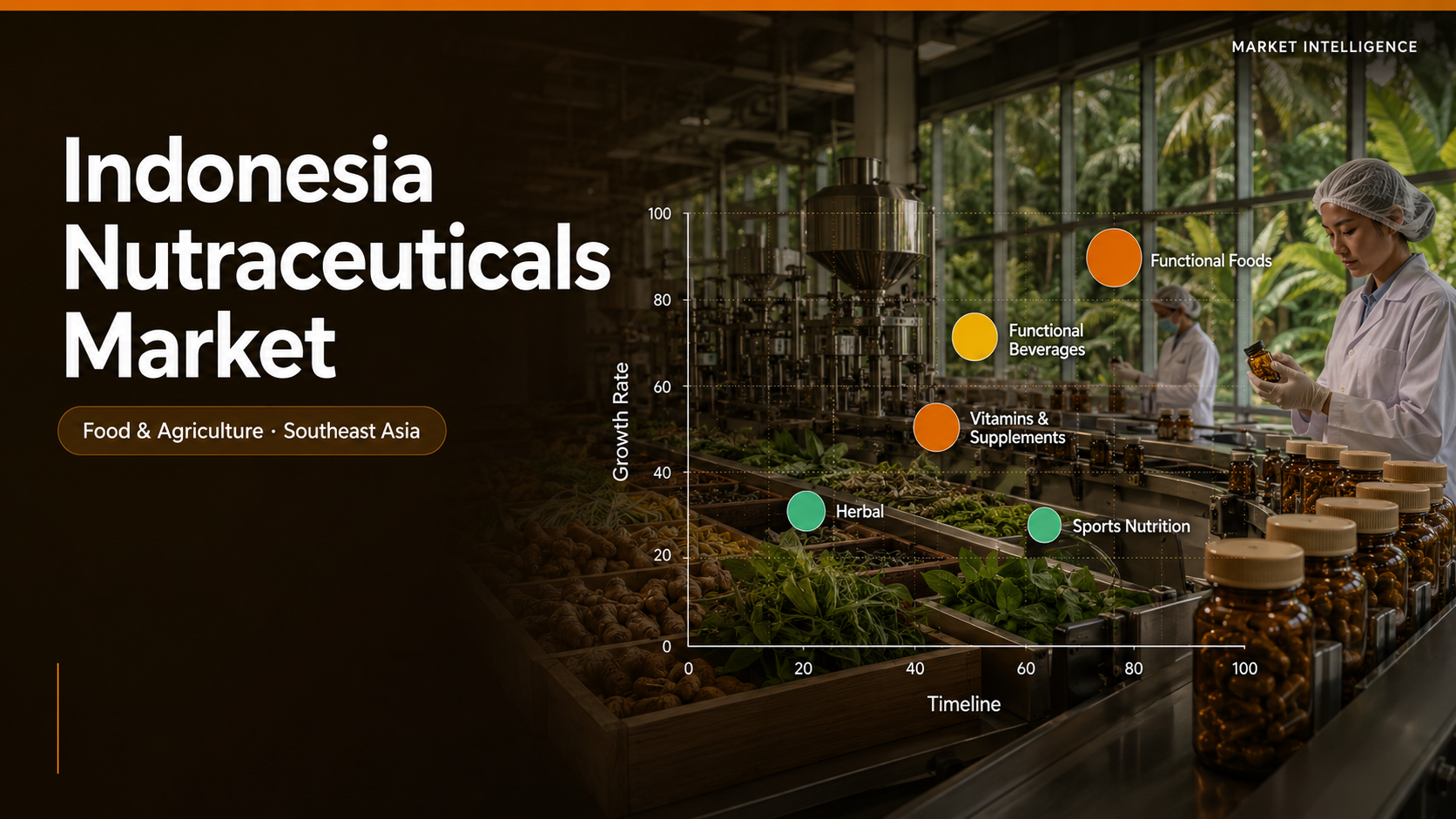
Indonesia's nutraceutical industry is moving from fragmented cottage-industry structures toward platform-scale consolidation. Per Ken Research analysis, functional beverages account for an estimated 47.9% of total market revenue in 2026, driven by sports drinks from Otsuka Holdings and Nestle Indonesia. Vitamins and dietary supplements represent 31.6% of ingredient-level revenue, with Kalbe Farma and Sido Muncul holding dominant retail shelf placement in pharmacy channels. BPOM's halal certification compliance acts as a competitive moat concentrating share among established manufacturers, with certification overhead estimated at 10 to 15% of operating expenses for mid-size players.
- Functional Foods: Led by Danone Group and Indofood Sukses Makmur, targeting infant nutrition and dairy fortification for Indonesia's 27 million children under five.
- Functional Beverages: Otsuka Holdings and Mayora Indah command this segment, with distribution covering over 500,000 retail outlets nationwide.
- Vitamins and Supplements: Herbal supplement demand is accelerating at double-digit rates in tier-2 and tier-3 cities, led by Sido Muncul and Tempo Scan Pacific.
BPOM Halal Mandate Cuts Production Costs by 15% for Certified Operators
BPOM's mandatory halal certification framework, reinforced by the Halal Product Assurance Law, has created a two-tier market where certified players command measurable retail premiums. The nutraceutical formulation pipeline is increasingly dominated by domestic ingredient sourcing, as the government's food sovereignty push incentivizes local extraction of herbal actives. Operators investing in contract manufacturing with BPOM-licensed facilities report 15 to 20% lower per-unit production costs versus import-dependent peers. Indonesia's aging population is a structural tailwind: the population above 60 years is projected to reach 47 million by 2030, creating durable demand for bone health, cardiac, and memory supplement categories. For investors benchmarking premium-ingredient margins across the region, the Thailand Nutraceuticals and Dietary Supplements Market offers a direct parallel where halal compliance dynamics have similarly reshaped category leadership.
- Halal Compliance: Covers 100% of food and supplement products sold in Indonesia, elevating barrier to entry for new operators.
- Herbal Supplement Growth: Over 300 BPOM-registered herbal supplement brands compete nationally, with jamu-based products gaining clinical positioning.
How are Indonesia's functional food brands competing for shelf placement against multinationals? Download Sample Report for competitive benchmarking across all segments.
Why Is Indonesia's Dietary Supplements Segment Growing at 10.3% CAGR Through 2033?
The dietary supplements sub-market is outpacing the broader category, reflecting a shift from treatment to prevention-led health spending. Dietary supplements reached USD 2.94 billion in 2025, growing at a 10.3% CAGR compared to the overall market's 7.7% trajectory, per independent sector benchmarking. E-commerce health platforms including Tokopedia Health and Shopee Mall now account for an estimated 18% of supplement sales in 2026, a share that nearly doubled since 2022. This digital channel shift is compressing margins for pharmacy-reliant brands while rewarding those with direct-to-consumer acquisition models built on content-driven supplement discovery.
Indonesia Nutraceuticals Outlook to 2033: USD 15.6B and the Consolidation Tipping Point
By 2026, Indonesia's nutraceutical market is entering a consolidation phase separating platform-scale operators from single-category specialists. The USD 8.01 billion base in 2026 will grow to USD 15.60 billion by 2033, but functional food manufacturers with established BPOM certification pipelines are positioned to capture disproportionate share. Players without local contract manufacturing face an escalating cost disadvantage as domestic ingredient sourcing becomes a procurement requirement. Strategists building a full picture of Indonesia's health and wellness landscape should review the Indonesia Bone and Joint Health Supplements Market, where aging-population demand is creating high-margin sub-categories multinationals are racing to dominate.
- E-commerce acceleration: Digital health platforms projected to reach 25% of supplement sales by 2028, reshaping distributor margins and brand discovery.
- Aging population tailwind: The 60-plus cohort at 47 million by 2030 creates a durable demand floor for bone, cardiac, and cognitive health products.
- Consolidation pressure: BPOM compliance costs favor manufacturers with annual revenues above USD 50 million, accelerating share concentration among top-tier players.
What Brand Owners, Investors, and Distributors Must Do in This 7.7% CAGR Window
Indonesia's nutraceutical market is at a 7.7% CAGR inflection where BPOM regulatory tightening, e-commerce channel shift, and halal certification mandates converge within a two-to-three year window that will lock in competitive positioning for the rest of this decade.
- Brand Owners: Secure BPOM halal certification now, as late-stage delays cost an estimated 6 to 12 months of market access in a market growing at USD 800 million per year.
- Investors: Target contract manufacturers with dual BPOM and halal accreditation, as these facilities command 20 to 30% revenue premiums from multinational brand owners seeking local production partners.
- Distributors: Build e-commerce fulfillment capabilities alongside traditional pharmacy networks, as digital channels gain 2 to 3 percentage points of share annually and will reach USD 2 billion by 2028.
Ready to map Indonesia's nutraceutical landscape before consolidation locks in? Indonesia Nutraceuticals Market Report delivers segment forecasts, player strategies, and channel analysis through 2033.
Conclusion
Indonesia's nutraceutical market is being reordered by regulation, demographics, and digital commerce simultaneously. The operators who will own the USD 15.6 billion market in 2033 are building halal compliance infrastructure and e-commerce fulfillment capability now. The strategic question is no longer whether to enter Indonesia but how quickly to build the capabilities platform-scale competition demands. Access the Indonesia Nutraceuticals Market Report for the full competitive and forecast analysis.
Frequently Asked Questions
Q1: What is the size of the Indonesia Nutraceuticals Market?
The Indonesia nutraceuticals market is estimated at USD 8.01 billion in 2026, projected to reach USD 15.60 billion by 2033 at a 7.7% CAGR. The dietary supplements sub-segment is growing at 10.3% CAGR, reflecting disproportionate growth in preventive health categories driven by urban chronic disease management.
Q2: Who are the key players in the Indonesia Nutraceuticals Market?
The market is led by Kalbe Farma, Sido Muncul, Danone Indonesia, Nestle Indonesia, and Otsuka Holdings. Domestic brands hold over 55% of retail pharmacy shelf share while multinationals dominate modern trade. The Indonesia Bone and Joint Health Supplements Market details sub-category player rankings across high-growth segments.
Q3: Which segment leads the Indonesia Nutraceuticals Market?
Functional beverages lead with an estimated 47.9% revenue share in 2026. Dietary supplements are growing at 10.3% CAGR, outpacing the 7.7% overall market rate, driven by e-commerce channel growth and rising preventive health spending among Indonesia's urban middle class of approximately 52 million households.
Q4: What is driving growth in the Indonesia Nutraceuticals Market?
Key drivers include the aging population projected at 47 million above 60 years by 2030, rising lifestyle-disease incidence, and e-commerce platforms capturing 18% of supplement sales in 2026. BPOM's halal certification mandate simultaneously consolidates the field by raising compliance barriers for smaller operators.
Q5: How does BPOM regulation affect the Indonesia Nutraceuticals Market?
BPOM's halal mandate covers 100% of food and supplement products, with compliance consuming 10 to 15% of operating expenses for mid-size manufacturers. Over 300 registered herbal supplement brands compete under this framework, favoring operators with annual revenues above USD 50 million who can absorb certification overhead.
For the full competitive benchmarking, segment-level forecasts, and regional breakdown, access the Indonesia Nutraceuticals Market Report from Ken Research, covering food, agriculture, and health sectors across Southeast Asia.


Comments
Post a Comment