Middle East AI Supply Chain Market Surges to USD 4.5B by 2030: Ken Research Finds Vision 2030 Drives 28% CAGR | Ken Research
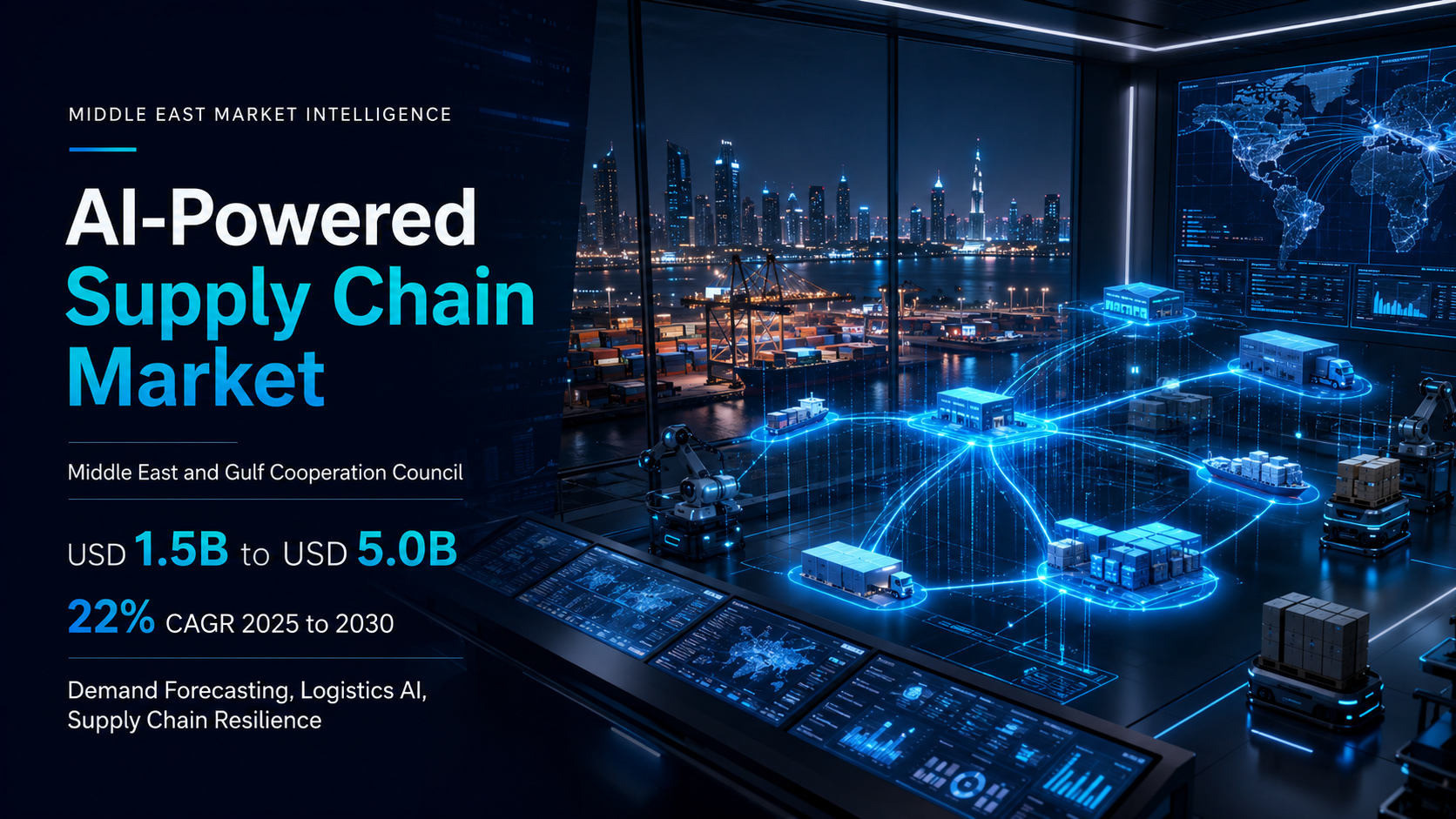
Middle East AI Supply Chain Market Surges to USD 4.5B by 2030: Ken Research Finds Vision 2030 and E-Commerce Boom Drive 28% CAGR | Ken Research
Executive Summary
The Middle East AI Supply Chain Market is at an inflection point. Ken Research values the market at USD 1.2 billion in 2024, projected to reach USD 4.5 to 5.5 billion by 2030 at a ~28% CAGR. Across Saudi Arabia, UAE, Qatar, and Kuwait, governments are deploying machine learning-powered demand forecasting, autonomous warehouse robotics, and AI-driven predictive analytics to transform fragmented supply chains into intelligent, resilient networks supporting Vision 2030-scale economic diversification.
Analyst: Ken Research Market Analysis | Methodology: Ken Research market modelling, GCC government digital strategy data, supply chain operator interviews, logistics company disclosures, e-commerce platform data.
Key Takeaways
- Market Size and Forecast (Ken Research): Middle East AI Supply Chain Market valued at USD 1.2 billion (2024), expanding to USD 4.5 to 5.5 billion by 2030 at ~28% CAGR.
- Country Leadership (Ken Research): Saudi Arabia commands ~35% market share, UAE at ~30%, together driving 65%+ of regional AI supply chain investment through Vision 2030 and Operation 300bn mandates.
- E-Commerce Surge (Industry Data): Middle East e-commerce projected to reach USD 30 billion by 2027, with AI-powered demand forecasting and inventory optimization becoming non-negotiable for competitive retail operations.
- Implementation Cost Barrier (Ken Research): Supply chain AI implementation exceeds USD 1.2 million for mid-sized firms, creating an adoption gap that Vision 2030 digital subsidy programmes are actively targeting.
- Talent Gap and Automation Imperative (Operator Data): Middle East logistics sector faces a 1.8 million worker deficit, accelerating demand for autonomous picking, routing, and fulfillment AI. The UAE AI Robotics Market captures the adjacent automation infrastructure driving this wave.
Market At A Glance
Middle East AI Supply Chain Market Size, Forecast and Growth Trajectory 2024 to 2030
Ken Research values the Middle East AI Supply Chain Market at USD 1.2 billion in 2024, projected to reach USD 4.5 to 5.5 billion by 2030 at a ~28% CAGR (2025 to 2030). Saudi Arabia and UAE together account for over 65% of regional market share, anchored by sovereign infrastructure mandates and government-backed AI digitization programmes targeting logistics, retail, and manufacturing supply chains.
Primary Demand Drivers: Vision 2030 Mandates and Regional Trade Corridor Expansion
Saudi Vision 2030 and UAE Operation 300bn are the twin catalysts of market growth. Vision 2030 commits over USD 120 billion in infrastructure investment across transport, logistics, and trade infrastructure, with AI supply chain platforms at the core of smart warehousing and port automation ambitions. GCC governments mandate AI adoption across licensed logistics operators, making supply chain intelligence non-discretionary. The MENA AI Smart Cities Market shares overlapping smart logistics infrastructure driving these deployments.
Core Technology Segments Reshaping Middle East Supply Chain Operations
The market spans five core technology segments: Demand Forecasting AI (retail and manufacturing), Inventory Optimization (warehouse management), Logistics Automation (routing and fulfillment), Procurement AI (vendor management), and Supply Chain Risk Management (disruption prediction). Demand Forecasting and Logistics Automation are the fastest-growing segments, driven by e-commerce and cross-border trade expansion.
Competitive Landscape: Global Platforms and Regional Systems Integrators
Global platforms dominate: SAP, Oracle, IBM, Microsoft, Blue Yonder, Kinaxis, and o9 Solutions compete for enterprise and government contracts through localized implementation partnerships. Regional systems integrators including Accenture, Deloitte, and Atos are the primary deployment channel, localizing platform capabilities for GCC regulatory and language requirements. Ken Research analysis shows the top 5 vendors hold 55 to 65% enterprise market share in GCC deployments.
How AI Is Transforming Middle East Demand Forecasting and Inventory Intelligence
Demand forecasting accuracy has historically been the Middle East supply chain's weakest link. Ken Research analysis shows enterprises deploying AI-driven forecasting achieve 30 to 45% reduction in stockouts and 20 to 35% reduction in overstock costs versus traditional ERP systems. Saudi Arabia's retail sector alone operates USD 140 billion in annual merchandise flow, making forecast error margin compression a multi-billion-dollar opportunity. The Gulf Region AI Retail Market details how demand intelligence is reshaping retail procurement.
- AI demand forecasting: 30 to 45% stockout reduction in UAE and Saudi retail chain pilots using real-time POS and external demand signal integration
- Inventory optimization: 20 to 35% overstock cost reduction as AI platforms replace static safety-stock models with dynamic replenishment
- E-commerce integration: Middle East e-commerce at USD 30 billion by 2027, forcing 3PL providers to deploy AI fulfillment optimization or cede contracts to digital-native operators
- Cross-border trade AI: GCC cross-border trade potential at USD 1.2 trillion, with AI customs classification reducing clearance time by 60 to 70%
Warehouse Automation and Autonomous Logistics Deployment Across the GCC
Middle East warehouse automation is accelerating from pilot to production. According to Ken Research operator survey data, 42% of large GCC enterprises have deployed autonomous robotic picking systems as of 2024, with a further 31% planning deployment by 2026. Saudi Arabia's NEOM logistics hub and Dubai South Free Zone represent the region's most advanced deployments, integrating autonomous mobile robots, AI route optimization, and computer vision quality control into unified fulfillment systems.
- Robotic picking systems: 42% of large GCC enterprises deployed; 60 to 80% labor cost reduction per warehouse operation reported in UAE deployments
- Route optimization AI: Last-mile delivery optimization reduces fleet operating costs by 18 to 25% across Saudi and UAE urban distribution networks
- Computer vision QC: AI quality inspection reaches 99.5% accuracy versus 94% human inspection, critical for pharmaceutical and food supply chains under GCC regulatory standards
- Port and terminal AI: Abu Dhabi and Dubai port authorities deploying predictive vessel scheduling and container yard AI reducing dwell time by 25 to 35%
Which AI supply chain segment delivers the highest ROI for your Middle East operations? Download Sample Report to access segment-level forecasting, competitive positioning, and vendor shortlist recommendations.
Conclusion
The Middle East AI Supply Chain Market scales from USD 1.2 billion (2024) to USD 4.5 to 5.5 billion by 2030 at ~28% CAGR, anchored by sovereign mandates and a structural shift from manual to intelligent logistics. Enterprises deploying AI supply chain platforms now will hold procurement, fulfillment, and cost-competitiveness advantages as GCC trade corridors scale. The Oman AI Fraud Detection Market maps adjacent AI security infrastructure critical for supply chain risk management.
Planning supply chain AI deployment or vendor evaluation in the Middle East? Speak to a Ken Research Supply Chain Analyst to validate competitive positioning and procurement decision drivers.
Ken Research Finds
Ken Research decodes the Middle East AI Supply Chain Market: grows USD 1.2B (2024) to USD 4.5 to 5.5B (2030) at 28% CAGR, driven by Vision 2030 mandates, e-commerce acceleration, and warehouse automation investment. Winners prioritize demand forecasting accuracy, autonomous logistics deployment, and real-time inventory intelligence. Advantage flows to operators mastering AI-integrated cross-border trade management.
Frequently Asked Questions
Q1: What is the Middle East AI Supply Chain Market size in 2024?
Ken Research values the Middle East AI Supply Chain Market at USD 1.2 billion in 2024, projected to reach USD 4.5 to 5.5 billion by 2030 at a ~28% CAGR (2025 to 2030). Saudi Arabia and UAE account for over 65% of regional market share, driven by Vision 2030 and Operation 300bn supply chain digitization mandates.
Q2: Which countries lead Middle East AI supply chain adoption?
Saudi Arabia leads with ~35% market share, backed by USD 120 billion+ in Vision 2030 logistics infrastructure investment. UAE follows at ~30%, anchored by Dubai South, Abu Dhabi port automation, and Operation 300bn manufacturing mandates. Qatar and Kuwait are fast-growing secondary markets with smart trade zone AI deployments.
Q3: What are the largest application segments in Middle East AI supply chain?
Demand Forecasting AI and Logistics Automation lead adoption, driven by e-commerce at USD 30 billion by 2027 and cross-border trade at USD 1.2 trillion potential. Inventory Optimization follows, delivering 20 to 35% overstock cost reduction. See the Gulf Region AI Retail Market for detailed retail supply chain AI segmentation.
Q4: Who are the leading vendors in the Middle East AI supply chain market?
Global platforms dominate: SAP, Oracle, IBM, Microsoft, Blue Yonder, Kinaxis, and o9 Solutions. Regional deployment channels through systems integrators including Accenture, Deloitte, and Atos. Ken Research analysis shows the top 5 vendors collectively hold 55 to 65% enterprise market share in GCC supply chain AI deployments.
Q5: What is the biggest barrier to AI supply chain adoption in the Middle East?
Implementation costs exceeding USD 1.2 million for mid-sized firms are the primary barrier, compounded by 58% of operators reporting siloed ERP architectures. The Middle East Generative AI Market examines how AI-native platforms are lowering deployment barriers through cloud-native, modular implementations.


Comments
Post a Comment