Saudi Arabia Home Health Care Market Reaches USD 1.6B in 2024: Vision 2030 and NCD Burden Drive Digital Care Growth | Ken Research
Saudi Arabia Home Health Care Market Reaches USD 1.6B in 2024: Vision 2030 and NCD Burden Drive Digital Care Growth
Executive Summary
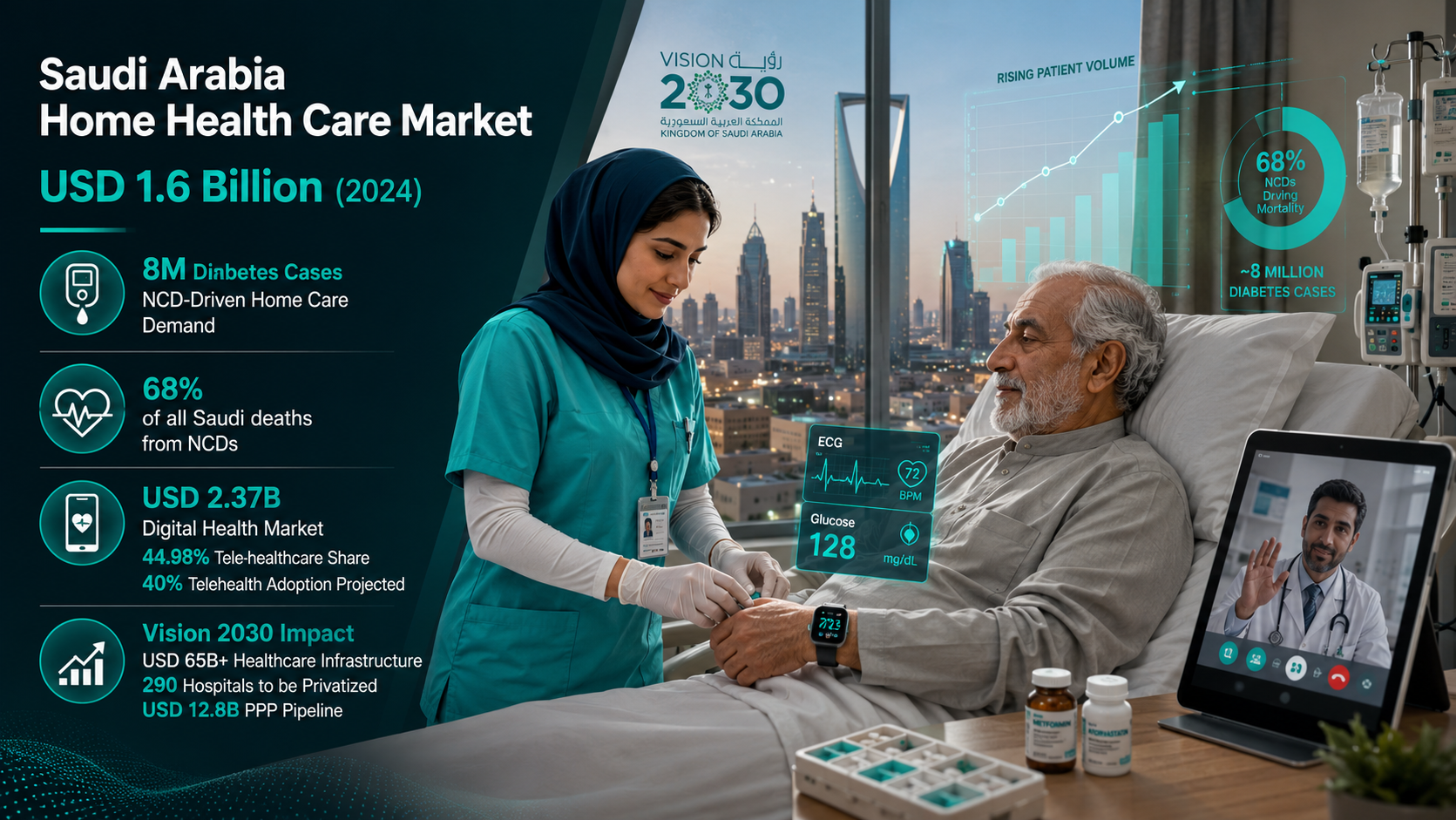
Saudi Arabia's home health care sector sits at the intersection of chronic disease acceleration and Vision 2030's privatisation agenda. Ken Research values the Saudi Arabia Home Health Care Market at USD 1.6 billion in 2024, with growth through 2030 anchored by a government healthcare budget of SAR 214 billion representing 17% of total government expenditure. NCDs account for 68% of all deaths, with ~8 million diabetes cases and adult obesity exceeding 40% creating a chronic care caseload hospitals alone cannot absorb. Vision 2030's privatisation of 290 hospitals and 2,300 primary health centres and a USD 65 billion healthcare infrastructure pipeline are accelerating home-based care adoption.
Analyst: Ken Research Market Analysis | Methodology: Ken Research market modelling, Saudi Ministry of Health budget data, CCHI regulatory review, digital health platform analysis, and Vision 2030 project deployment tracking.
Key Takeaways
- Market Size (Ken Research): Saudi Arabia Home Health Care Market at USD 1.6 billion in 2024, within a total Saudi healthcare market forecast at USD 102 billion by 2035; Saudi Arabia accounts for 60% of GCC healthcare spending.
- NCD Burden (Saudi Ministry of Health): NCDs account for 68% of all deaths in Saudi Arabia; ~8 million diabetes cases (23.1% of adults); adult obesity exceeds 40% - the primary structural demand driver for chronic home care.
- Digital Health Acceleration (Ken Research): Saudi digital health market at USD 2.37 billion (2024), growing to USD 11.07 billion by 2033 at 18.79% CAGR; tele-healthcare holds 44.98% share with 40% telehealth adoption projected.
- Vision 2030 Pipeline (Saudi Government): USD 65 billion+ healthcare infrastructure; 290 hospitals and 2,300 PHCs privatised; USD 12.8 billion in 100+ PPPs; private sector health share target raised from 20-25% to 35%.
- Workforce Gap (Ken Research): Shortfall of 25,000 nurses and caregivers; only 30% of families aware of formal home health care services - representing both challenge and market opportunity.
Market At A Glance
Market Size and Growth Trajectory
Ken Research values Saudi Arabia's home health care market at USD 1.6 billion in 2024, forecast through 2030. Saudi Arabia commands 60% of total GCC healthcare spending, with the total market projected at USD 102 billion by 2035. Government healthcare allocation reached SAR 214 billion (17% of budget) in 2024, rising to SAR 260 billion in 2025, creating unprecedented downstream demand for home-based care services aligned with healthcare construction in Saudi Arabia's building information modeling market.
NCD Burden as the Structural Demand Engine
NCDs are the defining structural driver of Saudi home health care demand. 68% of all Saudi deaths are attributable to non-communicable diseases, with ~8 million diabetes cases (23.1% of adults) and adult obesity exceeding 40%. The elderly population aged 60+ exceeds 7% of total population, projected to reach 5.5 million, creating a chronic disease cohort requiring sustained home nursing, infusion therapy, and physiotherapy. This demand reflects patterns across the Saudi family health spending economy where preventive and chronic care expenditure is rising across all household categories.
Digital Health and Telehealth Acceleration
Saudi Arabia's digital health market at USD 2.37 billion (2024) grows to USD 11.07 billion by 2033 at 18.79% CAGR, with tele-healthcare at 44.98% market share. With 95% internet penetration and 40% telehealth adoption projected, the Kingdom is among the world's most digitally prepared markets for remote chronic disease management. The SEHA Virtual Hospital - the largest virtual hospital in the Middle East - and SANAD and NEDA wearable monitoring bands enable real-time home patient management, comparable to IoT-driven field service transformation in the Japan fleet management market.
Competitive Landscape
Saudi Home Healthcare, Dr Sulaiman Al Habib Medical Group (SAR 2.6 billion revenue; USD 347 million facility), King Faisal Specialist Hospital, Aster DM Healthcare, Philips Healthcare, and ResMed compete across nursing, infusion, respiratory, and post-acute care. International players enter via Vision 2030 PPPs, with 100+ PPPs worth USD 12.8 billion and 21 health clusters unlocking private capital at scale. Regulatory compliance is evolving aligned with RegTech adoption across GCC healthcare operators where compliance automation is a market entry prerequisite.
Vision 2030 Privatisation and Infrastructure Pipeline
Vision 2030's healthcare privatisation programme is the primary policy accelerant for Saudi home health care. The private sector health share targets 35%, up from 20-25%, with 290 hospitals and 2,300 primary health centres being privatised. The USD 65 billion infrastructure pipeline and USD 1.5 billion health IT investment fund facility upgrades and outpatient networks that feed home-based care referral volumes. Healthcare real estate scaling mirrors Saudi Arabia's commercial real estate market where Vision 2030 is reshaping procurement across downstream sectors.
- CCHI Benefit Expansion: The Council of Cooperative Health Insurance expanded benefits for chronic disease management, enabling insurance-funded home care billing across Saudi residents - converting out-of-pocket spend into insured volume aligned with Africa's digital health insurance market models.
- Home Health Care Regulation 2020: The Home Health Care Services Regulation 2020 established formal licensing and quality standards for providers, converting an informal market into a regulated, investable sector.
- Consumer Financing: Credit accessibility through the Saudi Arabia micro-lending market enables first-time home care purchases for middle-income families managing elderly relatives.
Workforce, Awareness, and Market Access Challenges
Despite structural demand, Saudi Arabia's home health care market faces supply-side constraints. A workforce shortfall of 25,000 nurses and caregivers limits service capacity across care categories. Only 30% of Saudi families are currently aware of formal home health care offerings - an awareness gap representing the industry's largest expansion lever. Medical logistics for home care equipment - critical across the GCC medical supply chain - is scaling to meet urban home care delivery requirements, supported by transport connectivity in the Middle East hybrid train market.
- Training Investment: Vision 2030 workforce initiatives target Saudi national nurse and caregiver certification, aligned with the Kingdom's residential sector growth where in-home service demand is rising.
- Wearable Health Tech: SANAD and NEDA wearable bands monitoring vitals at home reduce hospital re-admission rates, creating measurable ROI for insurers and enabling home care reimbursement through outcome data.
- GCC Health Spending Context: Saudi Arabia's 60% share of GCC healthcare spend mirrors the GCC luxury consumer economy where wellness awareness is reshaping household spending priorities.
Which home health care segment - nursing, infusion therapy, or telemedicine - offers the highest yield in Saudi Arabia's Vision 2030 privatisation pipeline? Download Sample Report for operator benchmarking and care segment strategy.
Conclusion
Saudi Arabia's home health care market at USD 1.6 billion (2024) grows through 2030 on 68% NCD mortality burden, USD 65 billion+ Vision 2030 healthcare infrastructure, and digital health at 18.79% CAGR. Advantage flows to operators combining CCHI-aligned insurance billing, wearable tech, and telehealth depth across USD 12.8 billion in active PPPs and 290 privatised hospitals.
Planning home health care market entry or service expansion in Saudi Arabia? Speak to Our Saudi Healthcare Analyst to map your segment and channel strategy.
Ken Research Finds
Ken Research decodes Saudi Arabia's home health care market: valued at USD 1.6B (2024), driven by 68% NCD burden, 8M diabetes cases, and USD 2.37B digital health at 18.79% CAGR. Winners prioritize CCHI-funded chronic care, wearable monitoring, and telehealth depth. Advantage flows to operators with Vision 2030 PPP access, insurance reimbursement capability, and scalable home nursing networks.
Frequently Asked Questions
Q1: What is the Saudi Arabia Home Health Care Market size?
Ken Research values the Saudi Arabia Home Health Care Market at USD 1.6 billion in 2024, with growth through 2030 driven by NCD burden (68% of deaths; ~8 million diabetes cases), Vision 2030 privatisation (290 hospitals, 2,300 PHCs), and digital health at 18.79% CAGR.
Q2: Which companies lead Saudi Arabia's home health care market?
Ken Research identifies Saudi Home Healthcare, Dr Sulaiman Al Habib Medical Group (SAR 2.6B revenue), King Faisal Specialist Hospital, Aster DM Healthcare, Philips Healthcare, and ResMed as key participants across nursing, infusion, respiratory, and telehealth segments.
Q3: What drives Saudi Arabia home health care market growth?
Ken Research identifies NCD burden (68% of deaths; ~8M diabetes cases; 40%+ obesity), Vision 2030 USD 65B+ investment and 290 hospital privatisations, digital health at 18.79% CAGR, CCHI expanded chronic disease benefits, and a growing 5.5M elderly population as primary growth drivers through 2030.
Q4: What is the regulatory framework for Saudi Arabia home health care?
The Home Health Care Services Regulation 2020 established formal licensing and quality standards for home care providers. The CCHI expanded mandatory health insurance to include chronic disease home management, enabling insurance-funded home care billing across the Kingdom's resident population.
Q5: What is Saudi Arabia's digital health market size?
According to Ken Research, Saudi Arabia's digital health market stands at USD 2.37 billion (2024), growing to USD 11.07 billion by 2033 at 18.79% CAGR. Tele-healthcare commands 44.98% market share, with 95% internet penetration and 40% projected telehealth adoption making Saudi Arabia among the world's most digitally advanced home care markets.


Comments
Post a Comment