UAE AI Retail Market Hits USD 340M in 2024, Targeting AED 2.5B by 2030 | Ken Research
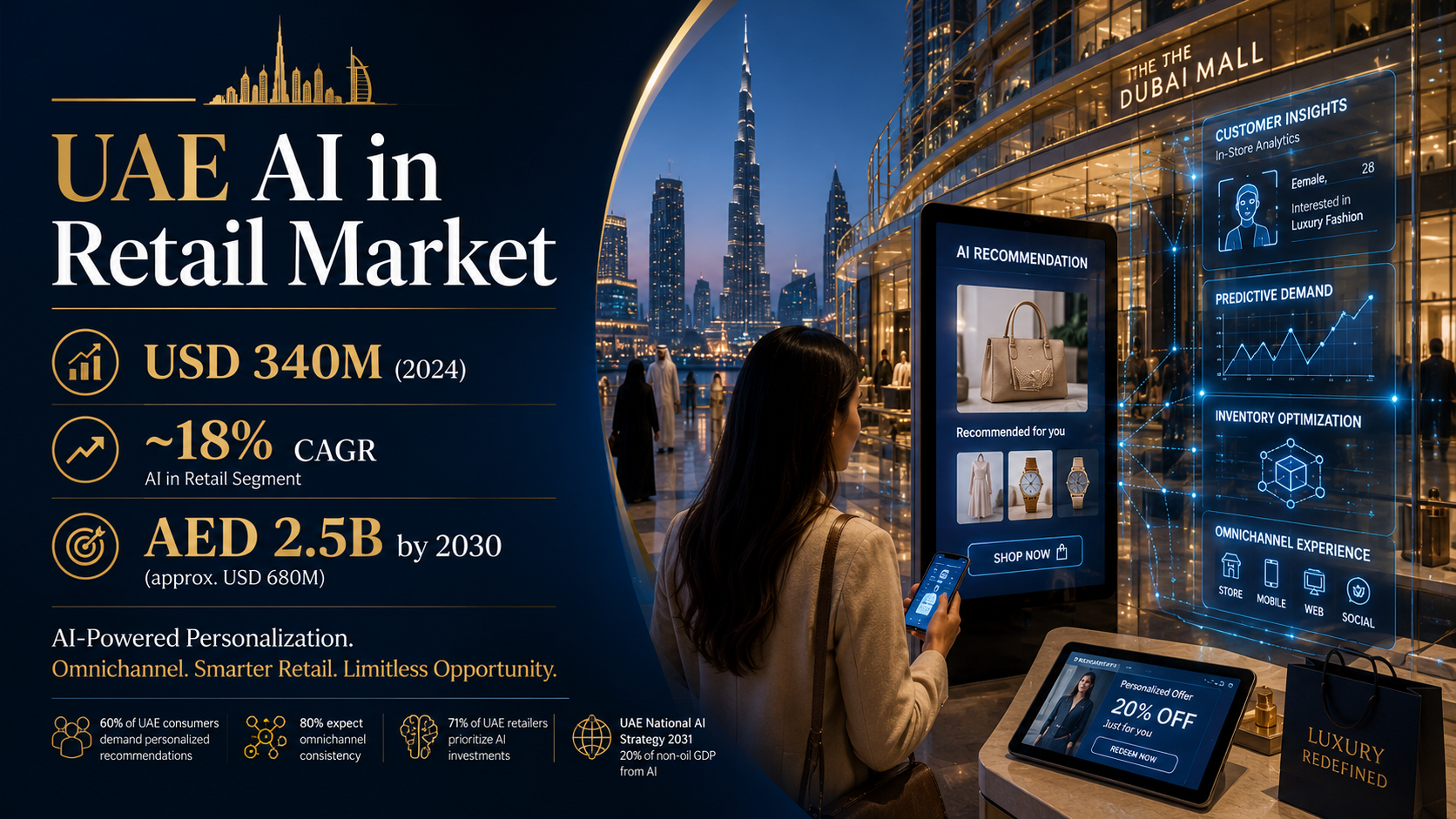
UAE AI Retail Market Hits USD 340M in 2024, Targeting AED 2.5B by 2030 | Ken Research
The UAE retail sector is undergoing a structural shift driven not by store expansion but by intelligence layers embedded across every customer touchpoint, from mobile discovery to in-store audience targeting. The UAE AI in Retail and Personalization Market reached USD 340 million in 2024, with retailers like Majid Al Futtaim and Noon already operating at production scale across AI pricing, personalization, and in-store audience analytics. This analysis is published by Ken Research, a leading market intelligence firm covering technology and retail sectors across the Middle East and GCC.
This analysis is based on Ken Research market modelling, operator deployment disclosures, government AI strategy data, and third-party retail-sector estimates.
Executive Summary: A USD 340M Market Accelerating Toward AED 2.5B by 2030
The UAE AI retail segment is past its pilot phase and into operational scaling. The market stood at USD 340 million in 2024 and is projected to reach AED 2.5 billion (approximately USD 680 million) by 2030, supported by a broader UAE AI economy expanding at 44% CAGR from a base of DH 12.74 billion in 2023. Consumer pull is unambiguous: 60% of UAE consumers demand tailored product recommendations, and 80% expect consistent omnichannel experiences. Retailers unable to deliver personalization at scale are already losing ground to platforms like Noon.com and Amazon.ae, which report 20-30% sales increases from AI-driven recommendation engines. The market is bifurcating rapidly between large operators running multi-model AI stacks and SME retailers facing cost barriers of AED 147,000 to AED 1.47 million per implementation.
Key Takeaways
- Market Size 2024: The UAE AI in Retail and Personalization Market valued at USD 340 million in 2024
- Forecast 2030: Market projected to reach AED 2.5 billion (approx. USD 680 million), with UAE e-commerce hitting AED 30 billion and mobile commerce reaching AED 15 billion
- Consumer Demand: 80% of UAE consumers expect omnichannel consistency; 70% prefer online shopping; internet penetration at 90% of population
- Operator ROI Proven: Majid Al Futtaim saved USD 1 million annually from a single Azure OpenAI deployment, cutting customer feedback processing from 7 days to 3-4 minutes
- Policy Tailwind: UAE National AI Strategy 2031 targets 20% of non-oil GDP from AI; 50 Chief AI Officers appointed across federal entities
Market at a Glance: Geography, Technology Mix, and Segment Dominance
Geographic concentration is stark in this market, with Dubai holding a structural advantage that shapes where AI retail investment lands first. Dubai commands approximately 50% of the UAE AI retail market, driven by its advanced tech infrastructure and concentration of flagship retail operators, while Abu Dhabi accounts for ~30% supported by smart city initiatives, and Sharjah and the Northern Emirates contribute the remaining ~20%. On the technology side, Machine Learning holds the largest share at ~32%, followed by Computer Vision at ~24% and Predictive Analytics at ~18%. Fashion and Apparel is the dominant end-user segment per Ken Research, reflecting the unusually high personalization ROI achievable with the UAE's cosmopolitan, high-income, expatriate-majority consumer base, where average transaction values and repeat purchase frequency amplify AI-driven revenue uplift significantly.
How Operators Are Deploying AI Today: From Shelf to Screen, 10 Hypermarkets Already Live
Physical retail AI is no longer a future concept in the UAE; it is running live in flagship stores right now, and the deployment metrics are measurable. Majid Al Futtaim's Spider AI pricing tool manages 7 million SKUs across 14 markets, serving 770,000+ daily customers while its Azure OpenAI-powered feedback engine processes 60,000-70,000 weekly customer responses in minutes rather than days, generating USD 1 million in documented annual savings. Separately, Carrefour UAE deployed Advertima's Audience AI with visual spatial 3D sensors across 10 flagship hypermarkets, with a Sensodyne campaign already executed across 23 UAE stores, segmenting shoppers in real time into families, young professionals, and bargain hunters for targeted in-aisle promotions. Noon.com's AI recommendation engine contributes to a reported 20-30% sales increase on the UAE's largest homegrown e-commerce platform, while predictive inventory AI at retailers like Carrefour reduces stock waste by 15-25%. The practical implication is that large UAE retailers have moved from AI experimentation to AI as core operating infrastructure, and the window for first-mover advantage is closing for any operator still running manual pricing or generic promotions at scale.
What Is Blocking Wider Adoption? Cost, Talent, and Data Privacy Create a Two-Speed Market
The same conditions that make the UAE an ideal AI retail testbed also create structural barriers that are concentrating gains among a handful of operators. Implementation costs ranging from AED 147,000 to AED 1.47 million per project act as a hard ceiling for mid-sized and small retailers, creating a bifurcated market where the largest chains run sophisticated multi-model AI stacks while SME operators cannot access equivalent tools. Compounding this, 75% of UAE consumers express concern about data privacy in AI-driven personalization systems, introducing regulatory and reputational risk into any aggressive data collection strategy; the UAE Data Protection Law and AI Ethics Guidelines already impose compliance obligations on AI-powered customer analytics. Meanwhile, 71% of UAE retailers identified AI as their top investment priority for 2025, yet the skilled AI and data science workforce needed to deploy these tools remains scarce domestically. The UAE is addressing the talent gap through the Mohamed bin Zayed University of AI (MBZUAI) and the Abu Dhabi 'AI for All' training programme, but a gap between strategic intent and technical execution capacity will constrain the pace at which the USD 340 million market scales toward its AED 2.5 billion target by 2030.
Want segment-level forecasts, competitive positioning data, and UAE AI retailer deployment benchmarks? Download Sample Report to access Ken Research's full UAE AI in Retail modelling across 2019-2030.
Forecast to 2030: Government Co-Investment, Mobile Commerce, and the AED 30B E-commerce Runway
The structural tailwind in UAE AI retail is unlike almost any other market globally because the government is not just regulating AI but co-investing in the infrastructure that makes retail AI viable at scale. The UAE National AI Strategy 2031 targets AI contributing 20% of non-oil GDP, with the Abu Dhabi Digital Strategy 2025-27 alone projected to add over DH 24 billion to GDP and create 5,000+ jobs from 200+ AI implementations across government and commercial services. The e-commerce runway supports an equally compelling forecast: UAE e-commerce is projected to reach AED 30 billion by 2030, with mobile commerce transactions hitting AED 15 billion, meaning ~50% of all UAE online retail is expected to occur on mobile, where AI personalization engines, push notification optimization, and in-app recommendation widgets become primary revenue drivers. Future retail sales across all channels in the UAE are projected at AED 120 billion by 2030, creating a large base against which AI-powered conversion rate improvements deliver outsized absolute returns. Investors and technology vendors monitoring this market should note that 75% of Middle East employees already use AI tools at work versus a global average of 69%, signalling that the workforce culture barrier to AI deployment is lower in this region than in many Western markets.
- E-commerce by 2030: UAE e-commerce projected at AED 30 billion, mobile commerce at AED 15 billion
- Total Retail Base: UAE future retail sales projected at AED 120 billion by 2030, creating the revenue base AI tools will optimize
- Broader AI Economy: UAE AI market projected at DH 170.14 billion (approx. USD 46.3 billion) by 2030 at 44% CAGR, with retail a priority vertical
Ready to benchmark your AI retail strategy against UAE market leaders? UAE AI in Retail and Personalization Market Report delivers operator-level intelligence, segment forecasts, and competitive landscaping through 2030. Alternatively, Speak to a UAE AI Retail Analyst to align findings to your investment or expansion strategy.
Conclusion
The UAE AI in Retail and Personalization Market is not a future growth story; it is an active scaling story. From USD 340 million in 2024 to a projected AED 2.5 billion by 2030, the market is being driven by a rare convergence of 90% internet penetration, government AI mandates targeting 20% of non-oil GDP, documented operator ROI at USD 1 million annual savings per deployment, and a consumer base where 60% demand personalization and 80% expect omnichannel consistency. The next competitive battleground is unified omnichannel AI: single systems that personalize across mobile browsing, loyalty programs, and physical in-store visits simultaneously. Operators still running siloed solutions will face integration costs and conversion gaps as the AED 30 billion e-commerce market and AED 120 billion total retail base reward those with the most intelligent customer experience layers.
Ken Research Finds
For the complete competitive landscape, operator deployment benchmarks, segment-level forecasts through 2030, and investment sizing analysis across the UAE AI retail sector, access the full UAE AI in Retail and Personalization Market Report from Ken Research, a leading market intelligence firm covering technology, retail, and e-commerce sectors across the GCC and Middle East.
Frequently Asked Questions
Q1: What is the current size of the UAE AI in Retail Market?
The UAE AI in Retail and Personalization Market was valued at USD 340 million in 2024 per Ken Research. The market is projected to reach AED 2.5 billion (approximately USD 680 million) by 2030, supported by UAE e-commerce projected at AED 30 billion and total retail sales at AED 120 billion by the same year.
Q2: Which technology segment leads the UAE AI retail market?
Machine Learning is the largest technology segment at approximately ~32% of the UAE AI retail market, followed by Computer Vision at ~24% and Predictive Analytics at ~18%. Natural Language Processing holds ~16%, with other technologies accounting for the remaining ~10%. The leading application segment per Ken Research is AI-Powered Recommendation Systems, driven by the high consumer demand for personalization in the UAE's expatriate-majority consumer market.
Q3: What are the main challenges facing UAE AI retail adoption?
The primary barriers are implementation cost, consumer data privacy concerns, and workforce talent gaps. AI retail deployment costs range from AED 147,000 to AED 1.47 million per project, limiting access for SME retailers and creating a two-speed market. Separately, 75% of UAE consumers express concern about data privacy in personalization systems, introducing compliance risk under the UAE Data Protection Law. The talent shortage in AI and data science is being partially addressed through the Mohamed bin Zayed University of AI and the Abu Dhabi AI for All training programme.
Q4: Which retailers are leading AI deployment in the UAE?
Majid Al Futtaim is the most advanced operator, with its Azure OpenAI deployment managing 7 million SKUs across 14 markets, serving 770,000+ daily customers, and generating USD 1 million in annual savings by cutting customer feedback processing from 7 days to 3-4 minutes. Carrefour UAE has deployed Advertima Audience AI with 3D visual sensors across 10 flagship hypermarkets, with a campaign already activated in 23 UAE stores. Noon.com uses AI recommendation engines contributing to 20-30% sales increases. Other key players include Al-Futtaim Group, Namshi, Ounass, Talabat, Amazon.ae, IBM Middle East, Microsoft Azure AI, SAP MENA, and Advertima.
Q5: How does UAE government policy support AI retail growth?
Government co-investment is a structural differentiator for the UAE AI retail sector compared to other global markets. The UAE National AI Strategy 2031 targets AI contributing 20% of non-oil GDP, with 50 Chief AI Officers appointed across federal entities. The Abu Dhabi Digital Strategy 2025-27 is projected to add over DH 24 billion to GDP and create 5,000+ jobs through 200+ AI implementations, while the broader UAE AI economy is on track to reach DH 170.14 billion by 2030 at 44% CAGR, creating the infrastructure and regulatory conditions that make retail AI deployment faster and lower-risk than in most comparable markets globally.


Comments
Post a Comment