UAE Digital Twin Market in Real Estate at USD 560M: Smart City Mandate and BIM Drive Growth | Ken Research
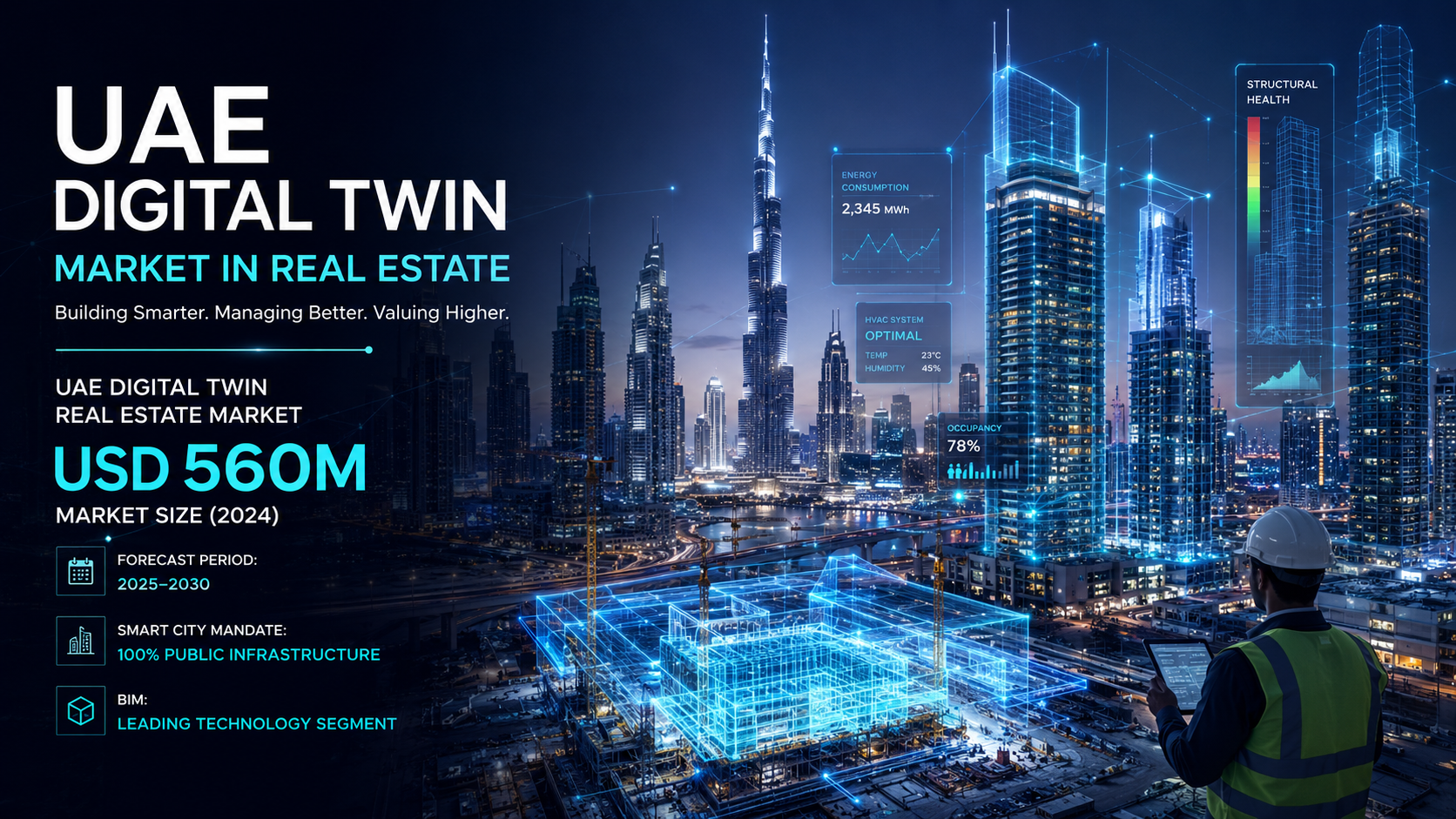
UAE Digital Twin Market in Real Estate Hits USD 560M: Smart City Mandate and BIM Drive 2030 Growth | Ken Research
The UAE real estate sector is undergoing a technology transformation that goes far beyond smart home features and app-based listings. Digital twins, virtual replicas of physical assets that update in real time using IoT and AI data feeds, are rapidly becoming a mandatory layer in how Dubai and Abu Dhabi plan, build, and manage property at scale. For a full data-backed breakdown of segment share, competitive landscape, and regional adoption rates, see the UAE Digital Twin Market in Real Estate Report. This analysis is published by Ken Research, a leading market intelligence firm covering technology and real estate sectors across the GCC and MENA region.
Analyst: Ken Research Market Analysis | Methodology: Ken Research market modelling, Dubai Land Department transaction data, Dubai Municipality BIM mandate disclosures, Abu Dhabi Housing Authority deployment records, smart building ROI benchmarks, and UAE government smart city programme investment data.
Executive Summary: A USD 560M Market Anchored by Government Mandates and a Record-Breaking Real Estate Cycle
Dubai's real estate sector recorded AED 761 billion in total transactions in 2024 across 226,000 deals, representing 36% volume growth and 20% value growth year-on-year. That volume creates a procurement environment where digital twin adoption is no longer discretionary. The UAE Digital Twin Market in Real Estate was valued at USD 560 million in 2024, supported by a national smart city budget of AED 50 billion (USD 13.6 billion) and digital twin investments exceeding USD 300 million between 2023 and 2025. With the UAE IoT market projected at AED 20 billion (USD 5.4 billion) and AI investment expected to exceed AED 15 billion (USD 4.1 billion), the enabling technology stack is growing in parallel with real estate demand, creating compounding adoption pressure across developers, construction firms, and facility managers through the 2030 forecast period. Dubai attracted 110,000 new real estate investors in 2024 alone, a 55% year-on-year increase, with investment transactions worth AED 526 billion across 217,000 deals.
Key Takeaways: 5 Facts That Define the UAE Digital Twin Market in Real Estate
- Market Size (Ken Research, 2024): The UAE Digital Twin Market in Real Estate reached USD 560 million in 2024, underpinned by record-level real estate transaction volumes and government-led smart city expenditure.
- Dubai Smart City Mandate (Dubai Municipality): Dubai mandates 100% digital twin implementation for all public infrastructure, and requires BIM for all buildings exceeding 40 floors or 300,000 sq ft, making adoption compulsory for most large-scale developers.
- Operational Cost Savings (Industry Data): Digital twin adoption reduces operational costs by 30%, while smart building implementations deliver 30-40% reduction in facilities staffing costs and up to 70% reduction in emergency repair events.
- Construction Sector ROI (Industry Data): Firms using construction digital twins report a 31% reduction in cost overruns, 23% fewer project delays, and 78% of professionals citing measurable productivity gains.
- Resale Value Premium (Dubai Market Data): IoT-enabled smart buildings in Dubai command 8-12% higher resale values compared to non-connected units, creating a direct financial incentive for developer adoption ahead of project completion.
Market At A Glance: Size, Policy Stack, and Ecosystem Drivers
Market Size and Forecast Trajectory Through 2030
Ken Research values the UAE Digital Twin Market in Real Estate at USD 560 million in 2024. The market moves through a 2025-2030 forecast period shaped by escalating government mandates, a construction sector projected to grow from USD 66.27 billion (2023) to USD 95.17 billion by 2029 at a 6.06% CAGR, and digital twin investments already exceeding USD 300 million in the 2023-2025 window. The construction sector digital opportunity alone is estimated at AED 30 billion (USD 8.2 billion), setting a substantial addressable ceiling for technology providers entering the UAE. Dubai's real estate market set an all-time record of 2.78 million procedures in 2024, a scale that demands data-driven asset management infrastructure at city level.
Regulatory and Policy Mandate Stack
The regulatory environment is unusually prescriptive by global standards. Dubai's Smart City Strategy mandates 100% digital twin coverage across all public infrastructure, while the Dubai 2040 Urban Master Plan designates 5 smart zones where large commercial projects must integrate digital twin systems. The Dubai Real Estate Strategy 2033 targets positioning Dubai in the top 3 global urban economies while doubling real estate's GDP contribution. Complementing these mandates, the DLD Smart Rental Index launched in January 2025 evaluates properties on a 1-5 star scale using 60-plus criteria including sustainability performance, creating rating-linked financial incentives for data-driven building management across the entire rental asset base.
Enabling Technology Ecosystem
The UAE is simultaneously scaling the enabling technology infrastructure that digital twins depend on. The UAE IoT market is projected at AED 20 billion (USD 5.4 billion), AI investment is expected to exceed AED 15 billion (USD 4.1 billion) driven by the UAE National AI Strategy 2031, and cybersecurity spending stands at AED 5 billion (USD 1.36 billion). DEWA has already integrated 99%-plus of Dubai's electricity meters into its smart grid, giving asset managers the live data feed architecture that digital twin platforms require at city scale. Players tracking parallel GCC digitisation waves can also reference the KSA Sovereign Cloud Market and the UAE Recommendation Engine Market for adjacent technology adoption patterns.
Segment Leadership: BIM and Real Estate Developers
Building Information Modeling (BIM) is the dominant technology sub-segment, reinforced by Dubai Municipality's mandate covering all buildings above 40 floors or 300,000 sq ft. Among end-user segments, Real Estate Developers are the primary adopters, followed by Construction Firms, Facility Management Companies, and Government Agencies. Deployment models span on-premises, cloud-based, and hybrid configurations, with geographic concentration in Dubai and Abu Dhabi across urban, suburban, and free zone areas.
Policy-Driven Adoption: How Government Mandates Create Guaranteed Procurement in a USD 560M Market
Most technology markets grow through commercial incentive. The UAE digital twin market in real estate is growing through something more powerful: legal obligation. The Dubai Smart City Strategy's requirement for 100% digital twin coverage across all public infrastructure, combined with the Dubai Municipality BIM mandate affecting every building above 40 floors or 300,000 sq ft, means that a substantial portion of the total project pipeline has no opt-out path. The Abu Dhabi Housing Authority (ADHA) and NNTC partnership, which deployed digital twins across 3,000-plus government houses using Unreal Engine 5, NVIDIA DLSS, and GIS technology in 2024, is a direct illustration of how government-initiated contracts are creating reference deployments at scale. For property investors benchmarking how smart infrastructure mandates are moving across MENA, the Middle East Smart Airports Market offers a parallel regulatory adoption case study, while the GCC AI in Healthcare Market shows how government-linked sectors are accelerating AI infrastructure investment region-wide.
- Dubai Smart City Strategy: Mandates 100% digital twin implementation for all public infrastructure, removing discretionary adoption risk for technology vendors serving the government segment.
- BIM Mandate Scope: Dubai Municipality requires BIM for all buildings over 40 floors or 300,000 sq ft, covering the vast majority of large commercial and mixed-use developments entering the pipeline.
- ADHA-NNTC Deployment: 3,000-plus government houses deployed with digital twins using Unreal Engine 5 and NVIDIA DLSS in 2024, establishing a large-scale reference architecture for public sector adoption.
- Dubai 2040 Smart Zones: 5 designated urban zones under the 2040 Master Plan require digital twin integration for large commercial projects, extending mandatory adoption beyond individual buildings to district-level planning.
Operational ROI That Justifies the AED 120,000 to 400,000 Setup Cost for Large Developers
Digital twin adoption in the UAE real estate sector is not purely a compliance story. The operational economics increasingly justify deployment on financial grounds alone, even before accounting for regulatory requirements. Smart building facilities management delivers 30-40% reduction in facilities staffing costs, up to 70% reduction in emergency repair events, and AED 20,000 to 60,000 in annual energy savings per floor, creating a quantifiable payback timeline for facility managers and investors. On the construction side, firms using digital twins report 31% fewer cost overruns and 23% fewer project delays, with 78% of professionals citing productivity gains as a primary outcome. These returns need to be weighed against setup costs ranging from AED 120,000 to 400,000 for large projects, with total project costs exceeding AED 1 million (USD 272,000) for complex deployments. Emaar Properties, which reported AED 19.1 billion (USD 5.2 billion) in 2024 revenue, alongside Aldar Properties' IoT analytics deployment at Yas Island, and DAMAC and Sobha incorporating smart home technology, illustrate how Tier 1 developers are absorbing these costs as a standard line item in premium project budgets. Technology buyers evaluating data infrastructure decisions in adjacent sectors can also benchmark against the UAE User Entity Behavior Analytics Market and the UAE Open Banking Platforms Market for data integration cost benchmarks.
- Facilities Staffing Savings: Smart building digital twin implementations reduce facilities staffing costs by 30-40%, the most immediate and measurable ROI driver for facility managers evaluating build-vs-buy decisions.
- Emergency Repair Reduction: Predictive maintenance enabled by digital twins reduces emergency repair events by up to 70%, converting reactive maintenance budgets into predictable capital planning cycles.
- Energy Cost Savings: Annual energy savings of AED 20,000 to 60,000 per floor provide a per-asset ROI metric that property owners can directly model against implementation costs.
- Resale Value Premium: IoT-enabled smart buildings command 8-12% higher resale values in Dubai, giving developers a market-rate justification for digital twin investment that applies at point of sale, not just operations.
Which UAE digital twin segment delivers the fastest ROI for your project type? Download Sample Report for segment-level financial modelling and competitive benchmarking.
Which Companies Are Competing for the UAE Digital Twin Real Estate Market Through 2030?
The competitive field spans two distinct groups with different positioning advantages. Global technology incumbents including Siemens AG, Autodesk Inc., Bentley Systems, Dassault Systemes, IBM Corporation, Microsoft Corporation, ANSYS, PTC Inc., Hexagon AB, Oracle Corporation, GE Digital, SAP SE, Altair Engineering, AECOM Technology Corporation, and Schneider Electric bring established digital twin platform capabilities with proven enterprise deployment track records. UAE-rooted developers including Emaar Properties, DAMAC Properties, Aldar Properties, Nakheel, Majid Al Futtaim, Dubai Holding, and Noumou Properties are not just customers of this technology but are increasingly shaping what the vendor ecosystem must deliver, given Emaar's AED 19.1 billion revenue base and Aldar's live IoT analytics deployment at Yas Island. The barrier that most meaningfully segments the competitive field is not platform capability but integration complexity: data privacy concerns and legacy system connectivity remain the most-cited obstacles to adoption, giving solution providers with UAE-specific integration expertise a material edge. Analysts tracking broader GCC technology platform competition can reference the Saudi Arabia Cloud Services Market and the UAE Commercial Drone Market for adjacent infrastructure technology competitive dynamics.
- Global Technology Leaders: Siemens AG, Autodesk, Bentley Systems, Dassault Systemes, and Microsoft bring enterprise-grade digital twin platforms with global deployment records applicable to UAE mega-projects.
- UAE Developer Influence: Emaar Properties at AED 19.1 billion in 2024 revenue and Aldar Properties with active IoT analytics at Yas Island are setting procurement specifications that global vendors must match to win UAE contracts.
- UAE-Specific Player: NNTC has established itself as the key local digital twin deployment partner, evidenced by the 3,000-plus government housing units deployed with ADHA using advanced rendering and GIS technology in 2024.
- Key Barrier: Data privacy compliance and legacy system integration, not platform cost, are the primary adoption obstacles, favouring vendors with UAE regulatory expertise and proven integration methodologies.
Ken Research Finds
Ken Research decodes the UAE Digital Twin Market in Real Estate as a policy-driven, ROI-validated, and infrastructure-enabled growth story that does not depend on a single driver. The market reached USD 560 million in 2024, supported by AED 761 billion in real estate transactions, a AED 50 billion national smart city budget, and construction sector digital opportunity estimated at AED 30 billion. Winners through the 2030 forecast period will prioritise mandatory BIM compliance capability, IoT integration with DEWA's 99%-plus smart grid coverage, and predictive maintenance platforms that can demonstrate the 30-40% facilities cost reduction now expected by UAE facility managers. Competitive advantage will flow to players that solve the integration gap between legacy property systems and real-time digital twin data, the barrier that currently separates pilot adoption from portfolio-wide deployment across Tier 1 UAE developers. The convergence of the Middle East Electric Vehicle Market infrastructure buildout and smart building energy management creates an additional demand vector for digital twin platforms with energy optimisation capabilities, while the GCC Telemedicine Market illustrates the GCC's demonstrated willingness to mandate digital infrastructure at sector level when strategic objectives demand it.
Conclusion
The UAE Digital Twin Market in Real Estate has reached USD 560 million in 2024, built on the intersection of a record-breaking real estate cycle, compulsory smart city mandates, and a national technology investment stack approaching AED 85 billion across IoT, AI, and cybersecurity. The construction sector expanding from USD 66.27 billion to USD 95.17 billion by 2029 at a 6.06% CAGR ensures the project pipeline that will demand digital twin integration remains robust through the 2030 forecast period. For developers, facility managers, technology vendors, and institutional investors positioning in this market, the full competitive analysis, regional breakdown, and segment-level forecast data are available in the UAE Digital Twin Market in Real Estate Report from Ken Research.
Ready to validate your market entry or investment thesis for UAE digital twin real estate? Speak to a Ken Research Digital Twin Analyst to validate technology selection, mandate compliance requirements, and 2030 positioning strategy.
Frequently Asked Questions
Q1: What is the size of the UAE Digital Twin Market in Real Estate?
Ken Research values the UAE Digital Twin Market in Real Estate at USD 560 million in 2024. The market is supported by a UAE government smart city budget of AED 50 billion (USD 13.6 billion) and digital twin investment exceeding USD 300 million in the 2023-2025 period, with growth tracking through the 2025-2030 forecast period against a construction sector expanding to USD 95.17 billion by 2029.
Q2: What government mandates are driving digital twin adoption in UAE real estate?
Dubai's Smart City Strategy mandates 100% digital twin implementation across all public infrastructure. The Dubai Municipality BIM mandate covers all buildings exceeding 40 floors or 300,000 sq ft, and the Dubai 2040 Urban Master Plan designates 5 smart zones where large commercial projects must integrate digital twin systems. The DLD Smart Rental Index, launched in January 2025, evaluates properties on a 1-5 star scale across 60-plus criteria, linking sustainability data to rental ratings. For parallel smart infrastructure regulatory dynamics see the Middle East Smart Airports Market.
Q3: Which companies lead the UAE Digital Twin Market in Real Estate?
Ken Research identifies 15 key players in the UAE Digital Twin Market in Real Estate. Global technology leaders include Siemens AG, Autodesk Inc., Bentley Systems, Dassault Systemes, IBM Corporation, Microsoft Corporation, ANSYS Inc., PTC Inc., Hexagon AB, Oracle Corporation, GE Digital, SAP SE, Altair Engineering, AECOM Technology Corporation, and Schneider Electric. On the UAE developer side, Emaar Properties (2024 revenue: AED 19.1 billion), DAMAC Properties, Aldar Properties, Nakheel, and Majid Al Futtaim Group are the primary adopters shaping procurement specifications. For comparable competitive analysis see the Saudi Arabia Fintech Wealthtech Robo Advisory Market.
Q4: What ROI does digital twin technology deliver in UAE real estate and construction?
Industry data cited by Ken Research shows digital twin adoption reduces operational costs by 30%, facilities staffing costs by 30-40%, and emergency repair events by up to 70%, with AED 20,000 to 60,000 in annual energy savings per floor. In construction, digital twins deliver a 31% reduction in cost overruns, 23% fewer project delays, and 20% reduction in carbon emissions, with 78% of construction professionals reporting measurable productivity gains. IoT-enabled buildings in Dubai also achieve 8-12% higher resale values compared to non-connected units.
Q5: What are the main barriers to digital twin adoption in UAE real estate?
The primary barriers are high implementation cost, data privacy compliance, and legacy system integration. Digital twin setup costs for large projects range from AED 120,000 to 400,000, with total project costs exceeding AED 1 million (USD 272,000) for complex deployments. Data privacy concerns under UAE regulatory frameworks and the technical complexity of connecting digital twin platforms to existing property management and building management systems remain the most-cited integration obstacles, particularly for mid-tier developers without dedicated technology procurement teams. For related data infrastructure adoption challenges in the region see the UAE User Entity Behavior Analytics Market.


Comments
Post a Comment