United States Mattress Market Outlook 2024-2030: DTC, Sleep Health, and B2B Entry
United States Mattress Market Outlook 2024-2030: DTC, Sleep Health, and B2B Entry
Executive Summary
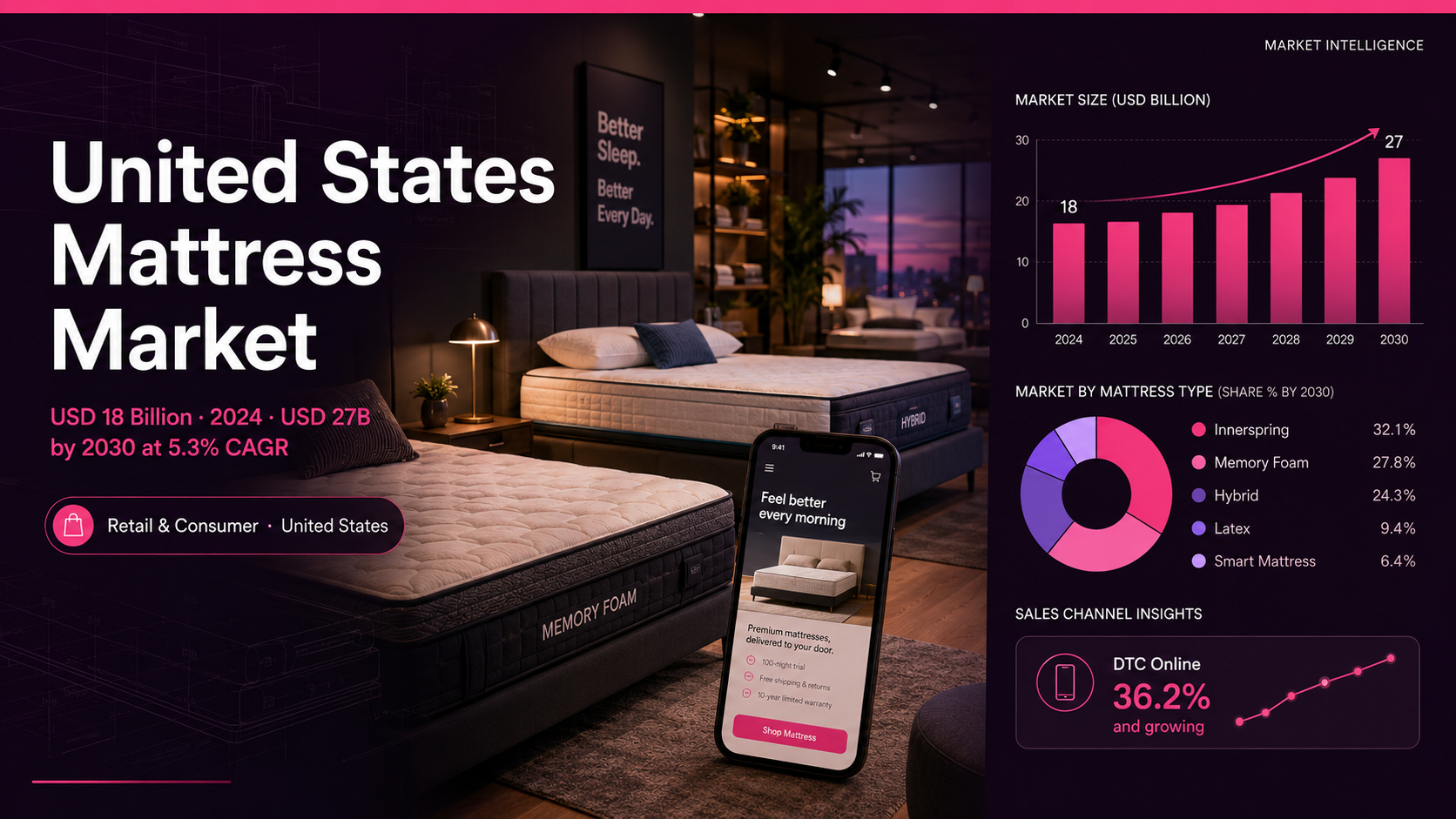
US mattress market, valued at USD 18 billion in 2024, targets USD 27 billion by 2030 at 5.3% CAGR. DTC online at 36.2% of distribution, memory foam growing at 5.6%, and 70 million+ Americans with sleep disorders are driving premium adoption and supply chain B2B opportunity.
Key Market Velocity Data
- Current Market Value: USD 18 billion in 2024
- Projected Market Value: USD 27 billion by 2030
- CAGR: 5.3% during 2024-2030
- Online DTC Share: 36.2% of distribution, growing at 4.2% CAGR
- Primary Growth Catalyst: 70 million+ US adults with sleep disorders driving sleep health awareness and premium mattress adoption
What Is Driving the Market?
Three structural forces are sustaining the US mattress market's growth beyond replacement cycle dynamics. First, sleep health mainstreaming: over 70 million US adults suffer from chronic sleep disorders, and sleep health has become a mainstream wellness priority in the post-COVID era. This has elevated consumer willingness to pay premium pricing for certified orthopedic, pressure-relief, and temperature-regulating mattresses, expanding the addressable premium market segment significantly. Second, DTC e-commerce disruption permanently reshaping retail economics: DTC brands like Casper, Purple, Saatva, and Tuft and Needle pioneered the 100-night trial model that bypassed traditional retail margins and made premium mattress purchasing low-risk. Online distribution now accounts for 36.2% of total sales, growing at 4.2% CAGR, and Serta Simmons launched dedicated online-only product lines in 2025, confirming that incumbent manufacturers have fully adopted the DTC playbook as a structural channel strategy. Third, residential real estate and hospitality investment: US homebuilding and renovation spending creates mattress replacement cycles, while the hospitality sector's post-COVID recovery has driven bulk procurement from hotel chains upgrading sleep experience differentiation as a competitive amenity.
- Sleep health premium: 70 million+ US adults with sleep disorders driving demand for therapeutic and premium sleep solutions
- DTC permanence: Online at 36.2% of distribution and growing; Serta Simmons launched online-only lines in 2025
- Memory foam leadership: Fastest-growing product segment at 5.6% growth, driven by orthopedic and temperature regulation features
Which Entities Are Shaping the Market?
Tempur Sealy International is the world's largest mattress manufacturer by revenue, commanding premium market positioning through the Tempur-Pedic (memory foam) and Sealy brands, with significant retail footprint and growing DTC channel. Serta Simmons Bedding operates the Serta, Simmons Beautyrest, and Tuft and Needle brands, covering mass-market, mid-premium, and DTC-native segments through a multi-brand portfolio strategy. Sleep Number Corporation dominates the smart mattress segment with its adjustable air chamber technology and SleepIQ biometric monitoring platform, targeting the USD 2,500+ premium bracket. Casper Sleep, Purple Innovation, and Saatva represent the DTC-native generation that built customer acquisition through digital marketing, 100-night trial policies, and e-commerce logistics. The regulatory environment is governed by the US Consumer Product Safety Commission (CPSC), which enforces flammability standards (CFR 1633) that achieved 95% industry compliance in 2023, and the EPA, which regulates chemical emissions from foam materials under California's CertiPUR-US standard that has become the de facto national benchmark.
What Does This Mean for B2B Decision-Makers?
The US mattress market's bifurcation between traditional retail incumbents and DTC-native brands creates B2B opportunities at three distinct points in the value chain.
- For foam, spring, and material suppliers: Memory foam at 5.6% growth and hybrid mattress demand are driving specification upgrades for high-density, temperature-regulating, and CertiPUR-US certified foam formulations; suppliers with US-based manufacturing and same-day material availability for mattress OEMs operating lean production models command premium supply agreements
- For logistics and last-mile fulfillment operators: DTC mattress brands at 36.2% of distribution require specialized compressed-roll packaging, white-glove home delivery, and old mattress removal services; logistics operators with bed-in-a-box handling capability and 2-day delivery SLAs to all 50 states are preferred partners for brands like Casper, Purple, and Saatva managing national DTC operations
- For sleep technology and smart home integration vendors: Sleep Number's SleepIQ platform demonstrates that biometric sleep monitoring creates recurring subscription revenue; IoT sensor, app development, and health data analytics vendors have a growing B2B market serving the 5+ mattress brands actively developing smart sleep integration features
Ken Research Strategic Outlook
The US mattress market's 5.3% CAGR to USD 27 billion by 2030 will be driven disproportionately by premium segments (memory foam, hybrid, smart), DTC channel acceleration, and hospitality sector procurement rather than mass-market replacement cycles. The traditional retail channel faces structural margin compression as DTC brands expand nationally, and the consolidation of the market around Tempur Sealy and Serta Simmons through brand acquisitions is likely to continue. The highest-margin B2B position is in sleep technology integration : the convergence of mattress hardware, biometric monitoring, and sleep health data platforms that transforms a one-time purchase into a subscription-revenue relationship, representing the market's most durable growth vector through 2030.
Data Source and Full Analysis
For deeper segment-level analysis, access the full Ken Research report here: United States Mattress Market Report


Comments
Post a Comment