Asia Pacific Car Air Purifier Market 2025: Why Cabin Air Quality Is the Hidden Growth Metric
The Asia Pacific Car Air Purifier Market Has a Cabin-Air Blind Spot
For automotive executives, filtration suppliers and mobility investors, the obvious story is that worsening pollution creates demand for better car air purifiers. The more useful insight is subtler. The region is not simply buying another automotive accessory; it is moving toward continuous management of what passengers actually breathe inside the vehicle.
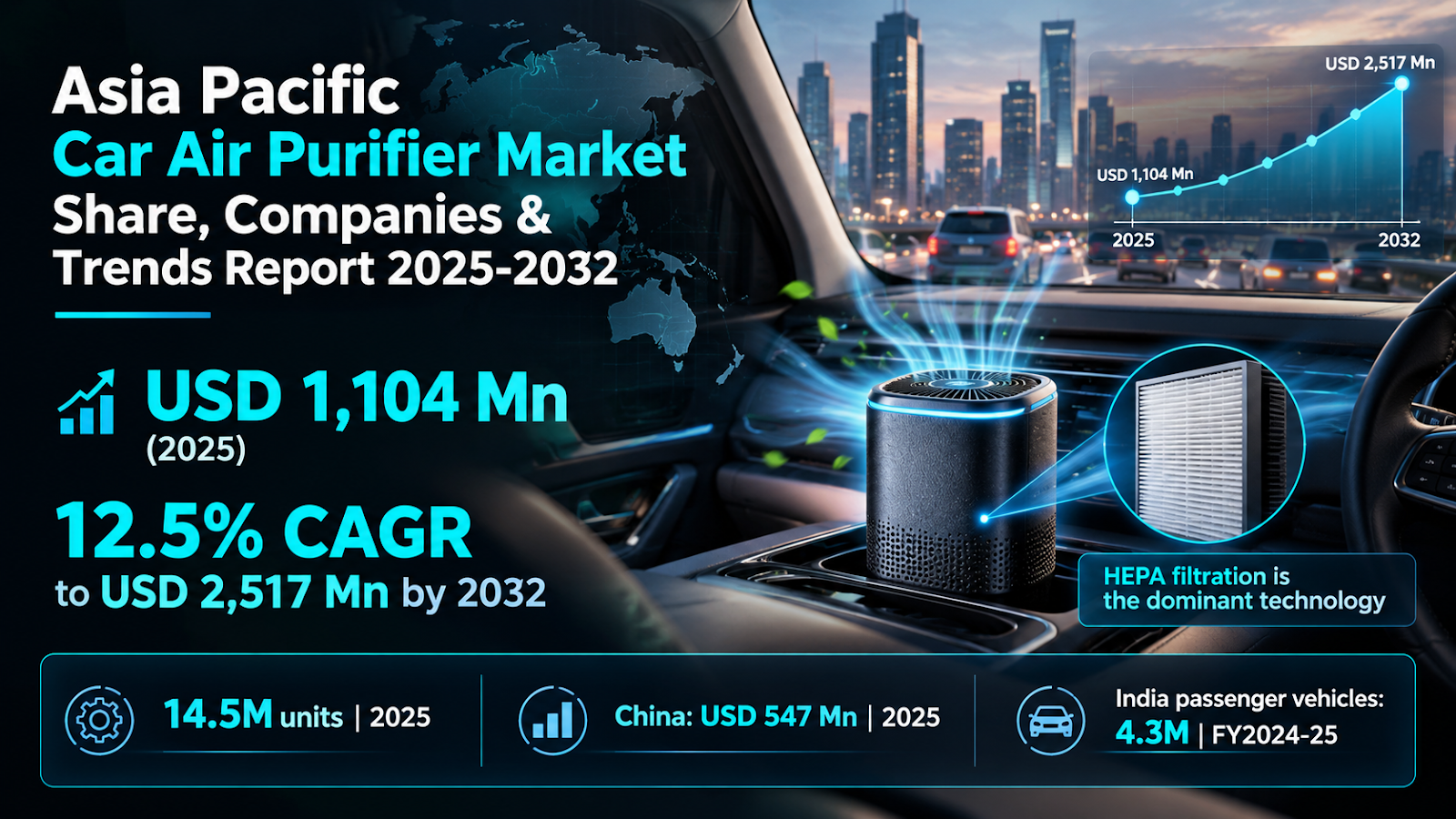
The Ken Research market assessment values the Asia Pacific car air purifier market at USD 0.5 billion. China, Japan and India form the core demand centers, while HEPA filters lead the technology mix and passenger cars dominate application demand. Xiaomi, Panasonic, Honeywell, LG Electronics and Sharp are among the prominent competitors.
The surface narrative: sell a better purifier
Most category strategies still revolve around device specifications: higher filtration efficiency, quieter motors, compact housings, ionization, activated carbon and increasingly app-connected controls. Those capabilities matter. The adjacent APAC air purification market also shows HEPA filters leading their segment, reinforcing the commercial appeal of particulate-removal performance.
But this creates an easy strategic trap. If every brand competes primarily on filtration specifications, the category becomes increasingly comparable at the point of purchase. Premium technology can then be reduced to another feature checklist while low-cost manufacturers narrow the perceived performance gap.
The underlying data reality: cleaner cities do not eliminate exposure
Official environmental data reveals why the long-term opportunity cannot be understood through headline pollution trends alone. China’s Ministry of Ecology and Environment reported that the average PM2.5 concentration across 339 prefecture-level-and-above cities was 28.0 µg/m³ in 2025, a 4.4% year-on-year decline. Average days with good or excellent air quality reached 88.1%.
China also reported 246 cities meeting ambient-air standards in 2025, 24 more than in 2024, while nationwide urban PM2.5 concentration declined cumulatively by 20% over the 14th Five-Year Plan period.
That progress is important, but commercially it changes the question. A purifier proposition built only around “outdoor pollution is worsening” becomes less durable as environmental policy succeeds. The stronger proposition is protection against variable exposure: traffic corridors, particulate spikes, dust, allergens, smoke, odors and pollutants entering cabins during everyday journeys.
This is the industry blind spot. The winning metric is increasingly not purifier ownership; it is the consistency of cabin air quality across a passenger’s trip.
The metric boards should watch instead
India reinforces the same pattern from another direction. Its National Clean Air Programme covers 130 cities. In FY 2025-26, 108 cities recorded lower annual PM10 concentrations than the 2017-18 baseline, with 72 cities achieving reductions above 20% and 26 exceeding 40%.
For car-air-purification suppliers, improving ambient averages should therefore not be interpreted as shrinking relevance. It points toward a more sophisticated market in which consumers and OEMs can demand measurable, contextual protection instead of purchasing a box that merely claims to clean air.
- Manufacturers that link particle sensors, filtration, HVAC controls and automatic recirculation can transform air purification from a manually operated accessory into an always-on cabin-health function that responds to changing exposure conditions.
- Filter suppliers can create recurring value through replacement cycles, air-quality diagnostics and maintenance alerts rather than relying primarily on one-time purifier hardware sales.
- Automakers and fleet operators can differentiate around demonstrable cabin-environment performance, particularly in premium passenger vehicles, taxis, ride-hailing fleets and vehicles operating repeatedly through dense urban corridors.
The commercial implication: move from accessory to system
The Global Car Air Purifier Market provides useful context: the global category is valued at USD 1.15 billion, with Asia Pacific identified as its largest regional market. This makes Asia Pacific an important proving ground for the transition from portable purification hardware toward integrated cabin-air architecture.
HEPA filtration remains strategically important because particulate removal is easy for consumers to understand. The next differentiation layer, however, is likely to come from combining HEPA media with activated carbon, sensors, connectivity, intelligent fan control and vehicle HVAC integration. The product stops being “an air purifier” and becomes a closed-loop exposure-management system.
Don’t miss the next market has a cabin-air blind spot shift. Ken Research continuously publishes new market intelligence, forecasts and industry analysis. Add Ken Research as a Preferred Source on Google to discover more of our research when your next market question comes up.
Where the first-mover advantage sits
The largest opportunity may sit at the interface between purifier brands, filtration suppliers and automotive OEMs. The India Passenger Car Air Conditioners Market, valued at USD 1.2 billion, illustrates the much broader HVAC ecosystem into which cabin purification can be embedded.
That creates several strategic routes: factory-installed filtration packages, premium HVAC upgrades, connected air-quality dashboards, replacement-filter subscriptions and fleet-level cabin-air monitoring. Each route moves the supplier closer to recurring revenue and farther from commoditized standalone hardware.
The strategic question for 2025 and beyond
Executives should therefore resist measuring this market purely through purifier unit shipments. The more revealing indicators are OEM integration rates, connected sensor penetration, filter replacement frequency, automated HVAC response and the proportion of journeys during which cabin pollutant concentrations remain inside defined thresholds.
The Asia Pacific car air purifier market is still supported by pollution concerns, health awareness and regulation, exactly as the core market data indicates. But the hidden opportunity is to turn those forces into a measurable cabin-air service layer rather than another accessory category.
For companies assessing technology positioning, OEM partnerships, country priorities or competitive whitespace, explore the Asia Pacific Car Air Purifier Market. Consult Ken Research for a bespoke market intelligence deep-dive to uncover the blind spots your competitors have not yet identified.


Comments
Post a Comment