Brazil Luxury Fashion And Lifestyle Market Shifts From Price-Led Growth to Clienteling and Volume
Brazilian Luxury Is Entering a Repeat-Purchase Era: Ken Research Maps the Move Beyond Price Inflation
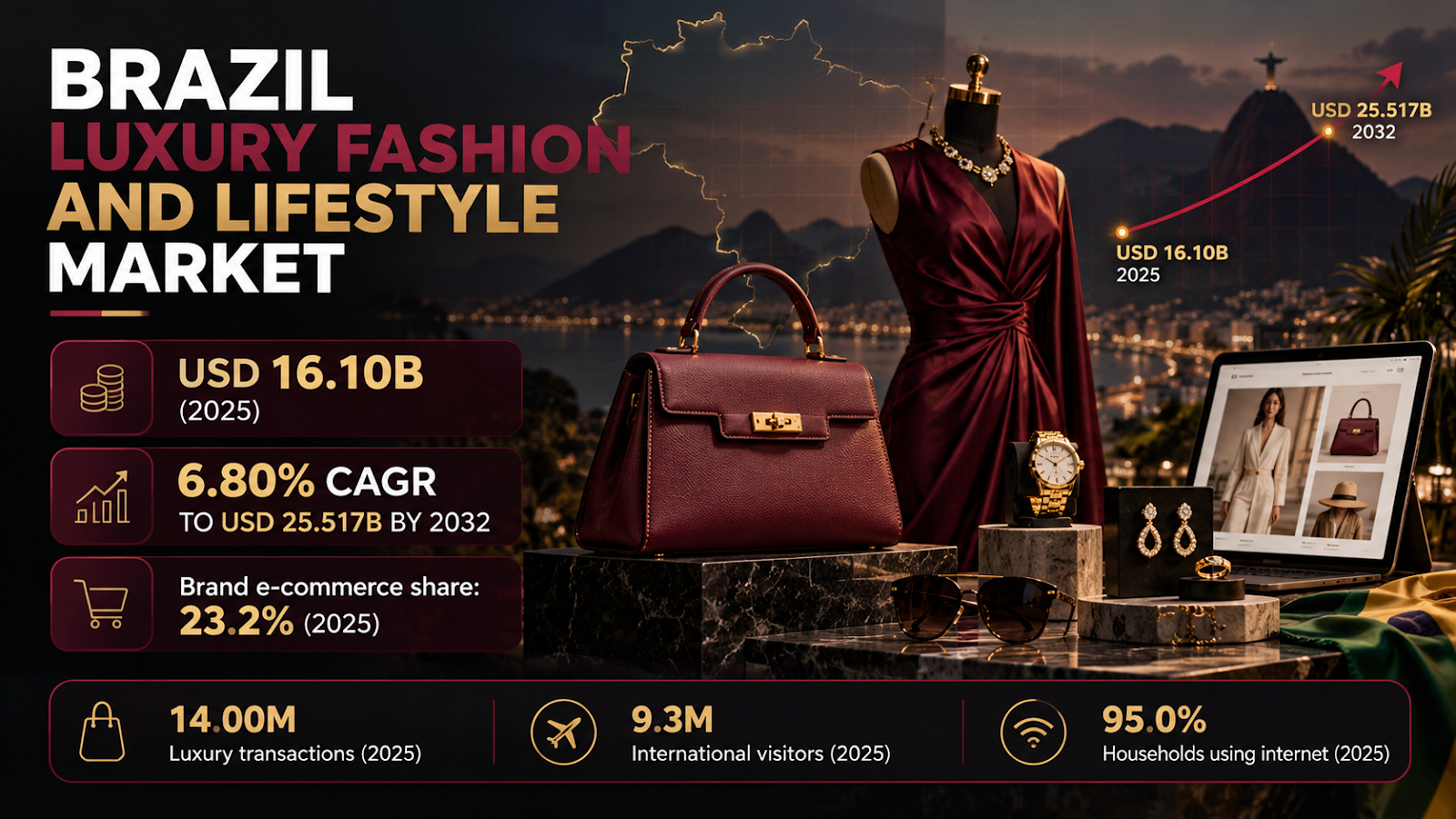
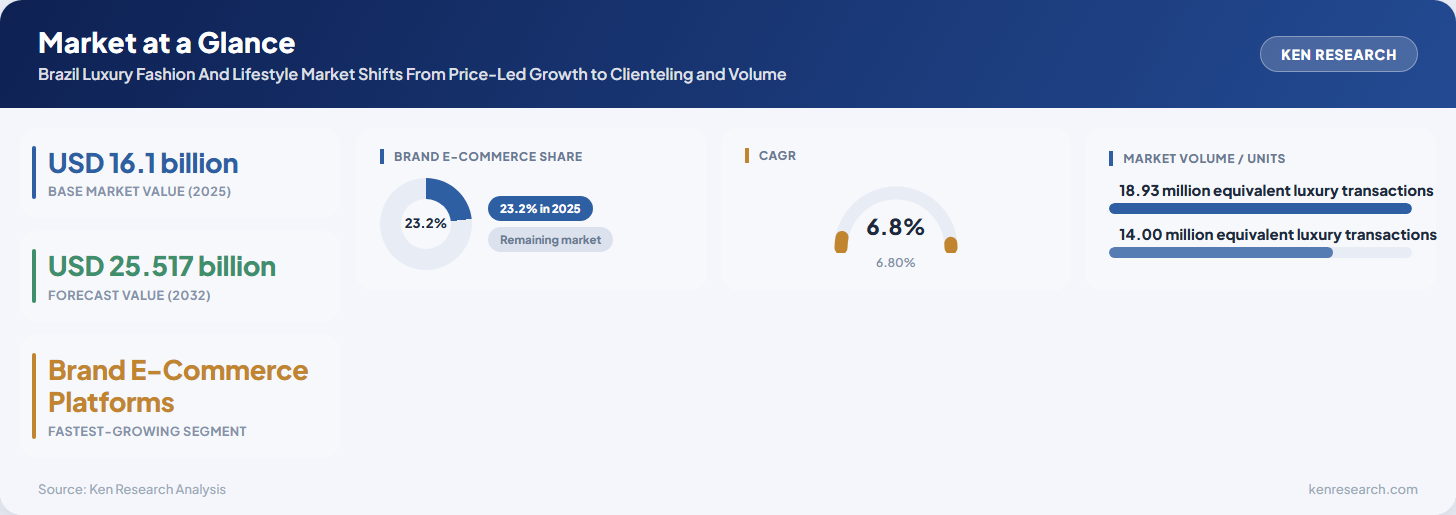
Brazil’s luxury fashion and lifestyle economy is moving into a different kind of growth cycle. The August 2026 analysis from Ken Research values the market at USD 16.1 billion in 2025 and projects it to reach USD 25.517 billion by 2032, a forecast CAGR of 6.80%. The strategic change is not simply that luxury spending is rising; future value creation is expected to depend more heavily on transaction growth, customer retention and direct channel economics than on repeated increases in list prices.
The market covers luxury and accessible-premium fashion, footwear, handbags and leather goods, jewellery and watches, prestige beauty, fragrance and related lifestyle accessories sold to Brazilian consumers and international visitors. It excludes luxury automobiles, hotels, fine dining and unrelated luxury experiences. Within that scope, the commercial opportunity is broadening from flagship-store selling toward an integrated model spanning boutiques, brand-owned e-commerce, remote clienteling, private appointments and cross-category customer relationship management.
The counter-thesis is equally important: high nominal market growth does not automatically produce stronger unit economics. Foreign-exchange exposure, import taxation, high-value inventory and aspirational-consumer price sensitivity can translate revenue expansion into weaker conversion or tighter margins if assortment is poorly managed. Adjacent evidence from the Brazil Jewelry Market illustrates the same tension: branded value can expand faster than physical demand, making mix, sourcing and ticket architecture as important as unit growth.
Growth Is Shifting From Price Elevation Toward Transaction Quality
The historical expansion contained a meaningful premiumization component. The model estimates equivalent luxury transactions increased from 11.89 million in 2020 to 14.00 million in 2025, while market value grew faster. That gap matters because it shows that pricing and product mix did significant work during the post-pandemic recovery. Repeating the same formula indefinitely would create greater affordability risk among consumers below the ultra-luxury tier.
The forecast therefore assumes a healthier composition of growth. By 2032, modeled transaction volume reaches approximately 18.93 million equivalent purchases, while the weighted luxury basket approaches USD 1,348. Ken Research expects transaction volumes to contribute roughly two-thirds of annual value expansion as price escalation moderates. For operators, this puts greater weight on purchase frequency, customer acquisition quality, retention and cross-category conversion rather than simple ticket inflation.
Strategic implication: brands that measure lifetime value, repeat-purchase intervals, category migration and client profitability should be better positioned than retailers whose commercial model depends mainly on annual price increases.
First-Party Digital Commerce Is Becoming a Profit-Control Layer
Brand e-commerce is one of the clearest structural changes in the market. The primary model places brand-owned digital commerce at 23.2% of the market in 2025 and identifies Brand E-Commerce Platforms as the fastest-growing distribution channel. The attraction is not merely incremental online revenue. First-party channels allow luxury operators to retain pricing control, unify inventory, collect customer data and connect digital discovery with boutique appointments and remote selling.
The surrounding infrastructure makes this strategy increasingly viable. According to IBGE, internet access reached 95.0% of Brazilian households, or 76.0 million households, in 2025. Broader evidence from the Brazil E-Commerce Market also shows why first-party and direct-to-consumer infrastructure matters when brands need tighter control over data, inventory and service quality.
Clienteling Turns Digital Reach Into Luxury Economics
Luxury e-commerce should not be interpreted as a replacement for boutiques. High-value selling still depends on trust, styling advice, authentication, product handling and relationship continuity. The higher-value model connects digital and physical touchpoints so that a customer discovered through social media or a brand site can move into a private appointment, remote consultation, reserve-and-collect flow or store-assisted transaction without losing context.
- Unified inventory: exposes premium stock across stores and digital channels without unnecessary duplication.
- First-party CRM: makes purchase history, preferences and high-value client signals usable across categories.
- Assisted checkout: preserves service intensity even when the transaction is completed remotely.
- Private clienteling: allows boutiques to generate revenue beyond their immediate physical catchment.
Product Mix Is Broadening the Luxury Customer Ladder
Ready-to-wear supports recurring brand engagement, but the strongest revenue-density opportunities extend into handbags, leather goods, jewellery and watches. These categories can generate larger tickets and create milestone, gifting and collectible purchase occasions that behave differently from seasonal apparel. Prestige beauty and fragrance can play the opposite role, lowering the entry ticket and giving brands an acquisition path into a broader customer lifecycle.
Jewellery and Leather Goods Raise Revenue Density
For portfolio owners, the commercial logic is to manage customers across price tiers rather than treat luxury as a single spending bracket. Accessible-luxury propositions can expand participation, while scarce products, high jewellery, leather goods and couture protect exclusivity at the top of the ladder. This creates room to grow both customer count and wallet share without applying the same pricing strategy to every cohort.
Emerging fashion demand adds another layer to that strategy. The Brazil Gen Z Apparel & Streetwear Market shows how digital fashion discovery and brand e-commerce are becoming embedded in younger consumer journeys. The implication for luxury houses is not that mass youth fashion and luxury are interchangeable, but that future premium customers increasingly expect direct digital access, recognizable brand identity and seamless transitions between online discovery and physical experience.
Wealth Clusters and Tourism Create a Two-Layer Demand Map
Brazil’s luxury opportunity remains geographically concentrated. The Southeast is the dominant commercial region, anchored by São Paulo’s flagship retail network, corporate wealth and premium mall infrastructure. At the same time, purchasing power is not confined to one city. Official IBGE household-income data show national monthly household income per capita at R$2,316 in 2025, while the Federal District reached R$4,538, the highest level among Brazil’s federation units.
That distribution supports a hub-and-spoke approach: flagship stores remain concentrated in high-productivity luxury corridors, while digital clienteling can extend assortment and service into Brasília, Belo Horizonte, Curitiba, Porto Alegre, Goiânia and other affluent clusters. For brands, the relevant question is therefore not simply how many physical stores to open, but which markets require permanent flagship presence and which can be served profitably through appointments, events, remote selling and selective retail partnerships.
International tourism creates a second demand pool. Embratur, citing Brazilian Central Bank data, reported foreign visitor expenditure of USD 7.865 billion in 2025, up 7.1% from 2024, alongside approximately 9.3 million international arrivals. That matters for luxury retailers because tourism adds high-value shopping occasions in destination cities, airports, premium malls, resortwear, jewellery and gifting categories without relying entirely on domestic household credit conditions.
Import Exposure Makes Inventory Discipline a Competitive Capability
The largest structural risk sits on the supply side. International luxury houses often acquire merchandise in foreign currency while earning local revenue in Brazilian reais. Currency depreciation, customs costs and tax complexity can therefore force an uncomfortable choice between raising local prices and accepting lower margins. That tension is most visible in accessible and aspirational luxury, where customers have more alternatives and can postpone purchases more easily than ultra-high-net-worth buyers.
Why Aspirational Luxury Is More Exposed
Price increases that protect gross margin can weaken conversion, reduce frequency or push consumers toward domestic premium labels and lower price tiers. Holding excessive imported inventory creates a different problem: working capital becomes trapped in expensive stock with long replenishment cycles and potentially high markdown costs. The most defensible response is better inventory allocation, localized assortment, disciplined good-better-best pricing and stronger forecasting of high-value SKUs.
- Foreign-exchange exposure: changes landed cost before local demand has necessarily changed.
- Import and tax complexity: raises the cost of assortment mistakes.
- High unit values: make excess stock more expensive to carry.
- Aspirational demand sensitivity: limits how much global price architecture can be transferred directly into Brazil.
- Long lead times: increase the value of local demand forecasting and inventory visibility.
Competition Is Moving Toward Brand Control, Clienteling and Local Execution
The competitive field includes Brazilian premium-fashion platforms, jewellery specialists and international luxury groups. The primary research identifies more than 180 market participants and profiles companies including Azzas 2154 S.A., Vivara Participações S.A., Veste S.A. Estilo, Track & Field Co S.A., LVMH, Kering, Chanel, Hermès, Richemont and Prada. Published company-level market-share percentages are not provided in the accessible dataset, so these names should be treated as an unranked participant set rather than a revenue ranking.
The more useful competitive question is what capabilities determine economic quality. Brand equity remains essential, but it is increasingly complemented by store productivity, CRM depth, digital direct-to-consumer execution, inventory control, localized merchandising and the ability to protect service quality across physical and digital channels. Domestic groups can benefit from local supply knowledge and broader price architecture, while global houses bring international brand scarcity and product depth; neither advantage removes the need for strong local execution.
That changes the meaning of scale. The strongest operator is not necessarily the one with the largest store footprint, but the one that can use each boutique as a high-value relationship node connected to first-party data, remote selling and disciplined product allocation.
What Luxury Operators Should Watch Through 2032
The forecast implies substantial absolute growth, but the quality of that growth will depend on whether operators convert broader demand into profitable repeat purchasing. Investors, brand owners, distributors and mall operators should therefore track operating indicators alongside headline market value.
- Transaction growth: whether purchase volume continues to contribute more meaningfully as price-led expansion moderates.
- Brand e-commerce mix: whether first-party digital growth improves customer ownership rather than simply shifting existing store transactions online.
- Repeat-purchase frequency: whether clienteling and CRM increase lifetime value across apparel, accessories, jewellery and beauty.
- Tourist spending: whether record visitor flows translate into durable demand for gifting, jewellery and destination retail.
- Inventory turns: whether imported high-value stock is being allocated efficiently across physical and digital channels.
- Accessible-luxury conversion: whether broader participation can grow without excessive discounting or brand dilution.
- Regional productivity: whether expansion beyond the principal Southeast hubs produces adequate sales density and service quality.
Market Outlook: More Growth, but a Different Source of Value
The Brazilian luxury fashion and lifestyle market is modeled to expand from USD 16.1 billion in 2025 to USD 25.517 billion by 2032. The more important message is what sits underneath that increase. The next cycle is expected to rely more on transactions, digitally enabled clienteling, jewellery and leather goods, premium domestic brands, tourism-linked spending and first-party customer relationships than on repeated double-digit price inflation.
The upside case strengthens if brands use digital channels to increase purchase frequency, widen geographic reach and improve customer lifetime value while keeping boutiques central to trust and high-ticket conversion. The downside case emerges if currency pressure, landed costs and excessive price increases weaken aspirational demand or if operators build inventory faster than client demand. Growth therefore creates opportunity, but execution determines whether that opportunity translates into stronger margins and healthier capital productivity.
For B2B decision-makers, the commercial shift is straightforward: Brazil is not merely becoming a larger luxury market. It is becoming a market in which customer ownership, assortment intelligence, inventory discipline and omnichannel service increasingly determine who captures the incremental value.
Don’t miss the next maps the move beyond price inflation shift. Ken Research continuously publishes new market intelligence, forecasts and industry analysis. Add Ken Research as a Preferred Source on Google to discover more of our research when your next market question comes up.
Research Basis and Data Status
The primary market framework is the August 2026 Ken Research Brazil Luxury Fashion & Lifestyle Market study. Its base year is 2025, historical period is 2020–2025, and forecast period extends through 2032. Market size, forecast values, transaction estimates, channel metrics and competitive-structure observations cited as Ken Research figures are proprietary estimates and should not be interpreted as government statistics.
Research Framework
- Brazil luxury-spending benchmark review.
- Premium retail channel mapping.
- Fashion import-export data review.
- Luxury-brand financial disclosure analysis.
- Primary interviews with luxury-house country managers, premium retail buying directors, boutique directors and brand CRM managers.
- Validation across 266 respondents and market cohorts.
- Cross-checking of brand revenues, channel metrics, demand indicators and historical growth arithmetic.
Official statistics used in this article are separately identified and linked to their originating institutions, including IBGE for household connectivity and income indicators and Embratur for international-tourism evidence. Company and adjacent-market observations remain distinct from government statistics and from the proprietary market-sizing model.
Explore the Brazil Luxury Fashion And Lifestyle Market report for detailed segmentation, competitive coverage, channel analysis and forecast assumptions.


Comments
Post a Comment