Brazil Online Classifieds and Real Estate Portals Market Shifts From Traffic to Monetization
Brazil’s Portal Economy Is Moving Beyond Listings: Ken Research Maps the USD 3.465 Billion Monetization Opportunity
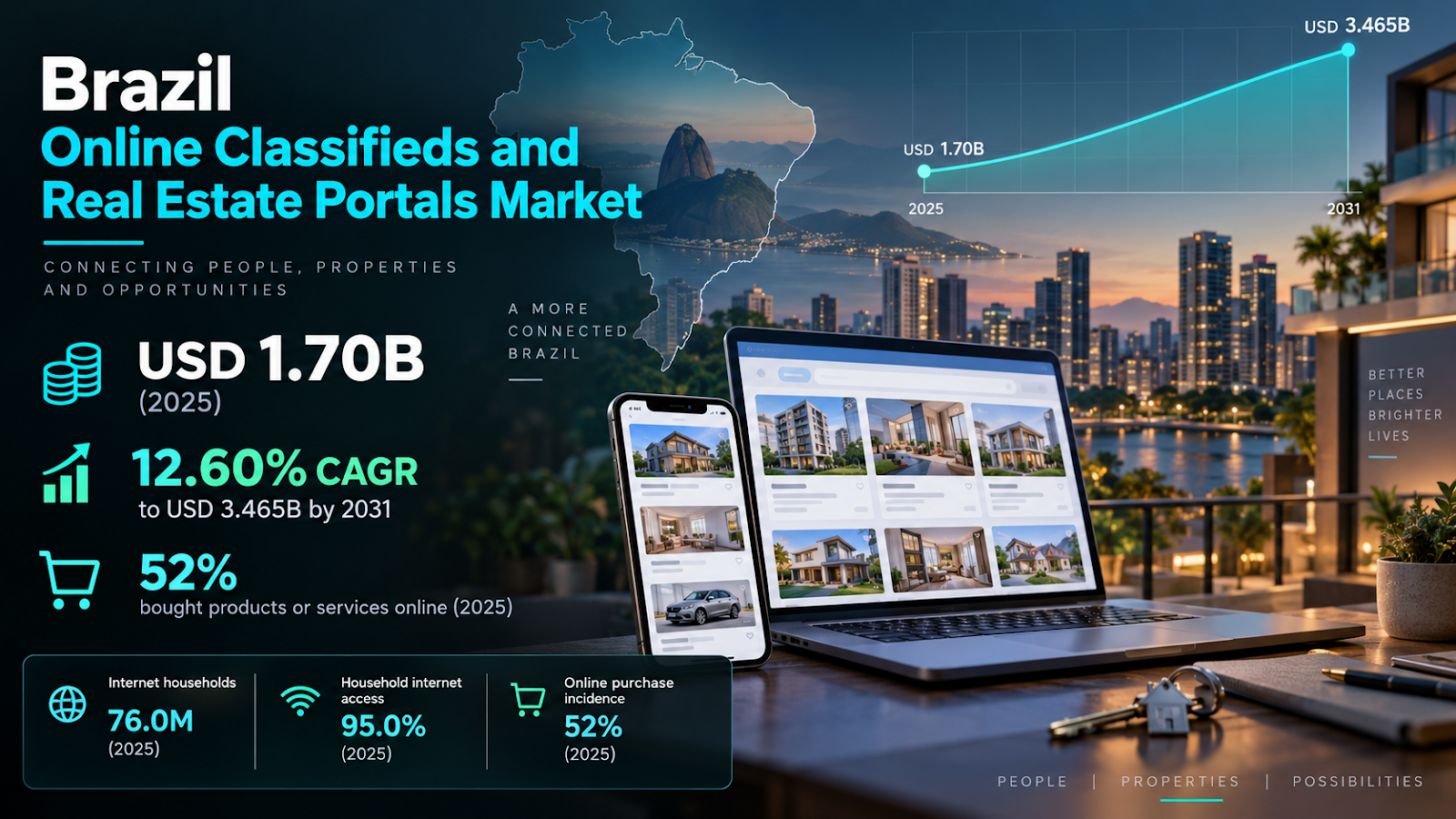
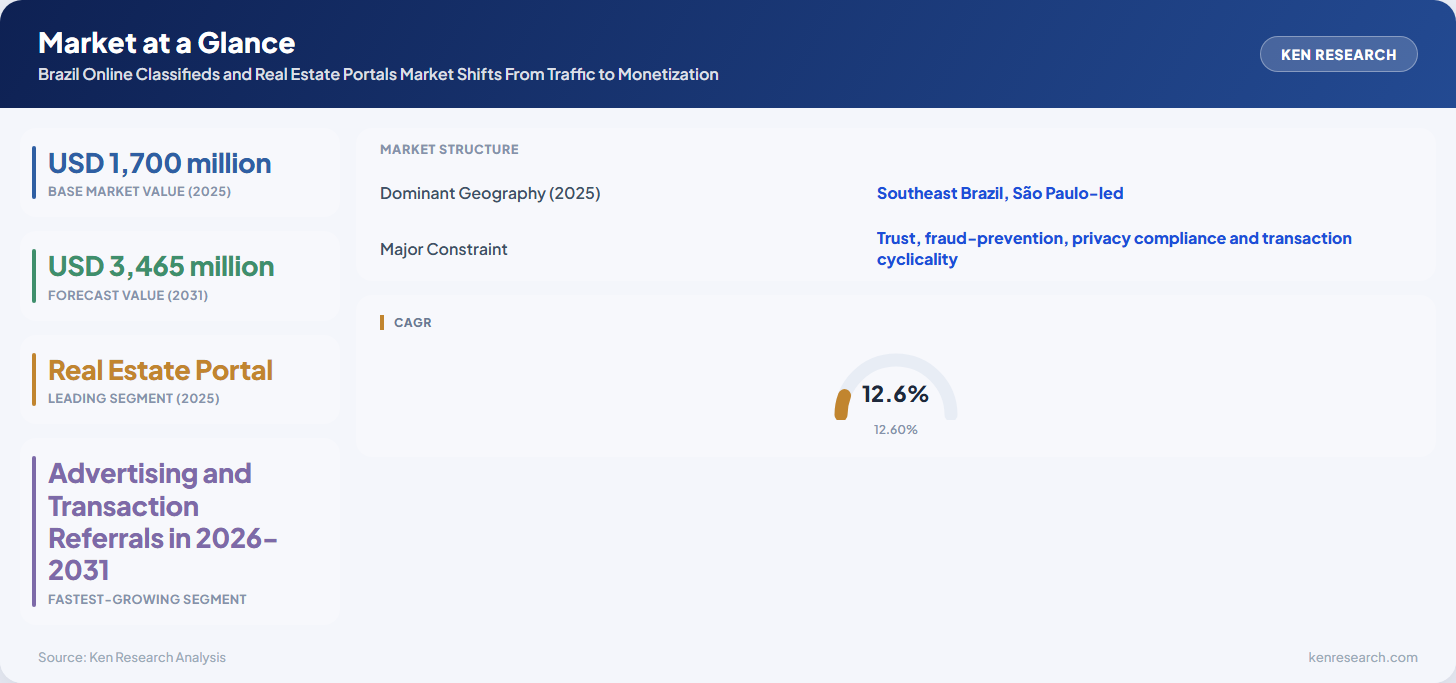
Brazil’s online classifieds and real estate portal economy is entering a phase in which revenue quality matters more than simply accumulating traffic or listings. The latest Ken Research framework values the market at USD 1.70 billion in 2025 and projects it to reach USD 3.465 billion by 2031, implying a forecast CAGR of 12.60%. Real estate portals remain the most commercially important solution category, while Southeast Brazil, led by São Paulo, forms the principal revenue hub.
The mechanism behind that expansion is changing. Brazil already had 168.7 million internet users aged 10 or older in 2025, equivalent to 90.5% of that population. With digital reach already extensive, incremental value increasingly comes from professional subscriptions, premium visibility, verified inventory, qualified leads, analytics, CRM integration and transaction referrals rather than another wave of first-time internet adoption.
The counter-thesis is that better monetization also raises execution requirements. Fraud controls, identity verification, data governance and advertiser ROI must improve while property and vehicle transaction volumes remain exposed to financing cycles. The broader Brazil Online Classifieds and Marketplaces Market shows the same economic direction: platform growth is moving beyond raw digital adoption toward sponsored discovery, subscriptions and higher-value seller services. The scope here is narrower, covering revenue generated by classifieds and portal platforms through subscriptions, paid listings, qualified leads, advertising and transaction referrals rather than the gross value of homes, vehicles or goods advertised through them.
Audience Scale Is Becoming the Baseline, Not the Growth Engine
Connectivity Changes the Monetization Question
Brazil’s digital audience is now sufficiently deep that portal strategy has to move from “How many people can be reached?” toward “How much economic value can be generated from each high-intent search?” The report records 76.0 million internet-enabled households in 2025 and identifies mobile applications as the principal engagement surface. High-frequency mobile access supports alerts, saved searches, instant messaging, location-based discovery and rapid responses to new inventory.
That changes platform economics. When consumers already search digitally, incremental revenue depends more heavily on converting brokers, dealers and other professional advertisers into paying accounts and then expanding wallet share. Premium placement can improve visibility; verified profiles can support trust; analytics can demonstrate lead performance; and CRM integrations can make the portal part of a professional workflow rather than a standalone advertising expense.
The next stage of portal growth is less about acquiring another browser and more about proving that each professional advertiser receives better leads, better workflow and better conversion economics.
Real Estate Portals Have the Deepest Recurring-Revenue Logic
Real estate portals are the market’s leading solution type because property discovery combines high-value transactions with long search journeys and a large professional advertiser base. Brazil’s Sistema Cofeci-Creci reported more than 650,000 registered real estate professionals and 74,000 real estate companies, operating through 27 regional councils. That creates a substantial pool of agencies and brokers for recurring listing plans, lead packages, syndication and workflow software.
Why Property Leads Can Support Higher Yield
A property lead can be monetized at several points: initial listing visibility, promoted positioning, buyer or renter qualification, valuation, financing introductions, documentation and property-management services. The adjacent Brazil Real Estate and PropTech Development Market also identifies property-search platforms and transaction automation as part of Brazil’s wider PropTech adoption, illustrating why portal economics increasingly overlap with workflow and transaction technology.
The commercial implication is that the most defensible portal relationship may no longer be the listing itself. A broker can distribute inventory to several destinations, but integrations, historical lead data, automated valuation, response management and transaction services create more persistent operating relationships. That makes professional productivity a more durable source of recurring revenue than one-off exposure alone.
Revenue Is Moving Closer to the Transaction Outcome
The primary report identifies advertising and transaction referrals as the fastest-growing revenue-model direction. This matters because basic listing fees monetize inventory availability, while lead and referral products monetize intent and, increasingly, measurable outcomes. Financing referrals, insurance partnerships, premium lead routing and transaction assistance can therefore increase revenue without requiring an equivalent increase in portal traffic.
Several revenue layers become strategically important as the market matures:
- Professional subscriptions: recurring packages for agencies, dealers and other commercial advertisers.
- Paid visibility: promoted inventory, featured listings and priority placement for high-value stock.
- Lead products: qualification, routing and pricing tied more closely to commercial intent.
- Workflow software: inventory feeds, CRM integration, analytics, valuation and response management.
- Transaction-adjacent services: financing, insurance, documentation, inspections and other referral opportunities.
The strategic test is attribution. Advertisers will tolerate higher portal spend when they can connect that spend to faster inventory turnover, qualified enquiries, completed visits or closed transactions. Monetization can therefore grow faster than underlying activity, but only when platforms demonstrate incremental value rather than simply charging more for the same visibility.
Sponsored Discovery Links Marketplace Economics With Digital Advertising
Premium listings increasingly behave like performance media. A professional advertiser is buying scarce attention inside a high-intent environment, and the platform can price that attention according to inventory quality, location, competition and probable conversion. This makes search ranking, recommendation systems and audience data commercially important even when the platform does not directly complete the transaction.
The same logic is visible in the Brazil Digital Advertising Market, where measurable inventory, commerce-linked advertising and automated buying are becoming increasingly important sources of value. For classifieds operators, the advantage is context: a consumer searching for an apartment, used vehicle or local service signals an immediate commercial need that can support higher-value sponsored discovery than broad untargeted reach.
AI can deepen this model through better ranking, duplicate detection, automated descriptions, valuation assistance, fraud screening and conversational search. Yet AI only creates commercial value if it improves matching quality or advertiser productivity. Poor recommendations, opaque ranking or low-quality generated content can reduce trust and undermine the same conversion economics the technology is supposed to improve.
Competition Is Shifting From Listing Scale to Trust and Workflow Depth
The report identifies OLX Brasil, QuintoAndar, ZAP Imóveis, Viva Real and Imovelweb among the major participants, with additional competition from vertical specialists such as Webmotors and PropTech-oriented operators such as Loft. The published dataset does not provide verified company market-share percentages, so the commercially relevant question is not an unsupported ranking but what capabilities increasingly separate one platform from another.
What Platforms Increasingly Have to Prove
Competitive differentiation is moving toward inventory liquidity, advertiser retention and measurable outcomes. Important capabilities include verified sellers and properties, fast lead response, accurate search and valuation, integration with professional systems, fraud detection, customer support and evidence that paid products improve conversion. Platforms that combine national traffic with deeply embedded professional tools can create switching costs that a basic listing directory cannot.
This also changes acquisition economics. Consumer reach remains important because advertisers follow demand, but acquiring traffic at any price is insufficient. A platform that spends heavily to generate low-intent sessions may produce weaker advertiser returns than a smaller but highly qualified audience. The strategic objective is therefore liquidity with quality: enough inventory and demand to create choice, combined with enough trust and intent to support premium monetization.
Southeast Brazil Concentrates the Highest-Value Commercial Density
Southeast Brazil, led by São Paulo and Rio de Janeiro, is identified as the dominant geography in the 2025 market framework. The region combines dense property inventory, professional broker networks, automotive dealerships, advertiser budgets and technology businesses. That concentration improves the economics of enterprise sales because platforms can serve large pools of high-value professional advertisers within a relatively dense commercial ecosystem.
National reach still matters. Digital distribution allows listings to be discovered across regions without replicating physical branch networks, while mobile search broadens participation beyond the largest metropolitan areas. The operational challenge is that monetization may not scale uniformly: inventory depth, professional advertiser density, local transaction liquidity and consumer purchasing power can differ materially by geography. A platform therefore needs national technology with locally relevant liquidity rather than assuming that one metropolitan operating model transfers unchanged across Brazil.
Trust and Regulation Are Becoming Product Requirements
As platforms handle identity data, behavioural signals, messages and increasingly transaction-adjacent services, compliance moves closer to the core product. Brazil’s Decree 12.975/2026 framework described by the ANPD added obligations for internet-application providers around proactive action, transparency, risk mitigation and the prevention of digital fraud and online scams. For classifieds businesses, these requirements intersect directly with fake listings, impersonation, payment scams and seller verification.
The cost implication is significant. Stronger controls require identity processes, moderation systems, anomaly detection, reporting mechanisms, privacy governance and operational teams capable of responding to abuse. However, compliance is not purely defensive: verified inventory and safer interactions can also improve lead quality and conversion. Platforms able to turn trust infrastructure into a visible product advantage may recover part of the compliance burden through advertiser retention and higher willingness to pay.
Financing cyclicality remains a separate constraint. Real estate and automotive searches may remain digitally active even when credit becomes expensive, but slower completed transactions can weaken advertiser ROI and transaction-referral income. That creates an incentive to maintain a diversified revenue mix rather than relying solely on fees tied to successful transactions.
What Platform Operators and Investors Should Watch Through 2031
The forecast to 2031 depends on more than continued digital traffic. The most useful indicators are those that reveal whether portals are deepening professional monetization while maintaining trust and transaction quality.
- Paid professional-account penetration: shows whether brokers, dealers and commercial advertisers are moving from occasional listings to recurring plans.
- Revenue per professional advertiser: indicates whether premium placement, analytics, lead products and workflow tools are expanding wallet share.
- Lead-to-transaction conversion: helps distinguish genuine monetization improvement from simple price increases.
- Verified-inventory penetration: provides a practical signal of trust infrastructure and fraud-control maturity.
- Transaction-referral contribution: reveals how far platforms have moved beyond basic listing fees into financing and adjacent services.
- Advertiser retention: tests whether paid products generate enough measurable value to remain recurring expenditure.
- Compliance cost per monetized interaction: indicates whether stronger verification and data governance are creating scalable infrastructure or eroding operating leverage.
Market Outlook: Revenue Quality Determines Whether Growth Compounds
The base case takes Brazil’s online classifieds and real estate portal market from USD 1.70 billion in 2025 to USD 3.465 billion in 2031, at a forecast CAGR of 12.60%. The opportunity is structural: digital discovery is already mainstream, a large professional advertiser pool exists, and high-intent verticals such as property and automotive can support recurring subscriptions, premium placement and transaction-adjacent revenue.
Upside depends on platforms increasing monetization per professional account without weakening ROI. Better lead qualification, verified inventory, AI-assisted matching, CRM integration and financing or service referrals would allow revenue to expand faster than underlying listing activity. The downside case emerges if compliance costs rise faster than monetization, fraudulent inventory damages trust, advertisers resist higher prices or weak transaction conversion makes performance-oriented products harder to justify.
The central business implication is therefore not simply that more classified activity will move online. Much of the discovery journey already has. The larger opportunity is to own more of the professional workflow surrounding that discovery and to price services according to the commercial value they create.
Don’t miss the next the USD 3.465 billion monetization opportunity shift. Ken Research continuously publishes new market intelligence, forecasts and industry analysis. Add Ken Research as a Preferred Source on Google to discover more of our research when your next market question comes up.
Research Basis and Data Status
The primary Ken Research dataset was published in August 2026, uses 2025 as the base year, covers a historical period of 2020–2025 and forecasts 2026–2031. Market values are proprietary estimates of platform revenue and should not be interpreted as government statistics or as the gross transaction value of properties, vehicles or goods advertised through these platforms.
Research Framework
- Desk research mapping classifieds and portal revenue streams.
- Review of the professional advertiser ecosystem and digital transaction indicators.
- Research into platform regulation and compliance conditions.
- Primary interviews with marketplace commercial directors, brokerage owners, automotive dealer managers and marketplace product or growth professionals.
- Validation through 395 respondent interviews.
- Reconciliation of professional-advertiser spending benchmarks, listing and lead economics and relevant demand proxies.
Official digital-access statistics cited in this article are separately sourced from IBGE; professional real estate registration figures are separately sourced from Sistema Cofeci-Creci; and regulatory information is separately sourced from the ANPD. These external statistics provide operating context rather than replacing the proprietary market-sizing model.
Explore the Brazil Online Classifieds and Real Estate Portals Market report for detailed segmentation, competitive coverage, market assumptions and the full 2026–2031 forecast framework.


Comments
Post a Comment