Netherlands Logistics Market Shifts From Freight Volume to Higher-Value Logistics Services
Netherlands Logistics Is Creating More Value From Each Freight Flow: Ken Research Maps the Shift Toward Warehousing, Automation and Integrated Services
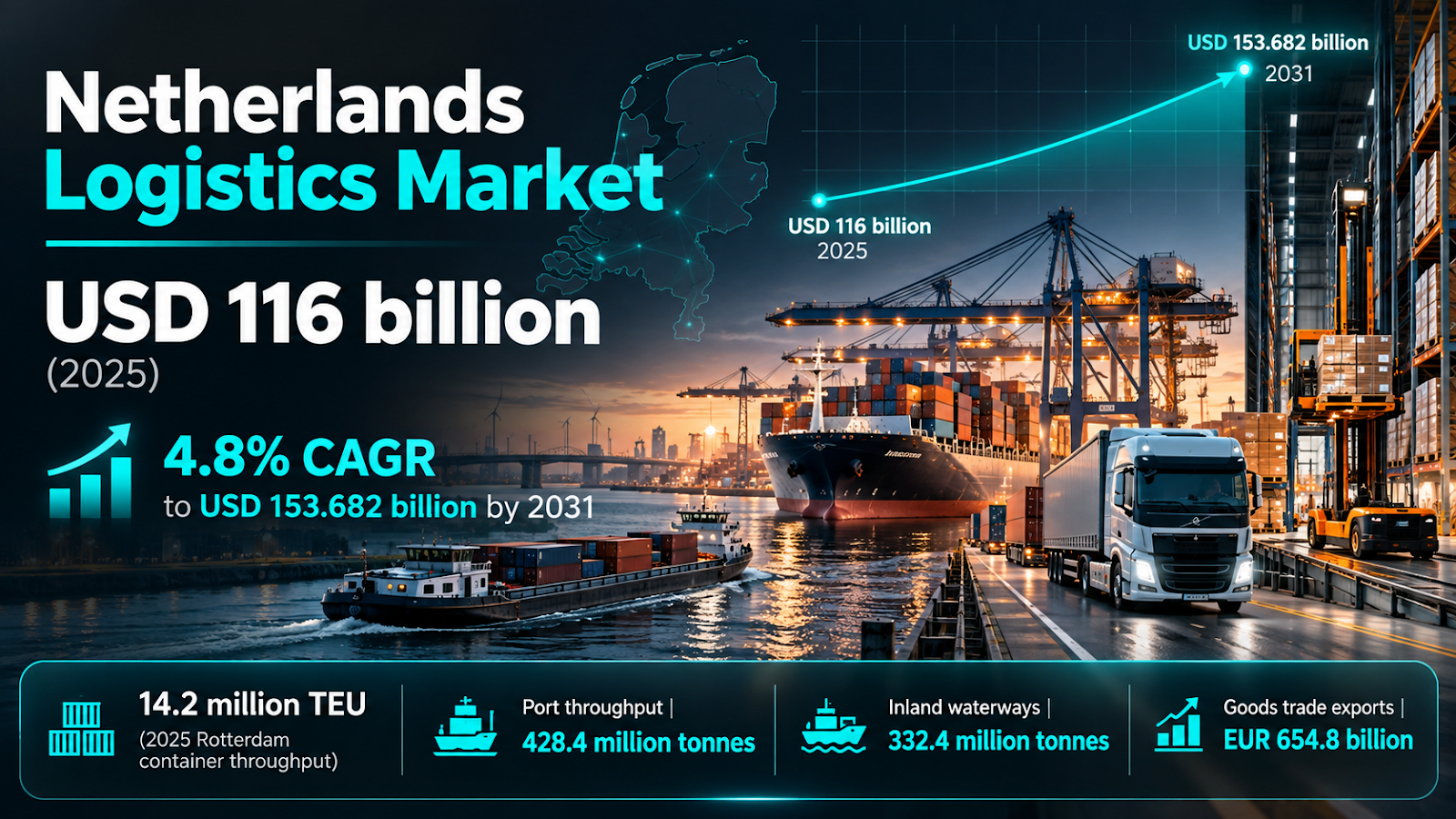
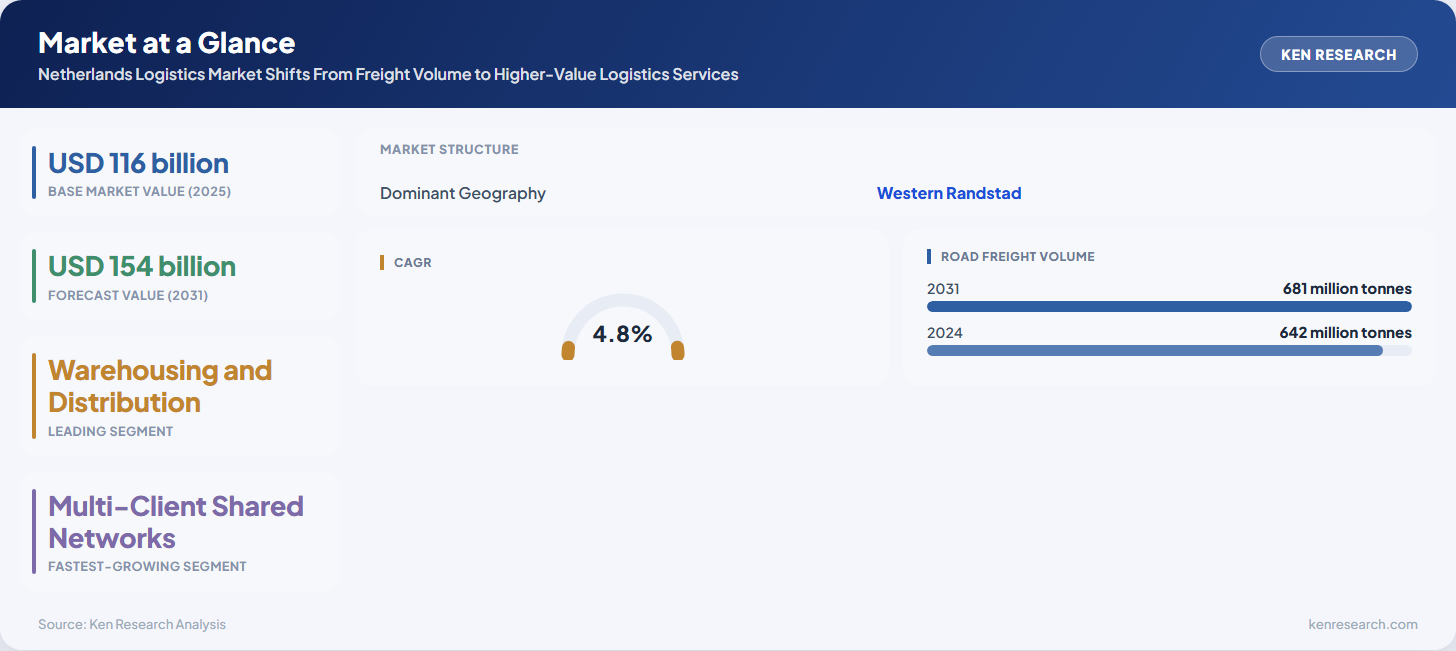
The Netherlands Logistics Market is entering a more disciplined growth phase. Ken Research estimates the market at USD 116 billion in 2025 and projects it to reach approximately USD 154 billion by 2031, implying a 4.8% CAGR over the 2026–2031 forecast period. The commercially important change is not simply more freight: market value is expected to advance faster than physical transport volumes as warehousing, contract logistics, compliance, technology and specialized handling capture a larger share of supply-chain spending.
That distinction matters because the Dutch logistics system already processes exceptionally dense trade flows. The next layer of growth increasingly comes from extracting more services from each shipment through storage, cross-docking, customs orchestration, fulfillment, returns, visibility and multimodal optimization. The market scope covers third-party freight transportation, warehousing, distribution, forwarding, customs brokerage, contract logistics and parcel services, while excluding passenger transport and logistics performed internally by shippers.
The counter-thesis is that rising logistics revenue does not automatically mean easier margins. Labor scarcity, road tolling, fleet decarbonization, electricity-grid constraints and volatile industrial cargo can all raise the cost of delivering service. That tension also increases the strategic relevance of the Netherlands Digital Freight Platforms Market, where freight matching, real-time visibility and route optimization address a growing need to use vehicles, labor and capacity more productively.
Gateway Trade Creates Several Revenue Events From One Cargo Flow
The Netherlands' structural advantage is not merely that large volumes of goods cross its borders. It is that cargo entering or leaving the country can generate multiple commercial transactions: port handling, customs clearance, forwarding, bonded or conventional storage, inland transport, cross-docking, fulfillment and final distribution. This makes trade intensity a more useful indicator of logistics-service potential than domestic consumption alone.
Statistics Netherlands (CBS) reported goods exports of EUR 654.8 billion and imports of EUR 581.9 billion in 2025. Both increased by 1.4% from 2024, while re-exports contributed EUR 7.9 billion of the annual increase in export value. For logistics providers, re-export intensity is particularly valuable because goods routed through the Netherlands can require handling and coordination without depending entirely on Dutch final demand.
Corridor Density Is a Commercial Asset
Road remains indispensable for domestic collection and European distribution, while waterways, rail and deep-sea shipping expand the range of economically viable hinterland options. The primary Ken Research dataset records 642 million tonnes of road freight in 2024 and projects 681 million tonnes by 2031. That is a much slower trajectory than market-value expansion, reinforcing the central thesis that service intensity, pricing and value-added activity increasingly matter more than tonne growth alone.
- Network density: Dense flows improve vehicle utilization, backhaul opportunities and consolidation economics.
- Customs capability: High cross-border and re-export intensity creates recurring demand for documentation and trade compliance.
- Modal optionality: Access to road, waterways, rail and ports allows operators to optimize cost, resilience and emissions.
- Distribution reach: Dutch gateways can serve Belgium, Germany and broader continental Europe rather than relying solely on domestic demand.
Rotterdam Illustrates Why Cargo Mix Matters More Than Headline Tonnage
The Port of Rotterdam demonstrates the difference between volume and logistics intensity. According to the Port of Rotterdam Authority, total throughput declined by 1.7% in 2025 to 428.4 million tonnes, yet container throughput increased by 3.1% to 14.2 million TEU. Container tonnage itself was slightly lower, showing that unit activity and cargo composition can move differently from aggregate tonnage.
That matters commercially because containers often require a wider chain of logistics services than undifferentiated bulk flows. Drayage, depot handling, customs, inventory staging, cross-docking and onward distribution can produce multiple revenue opportunities. By contrast, concentrated exposure to industrial bulk cargo can leave terminals and carriers more vulnerable to changes in manufacturing output, commodity flows or energy demand.
Why Warehousing Is Taking a Larger Share of the Economics
Ken Research identifies Warehousing and Distribution as the market's leading service segment. The mechanism is straightforward: gateway cargo may be transported once over a particular leg, but inventory can generate repeated storage, picking, packing, cross-docking, labeling, returns processing and fulfillment activity. Warehouses therefore create opportunities for recurring service revenue and greater customer integration than commoditized point-to-point haulage.
The economics overlap directly with the Netherlands Smart Logistics Warehousing Market. Published in October 2025, that research values the adjacent market at USD 6.1 billion and highlights automation, AI, IoT, real-time tracking and data-led warehouse management. These technologies matter to the broader logistics sector because labor availability and service-speed expectations make throughput per worker increasingly important.
Multi-Client Networks Change the Utilization Equation
Multi-Client Shared Networks are identified as the fastest-growing business model in the primary report. Instead of allocating an entire warehouse, vehicle pool or technology stack to one shipper, operators can spread infrastructure and labor across several customers. This is especially relevant for SMEs and digital-native retailers that require scalable logistics capacity but cannot justify a dedicated network.
- Asset utilization: Shared facilities can balance peaks across customers and sectors.
- Labor productivity: Automation and shared staffing reduce the dependence of growth on linear headcount expansion.
- Technology economics: WMS, robotics and visibility investments can be amortized across a larger revenue base.
- Customer flexibility: Capacity can scale without requiring every shipper to commit to long-duration dedicated assets.
- Urban compliance: Consolidated flows improve route density when city access becomes more restrictive.
The risk is utilization discipline. Automated or highly specified facilities become expensive when customer volumes fall below plan, integrations are slow or electricity capacity constrains expansion. The winning model is therefore not automation for its own sake, but automation tied to predictable throughput and diversified demand.
Regulation Is Becoming an Operating-Economics Variable
Road transport regulation now affects route economics, fleet decisions and technology requirements directly. The Dutch truck toll system began on 1 July 2026. It applies to Dutch and foreign vehicles in categories N2 and N3 with a maximum authorized mass above 3,500 kg on covered roads, and participating trucks require a functioning onboard unit.
The commercial effect extends beyond the direct per-kilometre charge. Pricing systems need to allocate toll costs correctly; route planning becomes more valuable; empty kilometres become more expensive; and cleaner vehicles can benefit from lower rates. For large operators, technology and network scale can spread those compliance costs. Smaller carriers and subcontractors may face a more difficult capital and administrative transition.
Cost Pressure Can Accelerate Productivity Investment
The primary market forecast assumes that labor, tolling, energy, compliance and automation costs increasingly feed into service rates. That is one reason value growth can outpace physical freight growth. The distinction for investors is important: higher revenue created by cost pass-through is economically different from higher revenue generated through better utilization, more value-added services or stronger customer retention.
Specialized Logistics Creates a Higher-Value Layer
Commoditized transport is not the only growth pool. Food, pharmaceuticals, batteries and other controlled or sensitive products require capabilities that are harder to replicate, including temperature monitoring, traceability, specialized storage, hazardous-goods competence, reverse logistics and regulatory documentation. These services can support longer customer relationships and higher switching costs than basic haulage.
This specialization is visible in the Netherlands Cold Chain & Temperature Logistics Market, published in October 2025 with an estimated value of EUR 4.1 billion. Its demand base includes perishables and pharmaceuticals, while technology-enabled monitoring and stricter product-integrity requirements make operating capability a buying criterion rather than merely transportation price.
The broader implication is that logistics operators can move up the value chain without abandoning transportation. Transport becomes one component of a wider service contract that may also include inventory management, compliance, conditioning, monitoring, fulfillment and returns. The downside is that specialization requires expertise, systems and capital; mistakes can carry higher financial and regulatory consequences.
Competition Is Moving From Fleet Scale to Network Productivity
The Dutch logistics ecosystem contains a large number of operators, but the primary report highlights major international participants including DHL Supply Chain, DSV, Kuehne+Nagel, CEVA Logistics and GXO Logistics. It does not publish reliable company-level market-share percentages on the public page, so these companies should be treated as an unranked major-participant set rather than assigned unsupported positions.
Competition increasingly turns on how effectively providers combine physical networks with operational intelligence. Fleet or warehouse ownership remains important, but density, multimodal procurement, customs competence, warehouse automation, systems integration, specialized-sector expertise and service reliability determine whether scale converts into acceptable returns.
- Integrated operators: benefit when customers want transport, forwarding, warehousing and value-added services from fewer counterparties.
- Technology-enabled providers: can compete through routing, visibility, capacity matching and lower administrative friction.
- Sector specialists: retain defensible positions where food, pharmaceutical, chemical or battery handling requires expertise.
- Regional carriers: can remain competitive through local density and service quality, but face stronger pressure from tolling, labor scarcity and fleet investment.
The Main Risk Is a Cost-Rich Market Without Enough Productivity Growth
A market can expand in nominal value while operator economics weaken. The 2026–2031 forecast therefore needs to be interpreted alongside labor, energy, vehicle, technology and compliance costs. If these costs rise faster than operators can improve utilization or recover pricing, top-line growth will not automatically translate into stronger margins.
Cargo composition creates another risk. Rotterdam's 2025 results showed that total tonnage can decline even when container units improve, while industrial cargo remains exposed to European manufacturing conditions. Inland-waterway economics can also deteriorate when low river levels reduce vessel payloads, shifting some freight toward more expensive alternatives. Grid congestion may simultaneously slow warehouse automation, charging infrastructure and fleet electrification.
- Labor availability: determines whether warehouses and fleets can expand without disproportionate wage or subcontracting inflation.
- Electricity capacity: affects automated facilities, refrigeration and commercial-vehicle charging.
- Industrial demand: influences utilization across bulk transport, terminals and manufacturing-linked logistics.
- River conditions: can change barge economics and modal allocation.
- Capital discipline: matters because automated warehouses and clean fleets require high upfront investment.
What Logistics Decision-Makers Should Watch Through 2031
The most useful indicators are those that distinguish genuine productivity-led value creation from inflation or regulatory cost pass-through. Investors and operators should therefore monitor a combination of freight activity, service mix, capacity utilization and operating constraints rather than market revenue alone.
- Contract-logistics mix: Ken Research projects contract logistics and value-added services to rise from approximately 27% of revenue in 2025 to 31% by 2031; progress toward that mix would signal deeper outsourcing and stronger service intensity.
- Road freight volume: movement from 642 million tonnes in 2024 toward the forecast 681 million tonnes in 2031 will show whether physical demand remains consistent with the market model.
- Rotterdam container activity: continued TEU growth would support forwarding, warehousing and hinterland demand even if aggregate port tonnage remains uneven.
- Shared-network utilization: higher occupancy and throughput are essential if multi-client facilities are to convert fixed automation investment into margin.
- Toll and fleet economics: route costs and vehicle-emission classes will increasingly shape carrier pricing and asset-replacement decisions.
- Labor productivity: automation must generate measurable throughput gains if it is to offset recruitment constraints and wage pressure.
- Grid availability: access to power is increasingly important for warehouses, cold-chain operations and charging infrastructure.
Market Outlook: Growth Becomes More About Revenue Quality Than Freight Quantity
The Netherlands Logistics Market is forecast by Ken Research to advance from USD 116 billion in 2025 to approximately USD 154 billion in 2031. The structural opportunity lies in the country's ability to convert gateway trade into multiple logistics services and then use automation, shared networks and specialized capabilities to raise the value captured from each freight flow.
The upside case requires continued trade connectivity, strong warehouse utilization, successful contract-logistics outsourcing and productivity gains that offset labor and regulatory costs. In that environment, operators can grow faster than underlying freight tonnes by increasing service intensity. The downside case is a market where weak European industrial demand combines with labor shortages, grid constraints, expensive fleet transition and underutilized automated assets.
For strategy teams, that makes the headline CAGR less important than the composition of growth. The strongest businesses will be those that can demonstrate that higher revenue comes from denser networks, recurring services, specialized expertise and better asset productivity—not simply higher costs passed through to customers.
Don’t miss the next Netherlands's logistics is creating more value from shift. Ken Research continuously publishes new market intelligence, forecasts and industry analysis. Add Ken Research as a Preferred Source on Google to discover more of our research when your next market question comes up.
Research Basis and Data Status
The primary dataset is the August 2026 Ken Research Netherlands Logistics Market framework. It uses 2025 as the base year, a historical period of 2020–2025 and a forecast period of 2026–2031. The market-size values, forecast, segment positioning and business-model conclusions cited as Ken Research findings are proprietary research estimates and should not be interpreted as official Dutch government statistics.
Research Framework
The published methodology combines desk research, primary industry engagement and triangulation. Desk research covers Dutch transport turnover, port and airport throughput, freight-corridor policy and operator filings, while primary research includes logistics executives, warehouse operations specialists, freight-procurement managers and port-hinterland planners.
- 286 respondents: published evidence base used in primary research and validation.
- Turnover-volume consistency checks: used to reconcile service revenue with freight activity.
- Modal revenue reconciliation: supports consistency across road, waterway and other logistics modes.
- Peer-market benchmark validation: provides a cross-market reasonableness check.
Official statistics in this article are separately attributed to Statistics Netherlands, the Port of Rotterdam Authority and Dutch truck-toll authorities. Those official figures validate trade, infrastructure and regulatory context; they do not independently constitute or certify the proprietary Ken Research market-size estimate.
Explore the Netherlands Logistics Market report for detailed segmentation, competitive coverage, methodology and forecast assumptions.


Comments
Post a Comment