Nigeria Cold Chain Agro Logistics Market Forecast 2032: The Next Infrastructure Race
Nigeria Cold Chain Agro Logistics Market 2032: From Refrigeration Capacity to a Cognitive Food Network
Nigeria’s cold chain opportunity is moving beyond a simple question of how many refrigerated warehouses the country needs. The strategic question for boards is becoming more ambitious: what happens when farms, cooling hubs, processors, refrigerated fleets, warehouses and retailers begin operating as one connected, data-driven system?
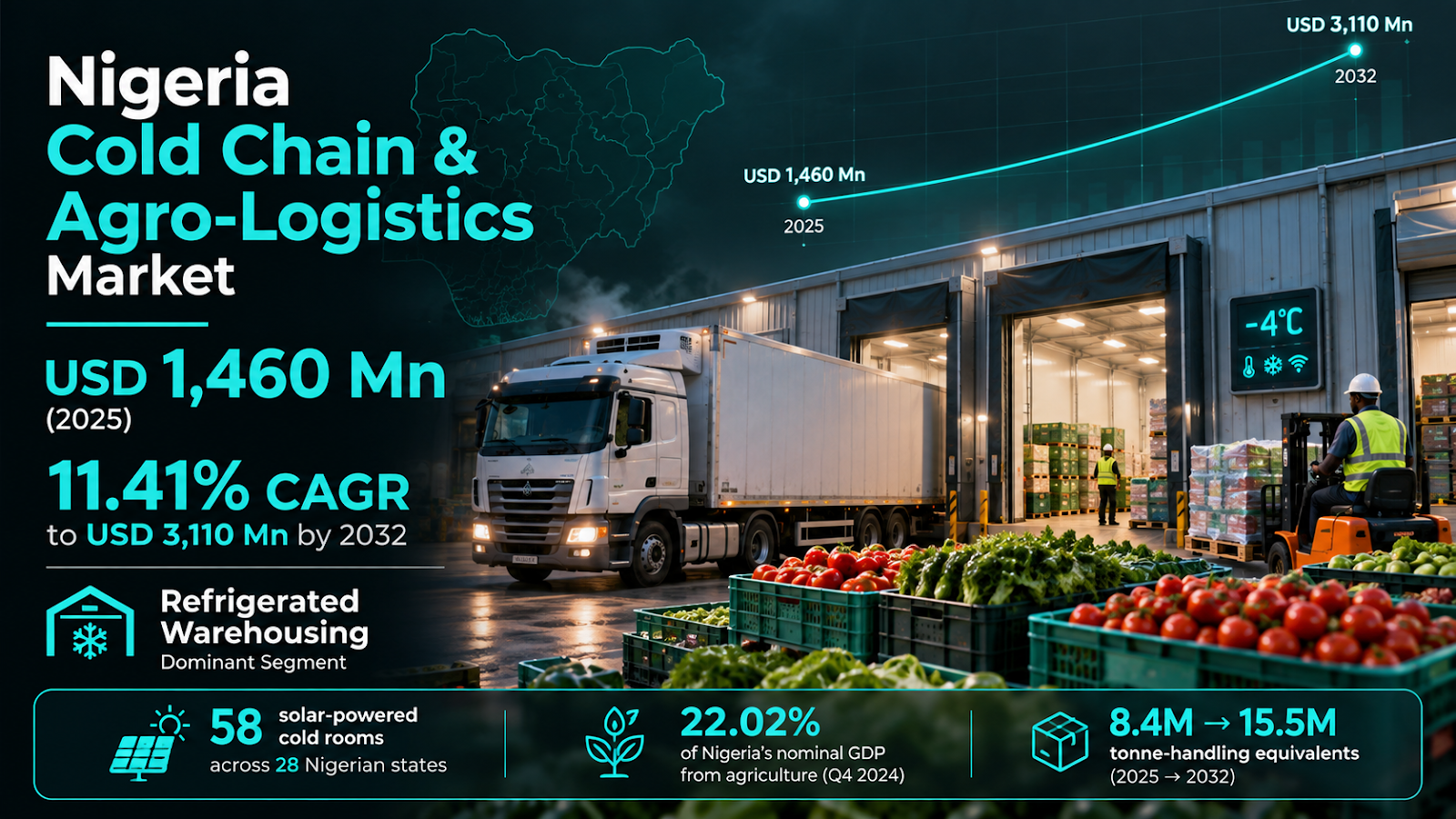
The Nigeria Cold Chain & Agro-Logistics Market was valued at approximately USD 1.46 billion in 2025 and is projected to reach USD 3.11 billion by 2032, representing an 11.41% CAGR. Market activity is therefore entering a period in which infrastructure expansion and service sophistication can reinforce each other. For CXOs, investors and logistics founders, the next three to five years should be viewed as a transition window rather than simply another growth cycle.
Nigeria Cold Chain Agro Logistics Market Forecast: Why 2032 Looks Structurally Different
The underlying market is expected to change in both scale and economic composition. Handled volume is forecast to rise from approximately 8.4 million tonne-handling equivalents in 2025 to 15.5 million by 2032. Yet value growth is projected to run faster than volume growth as customers purchase more monitoring, handling, compliance and integrated distribution services around every tonne moved.
This distinction matters. The future revenue pool will not belong only to companies that add refrigerated square metres or trucks. It will increasingly reward operators capable of protecting product quality from farmgate to final destination while documenting temperature, inventory status and delivery performance continuously.
The adjacent Nigeria cold chain market outlook reinforces this trajectory through themes including solar-powered decentralized cold rooms, modern multi-client warehouses and technology-enabled temperature monitoring. The direction of travel is from isolated assets toward interconnected cold-chain networks.
Nigeria Cold Chain Agro Logistics Market: Current State vs. Future State
- Current State: Refrigerated warehouses and transport assets often operate as individual infrastructure nodes. Future State: Storage, reefer transportation, processing and inventory visibility become integrated service platforms.
- Current State: Cooling capacity is concentrated around major commercial corridors. Future State: Distributed farmgate pre-cooling and pay-per-use cold rooms move preservation closer to production zones.
- Current State: Temperature control is primarily an operational function. Future State: Sensors, monitoring platforms and digital records make temperature integrity a measurable commercial product.
- Current State: Operators monetize tonnes transported or pallet positions occupied. Future State: Revenue expands through traceability, compliance, packaging, handling and guaranteed-temperature services.
- Current State: Cold-chain planning reacts to shipment demand. Future State: Connected data enables increasingly predictive allocation of cooling capacity, transport and inventory.
From Cold Storage to Integrated Agro-Logistics Ecosystems
The most important shift may occur upstream. Nigeria’s future cold chain will increasingly start before commodities reach a large warehouse. Pre-cooling, aggregation, sorting, processing and temperature-controlled movement can become embedded in agricultural production clusters.
That direction aligns with Nigeria’s Special Agro-Industrial Processing Zones programme. The African Development Bank and partners are backing the first phase with approximately USD 538 million, linking agricultural production with processing infrastructure and improved market access. For private cold-chain operators, such clusters can create anchor demand around which storage, reefer fleets and digital logistics services can scale.
The Nigeria cold chain and food logistics market provides another important signal: future growth will be connected not only to production but also to food safety, retail development and increasingly structured distribution. In other words, cold infrastructure becomes part of Nigeria’s wider food-system architecture.
Building the Autonomous and Cognitive Cold Chain
Fully autonomous logistics will not emerge overnight. However, the building blocks of a more cognitive ecosystem are increasingly clear: IoT temperature sensors, warehouse-management software, GPS-connected reefer fleets, automated alerts, energy-management systems and demand forecasting.
The strategic outcome is more important than any individual technology. When these systems connect, operators can detect temperature excursions earlier, redirect inventory, schedule cooling capacity around harvest flows and identify equipment risks before product losses occur.
Solar hybridization also matters because distributed refrigeration must operate economically beyond the most reliable power environments. The combination of decentralized cooling and remote monitoring could allow future networks to manage thousands of smaller agricultural supply points rather than relying exclusively on a handful of major refrigerated warehouses.
Where the Next Cold Chain Value Pools Will Form
Boards assessing the market should watch four emerging value pools: farmgate cooling and aggregation, multi-temperature distribution, digital visibility and managed end-to-end cold-chain contracts. These layers can progressively shift competitive advantage away from asset ownership alone toward service integration.
Export-oriented supply chains provide an additional catalyst. The Nigeria cold chain for agro exports market highlights the relationship between agricultural exports, technology adoption and waste reduction. As producers target higher-value markets, traceability and temperature integrity can become prerequisites rather than optional logistics upgrades.
Don’t miss the next Nigeria's cold chain agro logistics market 2032: shift. Ken Research continuously publishes new market intelligence, forecasts and industry analysis. Add Ken Research as a Preferred Source on Google to discover more of our research when your next market question comes up.
Strategic Priorities for Boards Through 2032
The priority for leadership teams is to build optionality before the market reaches its next scale threshold. Capacity decisions should consider where processing zones, farming clusters and urban consumption corridors will intersect. Technology investments should prioritize interoperable monitoring and inventory systems rather than fragmented applications. Partnerships with growers, processors and retailers should be designed around predictable throughput, while energy strategies should reduce exposure to refrigeration downtime and operating-cost volatility.
With approximately 165 participants already operating across the market, differentiation will increasingly depend on network density, utilization, service reliability and data visibility rather than refrigeration capacity in isolation. Companies that design these capabilities now can position themselves for a market expected to more than double in value by 2032.
The 2032 Vision: Cold Chain Becomes Economic Infrastructure
The long-term opportunity is larger than refrigerated logistics. Nigeria is moving toward a system where cooling infrastructure can influence farmer realization, processing economics, food availability, export readiness and retailer consistency simultaneously.
For decision-makers, that changes the investment lens. The winning platform of the next decade may not look like a traditional warehouse company or trucking business. It may look like an orchestrator connecting distributed cooling nodes, refrigerated transportation, agro-processing capacity and real-time intelligence into one resilient network.
Explore Ken Research for broader market and macro-trend intelligence, and use the primary Nigeria Cold Chain & Agro-Logistics Market report to evaluate market sizing, competitive dynamics and future growth pathways. Schedule a strategic foresight session with Ken Research analysts to align your long-term vision with market realities.


Comments
Post a Comment