Pasted text Brazil Digital Banking & Open Finance Market Shifts From Access to Monetization
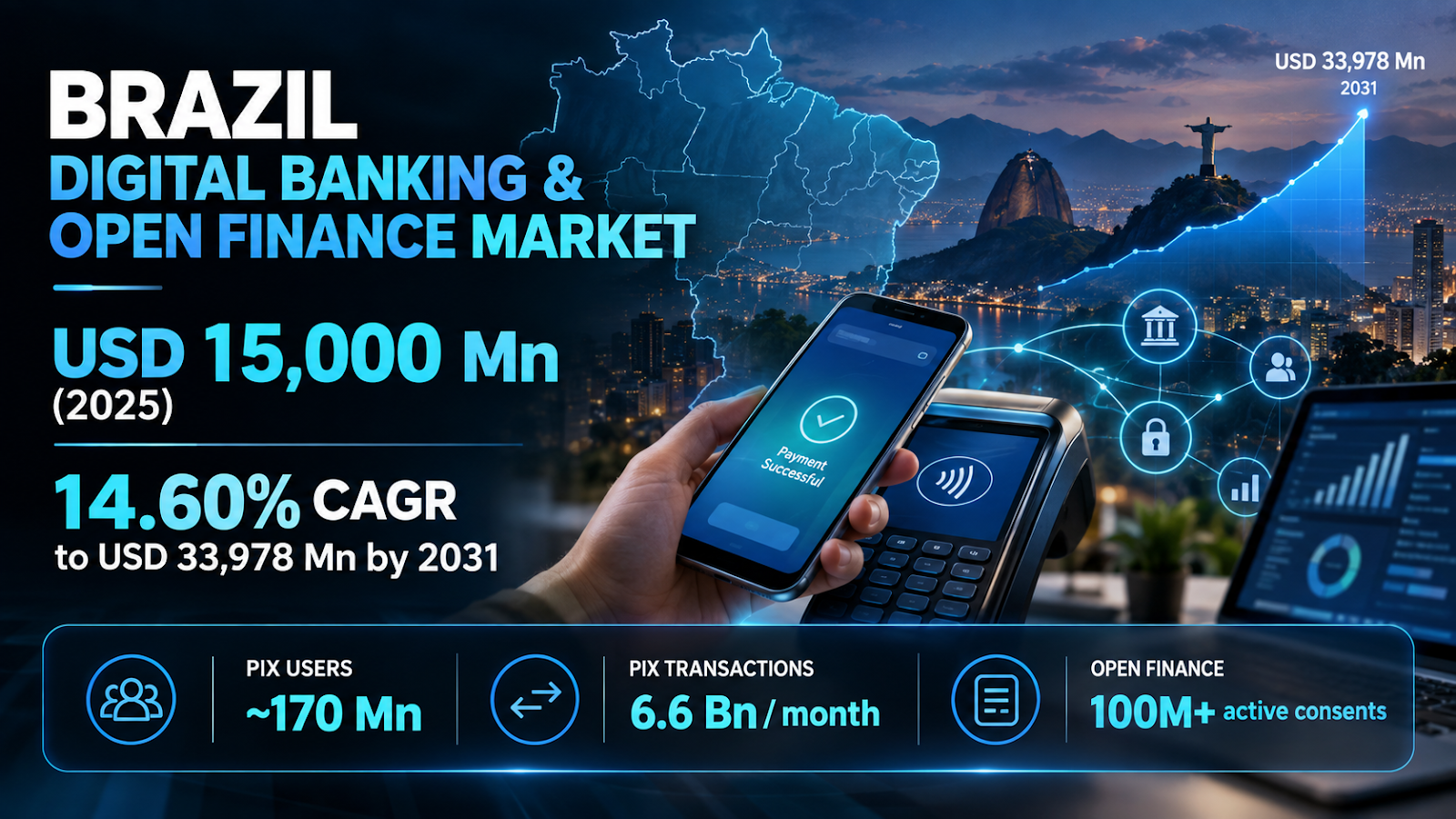
Brazil’s Digital Finance Scale Is No Longer the Story: Ken Research Maps the Race to Monetize Consent, Credit and APIs
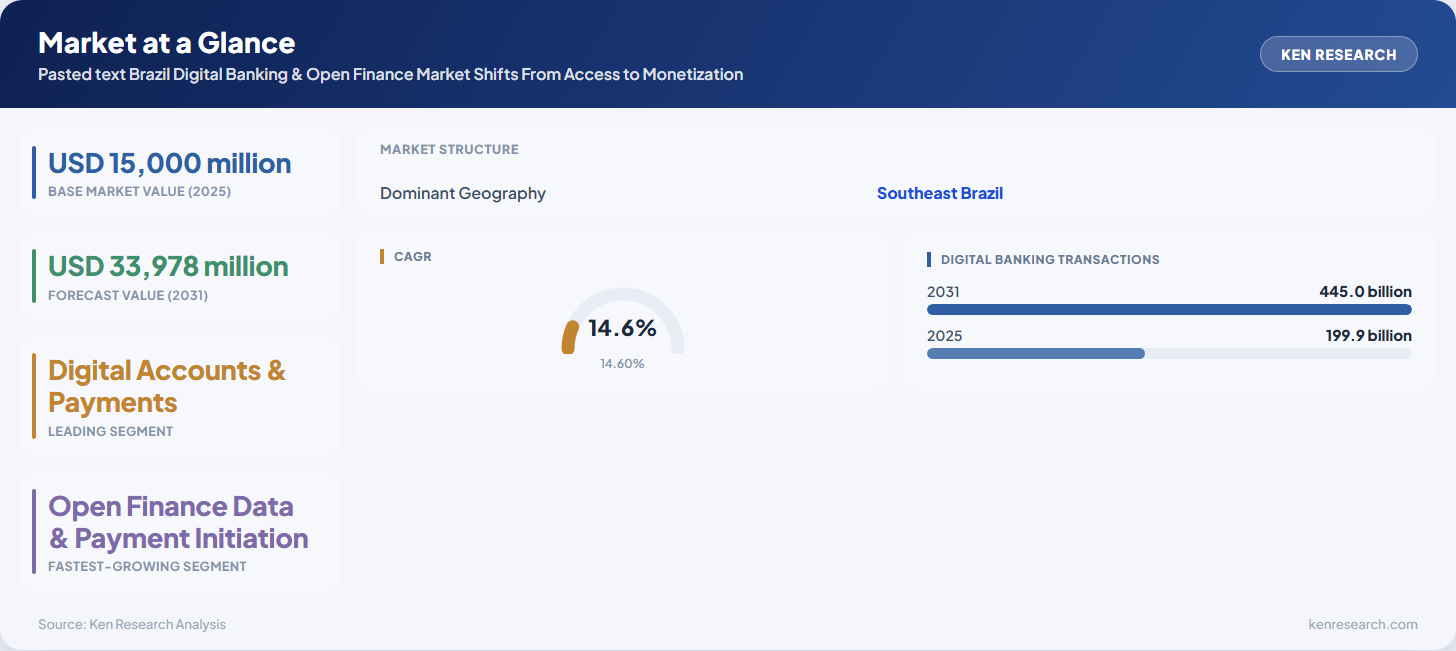
Brazil’s digital banking and Open Finance market is moving from a land-grab for digital access toward a tougher commercial test: converting transaction intensity and permissioned data into durable revenue. Ken Research estimates the market at USD 15,000 million in 2025, with value projected to reach USD 33,978 million by 2031 at a 14.60% CAGR. The question is no longer whether consumers will bank digitally, but which institutions can turn that scale into primary relationships, better underwriting and deeper product economics.
The mechanism is visible in the operating rails. Modeled digital banking transactions rise from 199.9 billion in 2025 to 445.0 billion by 2031, while Open Finance allows consented account and transaction data to move between regulated institutions. That combination makes payments an engagement layer, data a decisioning asset and APIs a distribution channel. The report’s revenue scope covers digital accounts and payments, digital credit, digital investment services and Open Finance-enabled financial services while excluding deposit balances, loan principal and securities assets under management.
Scale, however, does not guarantee attractive returns. Funding costs, fraud, credit deterioration, API failures and weak consent governance can absorb the economics created by higher digital activity. The August 2026 Brazil FinTech Online Lending and Credit Platforms Market provides an important adjacent signal: as digital lending matures, growth increasingly depends on underwriting selectivity, funding discipline and credit utilization rather than borrower acquisition alone. The same logic applies to digital banking—scale matters when it improves risk-adjusted customer lifetime value.
Digital Scale Is Becoming a Monetization Test
The market’s historical expansion reflects a period when moving consumers onto digital channels created value almost by itself. The modeled market increased from USD 6,200 million in 2020 to USD 15,000 million in 2025, equivalent to a historical CAGR of approximately 19.33%. As digital access becomes mainstream, repeating that growth through new-account acquisition alone becomes harder. Future value creation therefore depends more heavily on what institutions earn from an active relationship after onboarding.
This changes the internal economics of digital banking. High-frequency payments can strengthen primary-account behavior, improve cash-flow visibility and create more opportunities to distribute credit, investments, merchant products and premium services. Open Finance can add data from relationships held elsewhere, potentially improving personalization and underwriting. The advantage shifts from having an app to operating an ecosystem capable of converting activity into appropriately priced products at low servicing cost.
What Converts Activity Into Economics
- Primary-account status: frequent salary, payment and transfer activity can support deposits and a richer behavioral data set.
- Risk-adjusted credit: digital distribution is commercially valuable only when underwriting quality and funding economics support sustainable margins.
- Merchant relationships: acquiring, working-capital products and cash-flow tools can widen monetization beyond consumer banking.
- Wealth and protection: investments, insurance and premium services can raise product penetration without requiring another customer-acquisition cycle.
- API distribution: embedded journeys can put financial products inside commerce, software and third-party platforms rather than forcing every interaction through a proprietary banking app.
This earnings transition also appears in the August 2026 Brazil Digital Banking and FinTech Apps Market. That adjacent framework explicitly moves the growth argument away from account openings toward primary-account status, deposits, underwriting quality, transaction engagement and cross-sell conversion. For operators, this means market share measured only by registrations can be less informative than activity, product penetration and revenue per engaged relationship.
Open Finance Is Turning Consent Into a Distribution Asset
Open Finance is strategically important because it can weaken information advantages that once depended on a customer keeping most financial activity at one institution. According to the Banco Central do Brasil, the ecosystem had reached 103 million active data-sharing authorizations involving 68 million accounts by its 2025 milestone. The central bank also reported that R$31 billion in credit operations had originated from analysis of Open Finance data through June 30, 2025.
The commercial impact extends beyond data aggregation. Pix transactions initiated through Open Finance increased from roughly 546,000 in July 2024 to 4.7 million in July 2025. That progression matters because it moves Open Finance from passive information exchange toward transaction origination. Banks, fintechs and merchants can increasingly compete over the point where a customer compares an offer, authorizes data, receives a decision and initiates a financial action.
Credit Portability Raises Both Opportunity and Price Pressure
The regulatory architecture continues to evolve. Instrução Normativa BCB nº 759/2026, published on July 9, 2026, introduced version 8.0 of the Open Finance Data and Services Scope Manual and added scope related to credit portability. The normative text is scheduled to take effect on November 3, 2026. If implementation lowers refinancing friction as intended, institutions may gain a larger pool of addressable borrowers while simultaneously facing more transparent price competition.
That makes three operating capabilities particularly valuable: reliable consent journeys, data quality sufficient for rapid decisioning and API infrastructure capable of handling critical customer flows without degrading conversion. Open Finance therefore creates an opportunity for new distribution, but it also raises the cost of weak technology execution.
Pix Makes Payments Ubiquitous—and Monetization Harder
Pix has normalized immediate, app-led money movement at national scale. The Banco Central do Brasil Pix statistics show more than 170 million individual users, equivalent to around 80% of the population, while more than 7 billion Pix transactions were recorded in January 2026. For digital banks, this is powerful infrastructure: customers already understand the behavior, the network is broadly accepted and transaction frequency creates repeated opportunities for engagement.
But ubiquity also makes basic payments harder to defend as a standalone source of differentiation. When instant transfers become expected infrastructure, providers need to monetize what surrounds the payment—deposits, merchant acquiring, working capital, consumer credit, wallets, investments, subscriptions and contextual financial services. The competitive question shifts from who can execute a transfer to who can use the transfer relationship to create broader economic value.
The August 2026 Brazil Digital Wallet & Superapps Ecosystem Market provides a complementary view of this transition. Its outlook increasingly ties value creation to merchant acceptance, recurring payments, embedded credit and multi-product cross-selling rather than charging users for simple transfers. For banks and fintechs, that makes payment frequency a strategic input rather than the end product.
Competition Is Moving Up the Stack
The competitive field spans universal banks, digital-only banks, payment institutions and fintech platforms. The primary report identifies participants including Nubank, Itaú Unibanco, Banco do Brasil, Bradesco, Santander Brasil, Banco Inter, C6 Bank, PagBank, Mercado Pago and PicPay. Publicly available report data do not provide reliable company-level market-share percentages for this revenue scope, so these institutions are better treated as an unranked participant set rather than a definitive league table.
What increasingly separates competitors is not the ability to offer a digital account, but the economics underneath it. Large balance-sheet institutions may have advantages in deposits, funding and product breadth, while digital challengers can benefit from lower-cost servicing, focused user experiences and faster product iteration. Payment-led platforms can add merchant distribution and commerce data. Open Finance reduces some information barriers between these models, but it also makes execution quality more visible.
- Funding efficiency: determines how aggressively credit can be priced without sacrificing returns.
- Underwriting capability: converts richer transaction data into better risk selection rather than simply more approvals.
- API reliability: increasingly affects conversion when products are distributed through partners and Open Finance journeys.
- Fraud controls: protect the economics created by high transaction frequency.
- Cross-sell depth: determines whether a low-revenue account develops into a multi-product relationship.
- Customer activity: matters more than registrations when transaction frequency is the foundation for monetization.
The Southeast Leads, but Digital Economics Are National
The Southeast remains the report’s dominant geography because it concentrates major bank headquarters, fintech operators, enterprise buyers, technology talent and capital-market infrastructure. São Paulo in particular provides a dense ecosystem for partnerships, product development and senior financial-services talent. That concentration can accelerate innovation and commercial deal-making even when the end customer is located elsewhere in Brazil.
Digital distribution nevertheless weakens the traditional link between headquarters location and customer reach. A mobile-first bank can serve customers nationally without replicating a branch network at the same intensity as legacy distribution. The strategic implication is that the Southeast may remain the operating center of gravity while incremental customer growth, credit demand and merchant acquisition are geographically broader. Providers therefore need centralized technology scale combined with risk models, customer support and product design that work across diverse regional income and business conditions.
The Counter-Thesis: Scale Can Grow Faster Than Risk-Adjusted Returns
The bullish case rests on rising transaction activity, deeper Open Finance usage and broader product monetization. The counter-thesis is that each of those mechanisms creates a corresponding operating burden. More credit can increase losses if underwriting deteriorates. More APIs can increase operational dependencies. More payment frequency creates a larger fraud surface. More permissioned data raises the consequences of weak governance, authentication or access controls.
Investors and operators should therefore distinguish gross digital activity from economically productive activity. A platform can add transactions without improving margins if payments are commoditized, add borrowers while weakening credit quality, or add Open Finance connections without converting consent into valuable products. The strongest business models will be those capable of scaling engagement and controls together rather than treating risk infrastructure as a cost to be addressed after growth.
- Credit and funding risk: rapid lending expansion can lose value when acquisition outruns risk-adjusted pricing.
- Fraud and cyber risk: instant payments increase the importance of real-time detection, transaction tracing and response.
- Consent and privacy risk: Open Finance depends on customer authorization, secure data handling and clear governance.
- Operational resilience: API outages can disrupt customer journeys distributed across multiple institutions and partners.
- Margin compression: easier comparison and portability can benefit customers while intensifying pricing competition among providers.
What Banks, FinTechs and Investors Should Watch Through 2031
The forecast should be monitored through indicators that reveal monetization quality rather than digital reach alone. The most useful signals will show whether transaction scale, data portability and embedded distribution are producing better customer economics without weakening risk controls.
- Consent-to-product conversion: whether Open Finance authorizations translate into credit, investment, payment or financial-management activity.
- Payment-initiation volumes: whether Open Finance develops into a meaningful transaction-origination channel rather than remaining primarily a data-sharing layer.
- Revenue per active relationship: whether cross-selling is growing faster than the cost of servicing and acquiring customers.
- Credit-loss and funding trends: whether digital lending growth remains attractive after risk and cost of capital.
- API uptime and conversion: whether embedded and Open Finance journeys remain reliable enough to support commercial-scale distribution.
- Fraud-loss intensity: whether higher payment frequency can scale without disproportionate losses or customer friction.
- Primary-account behavior: whether providers capture deposits, salary flows and recurring usage rather than becoming secondary apps in a multi-banked customer base.
Market Outlook: Growth Depends on Monetization Quality
The base forecast remains structurally attractive. Ken Research projects the Brazil Digital Banking & Open Finance Market to rise from USD 15,000 million in 2025 to USD 33,978 million in 2031, representing a 14.60% CAGR. Modeled digital banking transactions more than double over the same horizon, reaching approximately 445.0 billion by 2031. The central commercial opportunity is therefore not simply digital adoption; it is the ability to attach higher-value products to already-digital financial behavior.
The upside case strengthens if Open Finance improves underwriting and distribution, payment initiation gains wider usage, embedded finance expands and institutions convert transaction frequency into deposits, credit and service revenue. The downside case emerges if funding pressure, fraud, privacy failures, weak API reliability or aggressive credit competition consume those gains. By the end of the forecast period, the market’s strategic winners are likely to be defined less by who accumulated the most accounts and more by who built the strongest economics around active, permissioned and multi-product customer relationships.
Don’t miss the next to monetize consent, credit and apis shift. Ken Research continuously publishes new market intelligence, forecasts and industry analysis. Add Ken Research as a Preferred Source on Google to discover more of our research when your next market question comes up.
Research Basis and Data Status
The primary market model used here is the August 2026 edition of the Brazil Digital Banking & Open Finance Market report. It uses 2025 as the base year, covers a historical period of 2020–2025 and forecasts 2026–2031. The market values, transaction forecasts, growth rates and segment interpretations attributed to Ken Research are proprietary estimates and should not be presented as official Brazilian government statistics.
The published methodology combines desk research covering Banco Central frameworks, digital transaction volumes, Open Finance adoption and institution disclosures with primary research involving banking executives, Open Finance product leaders, payments and credit directors and API engineering managers. The report states that 390 respondent observations were cross-validated, institution revenue pools were benchmarked independently, transaction volumes were reconciled with adoption data and forecast assumptions were tested across scenarios.
Research Framework
- Banco Central regulatory-framework assessment
- Digital transaction and Open Finance adoption analysis
- Bank and fintech disclosure review
- Primary interviews with relevant financial-services and technology stakeholders
- Revenue-pool benchmarking and transaction-volume reconciliation
- Scenario testing and forecast validation
Official statistics cited separately in this article come from the Banco Central do Brasil and are identified as such. They provide external context for Pix, Open Finance adoption and regulatory implementation; they are not substitutes for the proprietary market-sizing model.
Explore the Brazil Digital Banking & Open Finance Market report for detailed segmentation, competitive coverage, market modeling and forecast assumptions.


Comments
Post a Comment