Poland Renewable Hydrogen and Fuel Cells Market Shifts From EPC Spend to Recurring Offtake
Poland’s Renewable Hydrogen Market Is Leaving the Construction Phase: Ken Research Maps the Shift Toward Contracted Offtake and Utilized Infrastructure
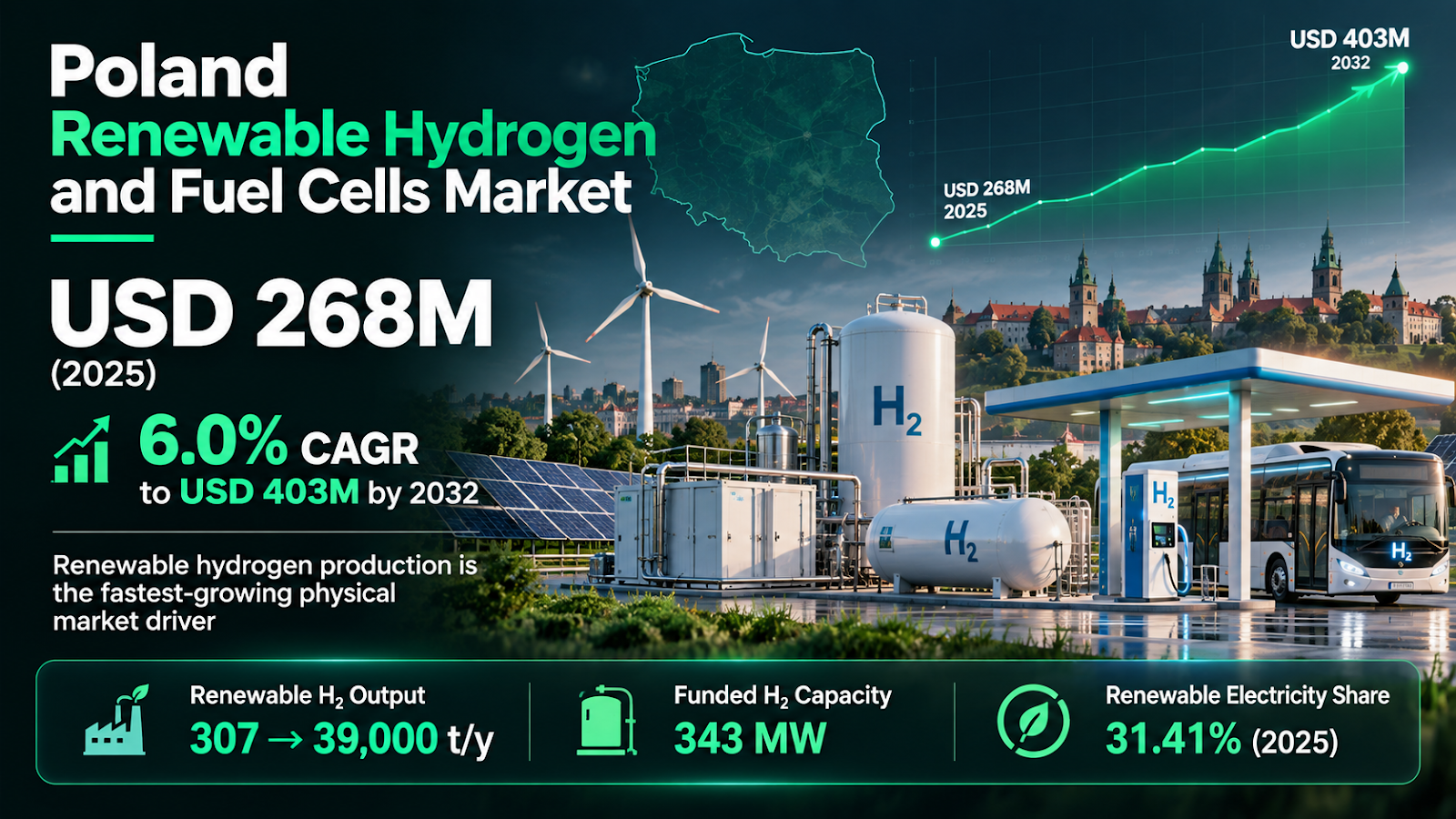
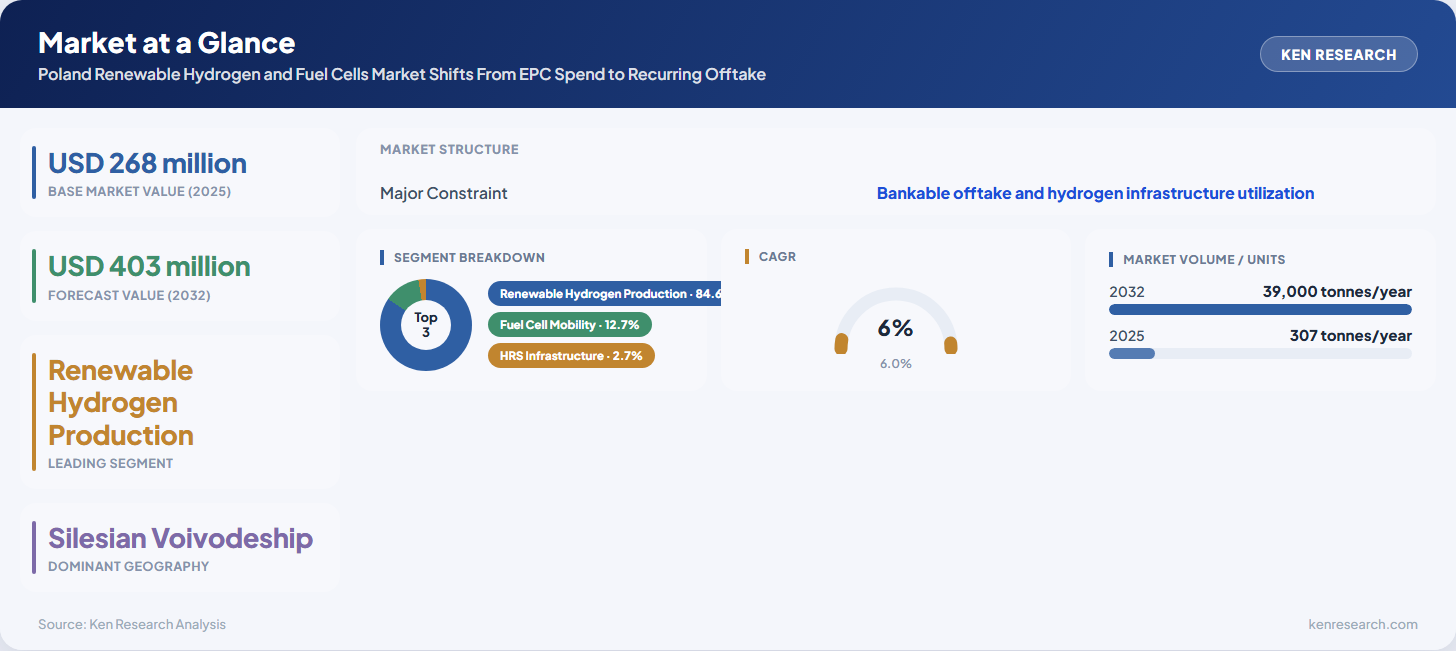
The Poland Renewable Hydrogen and Fuel Cells Market is entering a commercially different phase. The August 2026 model from Ken Research values the market at USD 268 million in 2025 and projects it to reach USD 403 million by 2032, representing a 6.0% forecast CAGR. The important story, however, is not simply the increase in value: the revenue pool is moving away from unusually heavy project-development, electrolyser and EPC expenditure toward commissioned hydrogen production, contracted offtake, refuelling and lifecycle services.
That transition explains why physical activity can accelerate much faster than headline market value. The proprietary model moves renewable-hydrogen output from approximately 307 tonnes per year in 2025 to 39,000 tonnes per year by 2032, while the modeled hydrogen-bus fleet rises from 140 units to 820 units. The study covers renewable-hydrogen production and offtake, electrolyser and plant EPC, hydrogen-refuelling infrastructure and O&M, and fuel-cell vehicle and system integration across industrial and mobility applications.
The counter-thesis is execution. Electrolysers do not create an attractive hydrogen economy unless renewable electricity, certification, customers, storage, distribution and infrastructure utilization develop in parallel. The adjacent Poland Smart Grid & Energy Storage Market provides useful context because Poland’s wider energy transition is simultaneously increasing the importance of grid flexibility, renewable integration and storage—the same operating environment in which large electrolyser projects must secure reliable power.
A Construction-Heavy Base Changes How the 6.0% CAGR Should Be Read
The market’s historical acceleration was exceptionally capital intensive. Ken Research estimates that value increased from USD 50 million in 2020 to USD 268 million in 2025, equivalent to a reconstructed historical CAGR of 39.9%, with the base year itself recording an estimated 56.7% increase. That surge reflects funding decisions, plant engineering, electrolyser procurement, construction and hydrogen-mobility assets rather than an equivalent increase in commercially sold renewable hydrogen.
Construction revenue is front-loaded
This distinction is visible in the report’s reconciled 2025 supply-side mix. Renewable Hydrogen Production, which in this framework includes project construction and early hydrogen sales, represented approximately 84.6% of segment value; Fuel Cell Mobility represented about 12.7%; and HRS Infrastructure contributed roughly 2.7%. As large projects move from development into operation, the commercial questions change from equipment delivery and construction timing toward utilization, power cost, plant availability, hydrogen pricing and contract duration.
The funded pipeline helps keep project activity substantial. The market framework identifies 343 MW of zero-, low-emission and RFNBO hydrogen capacity across 5 projects supported through Poland’s recovery-plan mechanism. For equipment vendors and EPC contractors this creates an identifiable delivery pool, but for investors the more important metric is how much funded capacity reaches final investment decision, commissioning and stable utilization.
Industrial Compliance Can Turn Hydrogen Demand Into Contracted Revenue
Industrial demand has the strongest potential to change the quality of future revenue. Under Directive (EU) 2023/2413, renewable fuels of non-biological origin are required to represent at least 42% of qualifying hydrogen use in EU industry by 2030, rising to 60% by 2035, subject to the directive’s detailed calculation rules and flexibility provisions. That makes certification, renewable-power sourcing and traceability economically relevant capabilities rather than sustainability add-ons.
The potential demand pool is also much larger than Poland’s currently operating renewable-hydrogen base. GAZ-SYSTEM’s Hydrogen Map of Poland assessed 178 complete projects and recorded respondent-declared hydrogen consumption of 1.27 million tonnes for 2030, together with an indicative domestic supply deficit of around 0.8 million tonnes. These are non-binding participant declarations rather than a national forecast, and GAZ-SYSTEM notes that many projects remain at preliminary stages, but the exercise reveals where potential industrial demand and infrastructure needs are accumulating.
Offtake becomes finance infrastructure
For producers, long-term industrial contracts can therefore do more than generate sales. Bankable offtake can support project financing, reduce exposure to merchant hydrogen prices, justify renewable-power procurement and give storage or transport infrastructure a clearer utilization case. Refiners, chemical producers and other hard-to-abate industrial users may consequently become more strategically important than highly visible pilot applications if they can commit to sufficient volumes and contract duration.
Power Access and Colocation Will Decide Which Projects Convert
Hydrogen production economics are inseparable from electricity economics. The primary market model records Poland’s renewable share of electricity generation increasing from 17.83% in 2020 to 31.41% in 2025, improving the structural supply base for low-carbon electrolysis. Yet developers still need qualifying renewable electricity at the right location, price profile and operating hours; nominal renewable capacity alone does not guarantee competitive hydrogen.
Broader investment in the Poland Renewable Energy and Solar Rooftops Market adds context to this supply-side requirement. Continued solar and wind expansion can deepen the renewable-power pool available to electrolysers, but hydrogen developers must compete with other electricity users and manage intermittency, grid constraints and the cost of firming supply.
Silesia is the clearest commercial test bed
The primary report identifies Silesian Voivodeship as the dominant geography because industrial demand, municipal mobility and prospective hydrogen production can be colocated. Polenergia’s H2Silesia project is designed around approximately 105 MW of electrolysis capacity and roughly 13,000 tonnes per year of hydrogen, illustrating the scale at which a regional hub can begin aggregating industrial buyers, infrastructure and supply.
This hub logic is consistent with the official Polish Hydrogen Strategy, whose 2030 reference points include 2 GW of low-carbon hydrogen-production capacity, 800–1,000 new hydrogen buses, at least 32 hydrogen refuelling and bunkering stations and at least 5 hydrogen valleys. Commercial success will depend less on achieving isolated asset counts than on connecting those assets into functioning demand clusters.
Mobility Gives Hydrogen Visibility, but Battery Economics Set the Hurdle Rate
Public transport remains one of the clearest demonstrations of fuel-cell deployment. The market model places Poland’s hydrogen-bus fleet at 140 units in 2025; the reported fleet had reached 229 buses by July 2026, and the proprietary outlook models 820 units by 2032. Each additional fleet can create recurring demand for hydrogen supply, station throughput, maintenance and fuel-cell servicing.
Visibility does not eliminate substitution risk. The primary report points to municipal operating evidence showing that hydrogen buses can carry a material operating-cost disadvantage relative to battery-electric alternatives. For fleet operators, the procurement question is therefore not simply whether hydrogen achieves zero-emission compliance, but whether route requirements, vehicle utilization, station throughput and hydrogen pricing create a total-cost-of-ownership case that direct electrification cannot serve more efficiently.
This competitive tension is also visible in the Poland EV Bus Fleets and Public Transport Market, where battery-electric buses are identified as the dominant propulsion segment while hydrogen fuel-cell buses are developing as an alternative. The implication for hydrogen suppliers is important: refuelling infrastructure should be tied to committed fleets and high-utilization operating cases rather than built on vehicle-growth assumptions alone.
Competition Is Shifting From Equipment Supply Toward Integrated Execution
The public market framework identifies more than 10 participants in the 2025 ecosystem and profiles ORLEN Group / LOTOS Green H2, Polenergia, Solaris Bus & Coach, TAURON and Promet-Plast among the leading companies. It also describes the participant mix as approximately 70% local and 30% regional or international, with 8 new entrants over the previous 5 years. Those percentages describe the composition of participants, not revenue or market share; usable company-level share percentages are not disclosed on the public report page.
The competitive advantage is therefore difficult to reduce to a simple equipment ranking. Developers need renewable-power access, project finance, certification expertise and industrial buyers; EPC firms need delivery capability and technology integration; mobility suppliers require fleet reliability and service networks; station operators require throughput. Companies able to combine several of these capabilities can capture value across more stages of the transition from project construction to operation.
Recurring economics should become increasingly important as the installed base grows. Hydrogen production contracts, O&M, balancing, compression, storage, dispensing, fleet servicing and energy optimization can generate revenue after construction is complete. That makes lifecycle capability and customer integration more defensible than relying only on one-off equipment delivery.
What Buyers, Developers and Investors Should Watch Through 2032
The most useful indicators are those showing whether announced capacity is becoming utilized commercial infrastructure. Market value alone can obscure this transition because physical hydrogen volumes are expected to expand much faster than revenue.
- Commissioning conversion: Track how much of the identified 343 MW funded project portfolio reaches final investment decision, construction completion and commercial production.
- RFNBO qualification: Monitor renewable-power sourcing, certification and traceability capability as industrial compliance requirements become commercially binding.
- Industrial offtake quality: Watch the duration, credit quality and volume commitments behind refinery, chemical and other hard-to-abate-sector contracts.
- Silesian hub execution: Follow whether projects such as the approximately 105 MW H2Silesia development create enough concentrated demand to improve transport, storage and infrastructure economics.
- Mobility utilization: The hydrogen-bus fleet had already reached 229 units by July 2026; station throughput and hydrogen cost will matter more than vehicle counts alone.
- Power economics: Monitor renewable PPAs, on-site generation, grid access and storage because electricity remains a central determinant of renewable-hydrogen cost.
- Transmission development: Compare infrastructure progress with the supply-demand locations identified by GAZ-SYSTEM, particularly where production and industrial consumption are geographically separated.
Market Outlook: The Opportunity Is in Conversion, Not Announcements
The move from USD 268 million in 2025 to USD 403 million by 2032 should be interpreted as a maturation of the revenue model rather than a slow-demand story. The physical production model expands far faster than the 6.0% value CAGR because large construction and equipment revenues are concentrated near the beginning of the forecast, while operating hydrogen is monetized progressively through recurring supply and infrastructure services.
The upside case requires funded projects to commission on schedule, renewable electricity to remain available at competitive cost, industrial users to sign bankable RFNBO-compliant contracts and infrastructure to achieve sufficient utilization. The downside case is a market with impressive announced capacity but delayed FIDs, weak station throughput, fragmented transmission, high hydrogen costs and stronger substitution from direct electrification. In that environment, the companies best positioned to create value will be those that convert project pipelines into contracted molecules and repeatedly utilized assets.
Strategic takeaway: Poland’s hydrogen opportunity is moving from selling the build-out to operating the system.
Don’t miss the next toward contracted offtake and utilized infrastructure shift. Ken Research continuously publishes new market intelligence, forecasts and industry analysis. Add Ken Research as a Preferred Source on Google to discover more of our research when your next market question comes up.
Research Basis and Data Status
The primary Ken Research study was published in August 2026, uses 2025 as its base year, reconstructs the historical period from 2020–2025 and models the forecast period through 2025–2032. Market values, segment estimates, hydrogen-output projections, fleet forecasts and competitive composition discussed above are proprietary estimates and should not be presented as Polish government statistics.
Research Framework
- Desk research covering renewable-hydrogen project pipelines, electrolyser and hydrogen-refuelling deployments, fuel-cell bus procurement and RFNBO policy requirements.
- Primary research involving hydrogen-development directors, electrolyser EPC project managers, fleet technical directors and industrial energy-procurement leaders.
- Validation and triangulation using 270 cross-value-chain respondent inputs, reconciliation of project-capex recognition timing, cross-checking of hydrogen-volume assumptions and controls against component-revenue double counting.
Official policy and infrastructure evidence is treated separately from the proprietary market model. The Polish Hydrogen Strategy provides national policy reference points; EU legislation defines RFNBO obligations; and GAZ-SYSTEM’s Hydrogen Map provides non-binding respondent declarations on prospective production, consumption and infrastructure demand. Company project disclosures and public-agency information are distinct from Ken Research market estimates.
Explore the Poland Renewable Hydrogen and Fuel Cells Market report for detailed segmentation, project-pipeline analysis, competitive coverage, methodology and forecast assumptions.


Comments
Post a Comment