Southeast Asia Decision Intelligence in Machine Tools Market Shifts From Monitoring to Operational Decisions
Machine-Tool AI Is Becoming a Decision Layer: Ken Research Maps the Shift From Uptime Tools to Higher-Value Factory Intelligence
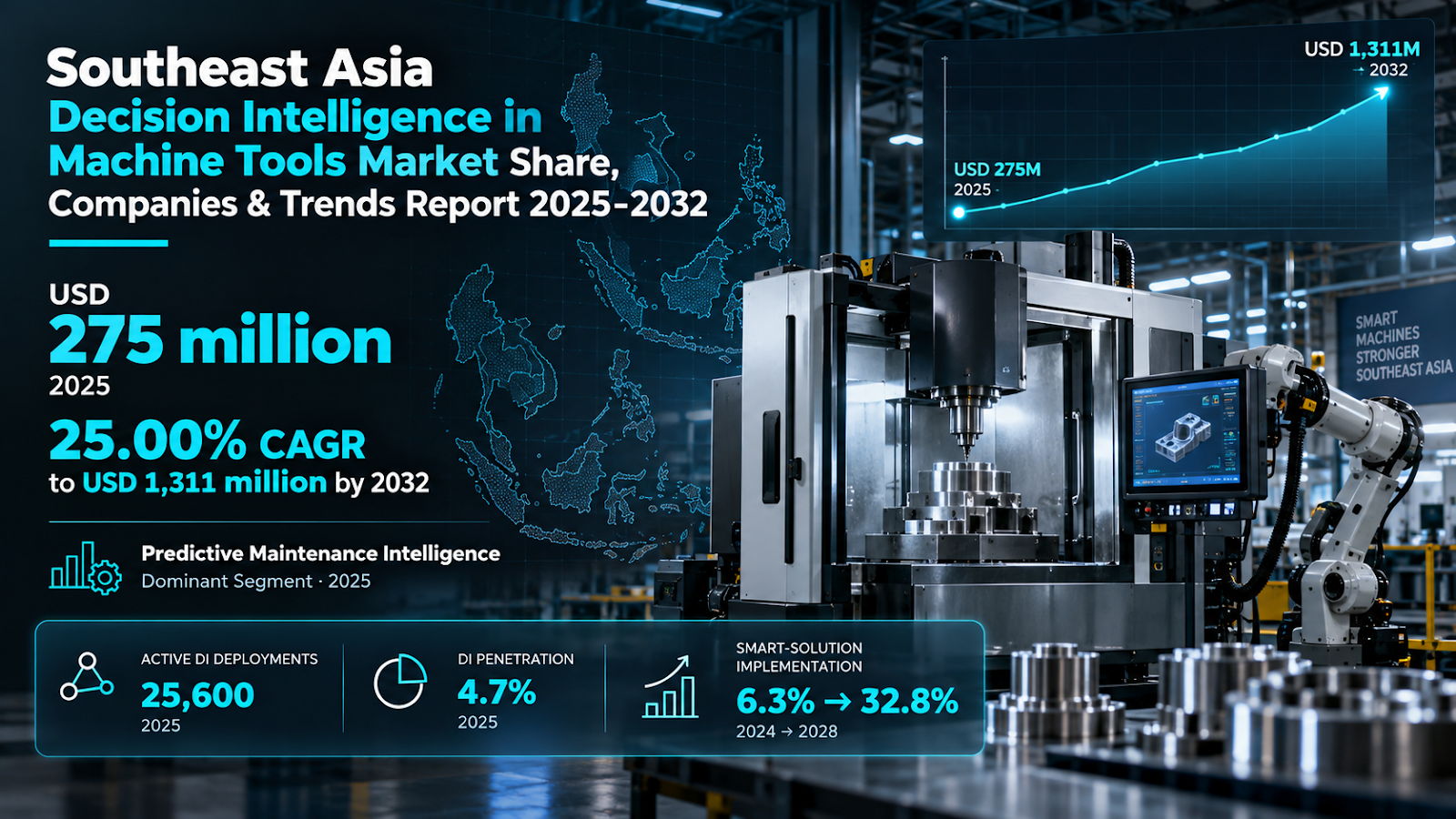
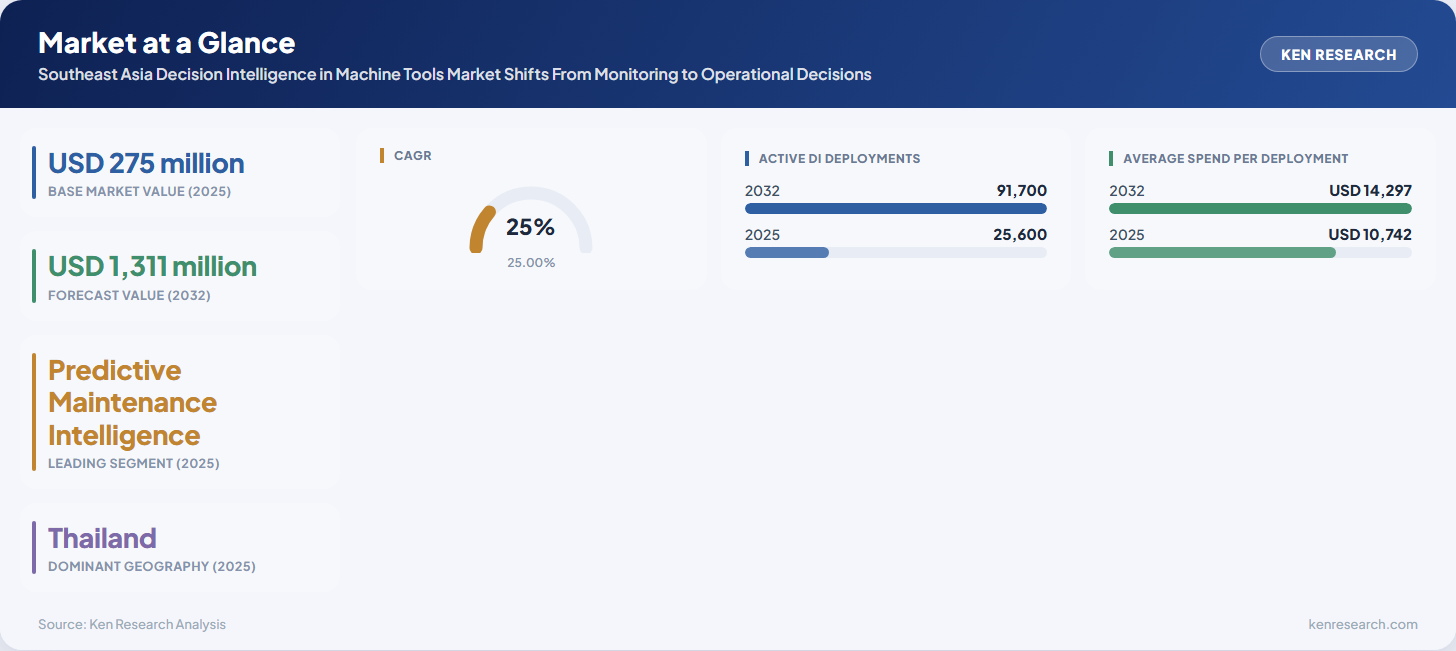
The Southeast Asia decision intelligence in machine tools market is moving beyond basic machine monitoring into software that recommends or supports operating decisions around maintenance, cutting conditions, inspection, scheduling and production performance. Ken Research estimates the market at USD 275 million in 2025, rising to USD 1,311 million by 2032 at a forecast CAGR of 25.00%. The commercial story is therefore not simply more connected machines; it is the increasing value of the intelligence layer attached to each connected production asset.
Two mechanisms drive that expansion. Active decision-intelligence deployments are modeled to rise from approximately 25,600 in 2025 to 91,700 in 2032, while average annual spend per deployment increases from roughly USD 10,742 to USD 14,297. The in-scope market includes AI and analytics software, SaaS subscriptions, embedded decision modules, digital-twin tools and associated professional services used specifically in machine-tool operations; it excludes machine-tool hardware, generic ERP or MES platforms, stand-alone robotics software and connectivity products without a decision layer.
The counter-thesis is that connectivity alone does not guarantee monetizable intelligence. Legacy controllers, inconsistent machine data, integration effort, cybersecurity requirements and shortages of staff who understand both machining and analytics can slow deployment. That constraint is visible one layer below decision intelligence in the Southeast Asia machine tool asset tracking market, where a still-developing connected-machine base leaves considerable retrofit potential but also exposes the engineering burden of integrating mixed equipment estates.
The Market Is Becoming a Software Layer on Top of CNC Assets
The market's growth rate makes more sense when separated from underlying machine-tool hardware demand. Decision intelligence monetizes software and analytics deployed across equipment that manufacturers may already own. That allows revenue to expand even when the physical machine base grows more slowly, provided more assets become digitally addressable and more customers attach analytics to those assets.
The regional automation backdrop is already substantial. The International Federation of Robotics reported that Asia installed 401,665 industrial robots in 2024, representing 74% of global new robot deployments. Industrial robots are not the same market as machine-tool decision intelligence, but the figure illustrates the scale of increasingly automated production infrastructure across Asia and the broader environment in which machine-level analytics are being commercialized.
Brownfield Penetration Creates the Near-Term Runway
Ken Research estimates decision-intelligence penetration of the Southeast Asian machine-tool base at only about 4.7% in 2025. That low starting point is commercially important because vendors do not need to wait for greenfield factories to create growth. Retrofitting existing CNC estates with gateways, edge processing, data normalization and decision modules can enlarge the addressable market without requiring replacement of the core production equipment.
The economic test, however, is whether vendors can convert raw signals into decisions operators trust. A dashboard showing spindle vibration has limited strategic value on its own. A system that interprets that signal, estimates failure risk, recommends an intervention window and links the decision to production scheduling moves closer to a workflow that can command recurring software spend.
Predictive Maintenance Lands the Account; Decision Suites Expand It
Predictive Maintenance Intelligence is the leading solution entry point in 2025 because its return on investment is comparatively easy to frame. Avoided downtime, better maintenance timing and longer tool or asset life can be connected directly to production economics. Once machine data is sufficiently reliable, however, the same data architecture can support additional applications that expand revenue per customer.
- Spindle and tool health: turns condition signals into maintenance and tool-change decisions.
- Cutting-parameter optimization: uses process data to balance cycle time, tool life, energy use and quality.
- In-process quality inspection: pushes defect detection closer to the machining operation rather than relying only on downstream inspection.
- OEE and bottleneck optimization: links machine-level data with throughput, downtime and production-flow decisions.
- Virtual commissioning and NC validation: shifts part of setup, simulation and program validation away from the physical machine.
This expansion logic overlaps with the Southeast Asia machine learning in industrial maintenance market, where recurring software subscriptions, asset-performance platforms and analytics services are also becoming more important. For machine-tool vendors, the implication is that predictive maintenance can function as the commercial beachhead rather than the full lifetime value of the account.
Recurring Delivery Changes Vendor Economics
The forecast assumes that value growth will exceed deployment growth. Active deployments expand at roughly 20% annually over the forecast framework, while spend per deployment increases at around 4% annually as customers adopt broader solution bundles. In practical terms, vendors can grow through both new logos and expansion revenue: more machines and sites come online, while existing customers buy additional optimization, quality, simulation or managed-service capabilities.
Cloud-Edge Architectures Turn Integration Into Part of the Product
Cloud SaaS and hybrid cloud-edge deployment models are expected to be among the fastest-growing approaches because machine-tool intelligence has conflicting technical requirements. Model management, fleet benchmarking and software updates benefit from centralized platforms, while latency-sensitive inference, plant-network resilience and industrial-data governance can favor processing close to the machine. The winning architecture therefore may not be purely cloud or purely on-premise, but an operationally credible combination of both.
This is also where integration capability becomes commercially inseparable from the software itself. Manufacturers may operate different CNC brands, controller generations, protocols and data structures across one site. Vendors that normalize those sources, preserve context and integrate outputs with maintenance, quality or production workflows reduce the amount of engineering the customer must absorb before measurable value appears.
Government-backed digitalization can broaden the pool of factories attempting that transition. Malaysia's Ministry of Investment, Trade and Industry describes a national ambition to create 3,000 smart factories by 2030. The relevance to decision-intelligence suppliers is not that every smart factory automatically becomes a customer, but that programs encouraging automation, data use and system integration create a larger base of manufacturers technically capable of adopting machine-level analytics.
Thailand Provides Scale; Vietnam Provides the Growth Challenge
Demand is concentrated rather than evenly distributed across Southeast Asia. Thailand, Vietnam, Indonesia, Malaysia and Singapore together represent an estimated 93% of in-scope spending in 2025. Thailand is the largest individual country market at approximately USD 80 million, while Vietnam is modeled at around USD 52 million and carries the strongest forecast growth among the core markets, at approximately 30.0% CAGR for 2025–2032.
The distinction matters for market-entry strategy. Thailand offers an established base of automotive, electronics and precision-machining demand, while Vietnam's growth profile is more strongly linked to manufacturing expansion and greenfield capacity. Thailand's Board of Investment previously published an automation-upgrade measure offering a 3-year corporate income-tax exemption subject to investment caps and qualifying conditions; its page states that applications had to be submitted by the last working day of 2025, so the measure is best treated as evidence of recent policy support rather than an open-ended current incentive.
Broader regional investment patterns also reinforce the strategic position of machine intelligence. The Asia Pacific smart manufacturing market shows industrial data and AI becoming a larger part of factory-modernization spending. For Southeast Asian machine-tool suppliers, the practical opportunity sits at the intersection of that software shift and country-specific manufacturing clusters rather than in a uniform region-wide adoption model.
Installed-Base Access Matters More Than Logo Count
The competitive field spans global CNC manufacturers, metrology and vision specialists, industrial-software vendors and regional system integrators. The primary research framework identifies approximately 100 market participants and notes 8 new entrants over the previous 5 years. Those counts indicate a broad supplier ecosystem, but they do not establish market-share leadership; the published page does not provide reliable percentage shares for individual competitors.
Named participants include Siemens Digital Industries, FANUC Corporation, Hexagon Manufacturing Intelligence, DMG MORI, KEYENCE Corporation, PTC, Rockwell Automation, Yamazaki Mazak, Mitsubishi Electric and Makino. Their routes to market differ: some begin with CNC control or machine ownership, others with industrial software, metrology, machine vision or plant-wide automation. That diversity makes installed-base access and integration depth especially important competitive variables.
The Moat Is Data Interoperability Plus Machining Context
Generic AI capability is unlikely to be sufficient on its own. The higher-value proposition combines access to machine data with knowledge of tooling, cutting conditions, failure modes, quality requirements and production constraints. Vendors also need connectors for mixed fleets, edge deployment capability, cybersecurity controls and local integration support. The more deeply the analytics becomes embedded in maintenance and production decisions, the higher the switching cost can become.
That creates an advantage for suppliers able to connect technical depth with a repeatable commercial model. Per-machine subscriptions may fit incremental retrofits, while site licenses and managed-service contracts can become more attractive once a customer moves from isolated use cases to enterprise-wide deployment.
The 25.00% CAGR Depends on Integration Capacity Keeping Up
The market's strongest upside mechanism is also its main execution risk. Low penetration means substantial whitespace, but it also means many factories have not yet standardized the operational data, connectivity and organizational processes required for advanced analytics. A manufacturer can purchase an AI module quickly; creating reliable machine histories, exception rules, maintenance workflows and operator trust can take considerably longer.
Several constraints therefore deserve more attention than headline AI adoption:
- Legacy connectivity: older controllers and proprietary machine interfaces increase integration cost.
- Data quality: incomplete failure histories and inconsistent tagging can reduce model usefulness.
- Operational trust: recommendations must be interpretable enough for maintenance and production teams to act on them.
- OT cybersecurity: more connected assets expand the industrial attack surface and raise governance requirements.
- Talent: scarce personnel who understand both machining processes and analytics can become a deployment bottleneck.
- ROI discipline: factories may postpone modules whose benefit is difficult to quantify against competing automation investments.
For investors and suppliers, the implication is that 4.7% penetration should not be read purely as effortless upside. The addressable runway is large precisely because implementation remains difficult in parts of the manufacturing base. Companies that reduce integration time and demonstrate production-level outcomes can convert that friction into differentiation; suppliers that require customers to solve the data architecture themselves may struggle to scale beyond pilots.
What Vendors and Factory Operators Should Watch Through 2032
The most useful indicators are those that reveal whether the forecast is being supported by real deployment economics rather than software enthusiasm alone. Market value should be interpreted together with installation density, customer expansion and operating performance.
- Active deployments: progress toward the modeled 91,700 deployments by 2032 indicates whether pilots are converting into scaled rollouts.
- Spend per deployment: movement toward approximately USD 14,297 by 2032 would signal successful cross-selling into optimization, quality, digital-twin and managed-service modules.
- Cloud-edge mix: faster adoption of hybrid architectures would indicate that vendors are solving latency and governance requirements without sacrificing centralized software economics.
- Use-case expansion: revenue moving beyond predictive maintenance into quality and process intelligence would strengthen the higher-value software thesis.
- Vietnam versus Thailand: Vietnam's modeled growth advantage should be tested against actual manufacturing investment and deployment conversion, while Thailand remains the key scale benchmark.
- Integration cycle time: shorter commissioning periods and more reusable connectors would directly improve vendor margins and customer payback.
- Industrial-data talent: expansion of capable system integrators and manufacturing analytics teams will influence how quickly mid-market factories can move beyond pilots.
Market Outlook: The Profit Pool Moves Toward Decisions, Not Connectivity Alone
The Southeast Asia decision intelligence in machine tools market is modeled to rise from USD 275 million in 2025 to USD 1,311 million in 2032. The strategic opportunity is not simply to connect more CNC machines. It is to convert those connections into trusted decisions that reduce downtime, improve cutting performance, raise quality, accelerate commissioning and improve utilization.
The upside case strengthens if deployment growth remains near the modeled trajectory, cloud-edge architectures reduce brownfield friction and customers expand from single-use maintenance modules into multi-function intelligence suites. The downside case emerges if poor data quality, long integration cycles, cybersecurity constraints or skill shortages prevent pilots from becoming repeatable multi-site programs. For suppliers, execution therefore matters as much as model sophistication: the market rewards systems that fit factory workflows and produce measurable operating outcomes.
Don’t miss the next uptime tools to higher-value factory intelligence shift. Ken Research continuously publishes new market intelligence, forecasts and industry analysis. Add Ken Research as a Preferred Source on Google to discover more of our research when your next market question comes up.
Research Basis and Data Status
The underlying Ken Research report was published in September 2026, uses 2025 as the base year, covers a historical period of 2020–2025 and forecasts through 2032. Market values, deployment counts, penetration estimates, country sizing and forecast assumptions presented as Ken Research data are proprietary estimates rather than government statistics.
Research Framework
- Machine-tool installed-base benchmarking.
- Industrial AI adoption tracking.
- Smart-factory policy-program review.
- Vendor product and filing analysis.
- Interviews with CNC operations managers, industrial automation directors, system-integration leads and manufacturing analytics heads.
- A 300-respondent cross-check framework.
- Vendor-revenue triangulation, deployment and ASP reconciliation, and demand-side intensity validation.
Official policy and industry statistics cited in this article are sourced separately from the relevant public institutions and are not presented as proprietary market estimates. Company product information is likewise distinct from the market-sizing model. For forecast consistency, this article follows the report's detailed 2025–2032 forecast table and FAQ, both of which assign the USD 1,311 million forecast value to 2032.
Explore the Southeast Asia Decision Intelligence in Machine Tools Market report for detailed segmentation, country comparisons, competitive coverage, deployment economics and forecast assumptions.


Comments
Post a Comment