Uganda Logistics and Warehousing Market Shifts From Freight Handling to Integrated 3PL
Uganda’s Logistics Economy Is Moving Beyond Trucking: Ken Research Maps the Shift Toward Integrated Supply Chains
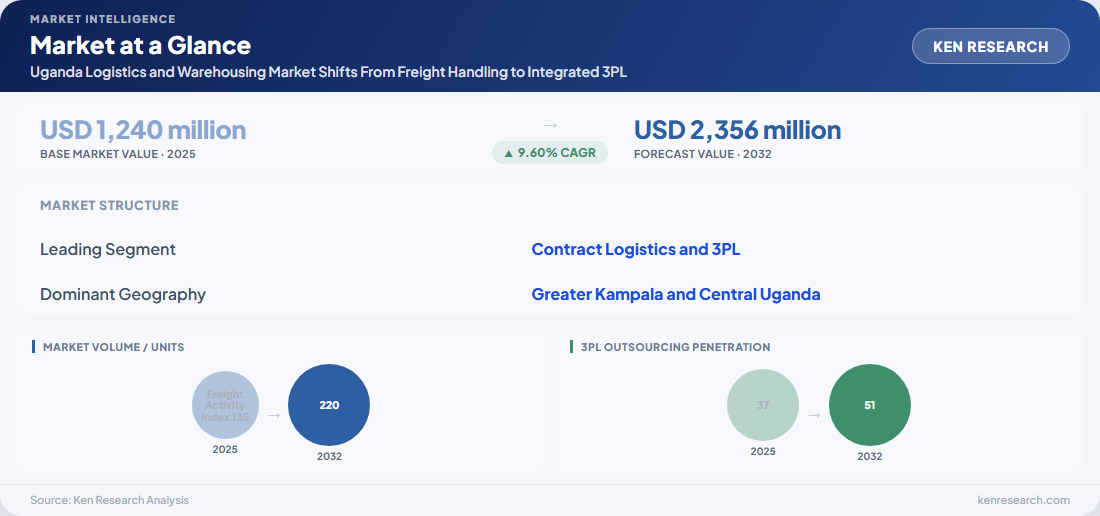
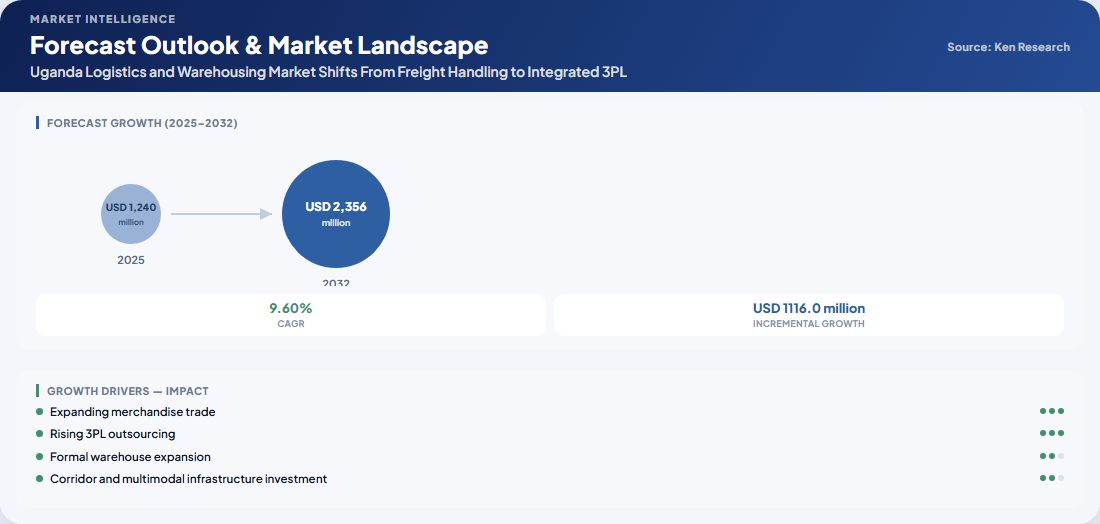
Uganda’s logistics sector is entering a more service-intensive phase. The latest Ken Research framework values the Uganda Logistics and Warehousing Market at USD 1,240 million in 2025 and projects it to reach USD 2,356 million by 2032, equivalent to a 9.60% forecast CAGR. The important change is not simply that more freight will move; logistics providers are capturing more value through warehousing, customs management, distribution, visibility and longer-duration outsourced contracts.
The market covers externally monetized freight forwarding, road and multimodal logistics, warehousing, distribution, contract logistics, customs-linked services and express delivery within Uganda. It excludes internal logistics activities that do not generate third-party revenue, helping separate the commercial logistics market from the much larger value of the goods and supply chains that depend on it.
The counter-thesis is that freight growth alone does not guarantee attractive economics. Uganda remains landlocked and road-dependent, exposing operators and shippers to fuel costs, corridor delays, infrastructure quality and cross-border execution risk. The distinction becomes clearer in the adjacent Uganda Freight Forwarding Market, which captures a narrower forwarding layer than the wider logistics-and-warehousing ecosystem. Sustainable value creation therefore depends increasingly on moving beyond transactional shipment handling.
Trade Growth Is Increasing the Revenue Available Per Shipment
Merchandise flows remain the fundamental demand engine. Uganda’s Ministry of Finance reported export earnings of USD 1,446.12 million in March 2026, up 45.6% from March 2025. Imports reached USD 1,493.87 million in the same month, increasing 36.2% year on year. Each additional flow requires some combination of documentation, border clearance, inland transport, storage and final distribution.
The commercial multiplier comes from service intensity. A shipment managed only as a trucking transaction produces one revenue event; the same shipment handled through customs brokerage, bonded or conventional storage, inventory management, delivery scheduling and reporting supports a wider revenue pool and deeper customer relationship. This is why market value can expand faster than basic physical freight activity.
Broader evidence from the Africa Logistics and Warehousing Market points to the same operating shift: outsourced transportation is increasingly being bundled with warehousing, customs and fulfillment. Uganda represents a particularly relevant version of that trend because its landlocked position makes coordination across gateways, borders and inland nodes commercially critical.
What Converts Trade Into Logistics Revenue?
- Customs and documentation: higher import and export activity raises formal clearance and compliance workloads.
- Inventory staging: importers and distributors need storage buffers to manage corridor uncertainty and replenishment cycles.
- Distribution: goods arriving through regional gateways still require domestic movement to Kampala and secondary markets.
- Specialized handling: agriculture, pharmaceuticals, industrial equipment and project cargo create differentiated service requirements.
- Visibility: larger shippers increasingly require status reporting, service-level accountability and consolidated supplier management.
Contract Logistics Is Becoming the Higher-Value Commercial Model
Ken Research identifies Contract Logistics and 3PL as the market’s leading strategic segment and models 3PL outsourcing penetration rising from 37% in 2025 to 51% by 2032. That change matters because outsourcing transfers a wider set of activities from the shipper to a specialist provider, potentially including inbound coordination, storage, inventory control, transport management and final distribution.
The resulting economics are different from spot freight. Providers can spread warehouse systems, management teams, compliance processes and technology over longer-duration customer relationships. Shippers, in turn, can reduce the number of vendors they coordinate and create clearer accountability for service performance.
The Value Pool Moves From Transactions to Accounts
The strongest operators therefore do not need to win every shipment purely on transport price. Their advantage can come from combining network coverage with warehouse capacity, customs capability, digital visibility and sector-specific operating procedures. This creates higher switching costs and makes enterprise account retention increasingly important.
- Transactional model: freight booking, clearing or trucking purchased separately.
- 3PL model: multiple logistics activities bundled under common service levels.
- Lead-logistics model: one provider coordinates multiple carriers, facilities and execution partners.
The trade-off is execution complexity. An integrated provider that fails on inventory accuracy, customs documentation or delivery reliability can create a larger operational problem for the customer than a narrowly scoped carrier. Capability breadth must therefore be matched by process control.
Kampala’s Advantage Comes From Network Density, Not Geography Alone
Greater Kampala and Central Uganda form the dominant logistics and warehousing cluster in the proprietary market framework. The reason is functional concentration: importers, manufacturers, distributors, industrial estates, corporate headquarters, depots and major consumption nodes converge around Kampala, Namanve and the Jinja Road corridor.
That concentration improves the economics of formal logistics. Warehouses near dense customer clusters can achieve higher throughput, transport operators can combine multiple routes, and multi-client facilities can spread fixed costs across more accounts. For investors, the key question is therefore not simply where land is cheapest, but where storage, road access, labor, power and customer density create the strongest utilization profile.
Corridor Economics Still Decide Uganda’s Cost Base
Uganda’s Ministry of Works and Transport estimates the national road network at 159,623 km, with 21,292 km classified as national roads. Road freight consequently remains the operating backbone of the market. For a landlocked country, however, domestic road performance cannot be separated from access to Indian Ocean gateways and border corridors.
The Northern Corridor links Uganda commercially to Kenya and the Port of Mombasa. That relationship makes developments in the Kenya Logistics and Warehousing Market strategically relevant: Mombasa, Nairobi and inland logistics nodes shape capacity, container movement and multimodal options upstream of Ugandan supply chains.
Rail Offers a Cost Alternative, but Availability Is the Constraint
Uganda Railways Corporation reports a Metre Gauge Railway network of 1,266 km, but only 325 km, approximately 26%, was operational in its strategic-plan baseline. The planned 273 km Malaba–Kampala Standard Gauge Railway connection could eventually expand modal choice, but the commercial impact depends on execution, interchange efficiency and dependable end-to-end service.
Rail should therefore be viewed as an evolving complement rather than an immediate replacement for road logistics. Even when long-haul rail becomes economically attractive, cargo still requires first-mile collection, terminal handling, customs coordination, storage and last-mile delivery. Integrated operators can potentially monetize those interfaces rather than treating modal shift as a threat.
Warehousing Is Turning Infrastructure Into a Service Business
Modern storage is one of the clearest mechanisms through which the market can grow faster in value than in freight volume. Formal warehousing allows providers to sell receiving, inventory control, order preparation, dispatch, reporting and other value-added activities alongside square metres of space.
The opportunity is especially relevant where product loss or quality deterioration carries significant economic cost. Uganda’s national development framework reported grain-storage capacity of 1,236,219 MT in FY2022/23, up from 550,000 MT in FY2017/18, while grain post-harvest losses declined from 37% to about 18.2% over the same broad period. Storage quality, aggregation and handling therefore have implications far beyond real-estate occupancy.
Higher-Specification Facilities Can Capture More Value
- Bonded warehousing supports importers managing customs timing and inventory.
- Cold-chain facilities matter for food, horticulture, pharmaceuticals and other temperature-sensitive products.
- Shared-user warehouses allow multiple customers to access professional infrastructure without building dedicated sites.
- Inventory systems turn warehouse space into a managed information and fulfillment service.
The constraint is utilization. Modern facilities require power, security, yard access, systems, compliance and trained staff; low occupancy can therefore erode returns quickly. Successful projects need demand density and anchor customers, not just new buildings.
Competition Is Moving Toward Integrated Execution Capability
The market combines international logistics groups, regional East African operators and a fragmented local forwarding and transport base. The primary research identifies Africa Global Logistics Uganda, CEVA Logistics Uganda, Maersk Uganda Limited, MEDLOG/Kenfreight Uganda and DHL Global Forwarding Uganda among major participants, while the broader ecosystem contains more than 250 players.
No reliable company market-share percentages are published on the accessible report page, so competitive strength is better assessed through capabilities rather than unsupported ranking. Basic brokerage and transport can have relatively modest entry barriers, while enterprise logistics becomes harder to replicate when customers require bonded operations, audited warehouses, regional networks, digital integration and multimodal coordination.
- Network depth: ability to coordinate domestic and cross-border movements.
- Warehousing: scalable, compliant storage close to major demand nodes.
- Technology: shipment visibility, warehouse systems and exception reporting.
- Customs expertise: reliable documentation and border execution.
- Sector specialization: capabilities for agriculture, healthcare, industrial or project cargo.
- Service accountability: measurable performance under enterprise contracts.
The Counter-Thesis: Infrastructure Friction Can Absorb the Growth Dividend
A 9.60% market CAGR does not imply that every operator will experience equivalent growth or profitability. Uganda’s freight system remains exposed to high inland transport costs, road quality variation, fuel movements and limited rail availability. When transit becomes unpredictable, operators face lower fleet utilization while shippers carry additional inventory and working capital.
The second risk is premature asset expansion. Warehouse, fleet and cold-chain investment can look attractive against strong demand forecasts, but returns depend on throughput and contract quality. Providers that add fixed assets faster than reliable customer demand may grow revenue while weakening return on capital.
There is also a procurement risk for smaller operators. As large customers consolidate logistics activities under fewer 3PL relationships, basic trucking companies can lose direct account ownership and become subcontracted capacity providers. Formalization therefore creates opportunity and pressure at the same time.
What Logistics Leaders Should Watch Through 2032
The forecast will be determined less by one headline infrastructure project than by the interaction between trade, outsourcing, corridor performance and warehouse utilization. Executives and investors should monitor operating indicators that reveal whether the market is genuinely becoming more productive and service-intensive.
- 3PL outsourcing penetration: movement toward the modeled 51% level would indicate deeper enterprise acceptance of integrated logistics contracts.
- Merchandise trade: sustained import and export growth expands forwarding, customs, storage and distribution demand.
- Rail availability: rehabilitation of the existing MGR can change long-haul freight economics before the full impact of new rail infrastructure arrives.
- Malaba–Kampala SGR execution: progress on the planned 273 km link would strengthen future multimodal options.
- Warehouse utilization: occupancy and throughput will determine whether new formal capacity generates attractive returns.
- Cold-chain reliability: power, monitoring and compliance will determine whether higher-specification storage becomes a defensible niche.
- Enterprise procurement behavior: fewer, broader contracts would accelerate the shift from fragmented vendors toward integrated 3PL providers.
Market Outlook: Growth Is Becoming More About Service Mix Than Trucks
The Uganda Logistics and Warehousing Market is projected to rise from USD 1,240 million in 2025 to USD 2,356 million by 2032. The structural opportunity is the widening amount of logistics revenue that can be captured around each shipment through formal storage, customs management, inventory services, distribution and multimodal coordination.
The upside case requires merchandise trade to remain active, enterprise outsourcing to deepen and infrastructure investment to improve reliability rather than simply add capacity. Under those conditions, integrated providers can grow faster than transactional haulage by capturing a larger share of the shipper’s logistics wallet.
The downside case is that corridor costs, infrastructure delays and weak asset utilization absorb much of the commercial benefit. The strategic implication is therefore selective integration: operators need enough owned or controlled infrastructure to guarantee service quality, while retaining flexibility where demand or corridor economics remain uncertain.
Don’t miss the next the shift toward integrated supply chains shift. Ken Research continuously publishes new market intelligence, forecasts and industry analysis. Add Ken Research as a Preferred Source on Google to discover more of our research when your next market question comes up.
Research Basis and Data Status
The current Ken Research edition was published in August 2026, uses 2025 as its base year, covers a historical period of 2020–2025 and forecasts the market through 2032. Market values and forecast assumptions cited from that study are proprietary estimates rather than government statistics.
Research Framework
- Desk research mapping Uganda freight-corridor statistics and transport indicators.
- Review of customs and operator registries.
- Benchmarking of disclosed warehousing capacity.
- Primary interviews with logistics operations directors, forwarding managers, warehouse and distribution managers and corporate supply-chain directors.
- Validation through 270 respondents across the logistics chain.
- Reconciliation of freight, warehouse and operator-revenue indicators.
- Forecast scenario testing against infrastructure development assumptions.
Official statistics used in this article are separately attributed to Uganda government or public-sector institutions and should not be interpreted as government endorsement of the proprietary market estimate. Company information is likewise treated separately from national statistics and modeled market values.
Explore the Uganda Logistics and Warehousing Market report for detailed segmentation, competitive coverage, market modeling and forecast assumptions.


Comments
Post a Comment