Austria Prefabricated Housing Market Moves From Unit Recovery to Higher-Value Turnkey Growth
Austria’s Prefab Recovery Is Becoming a Value Story: Ken Research Maps the Shift Toward Turnkey Housing
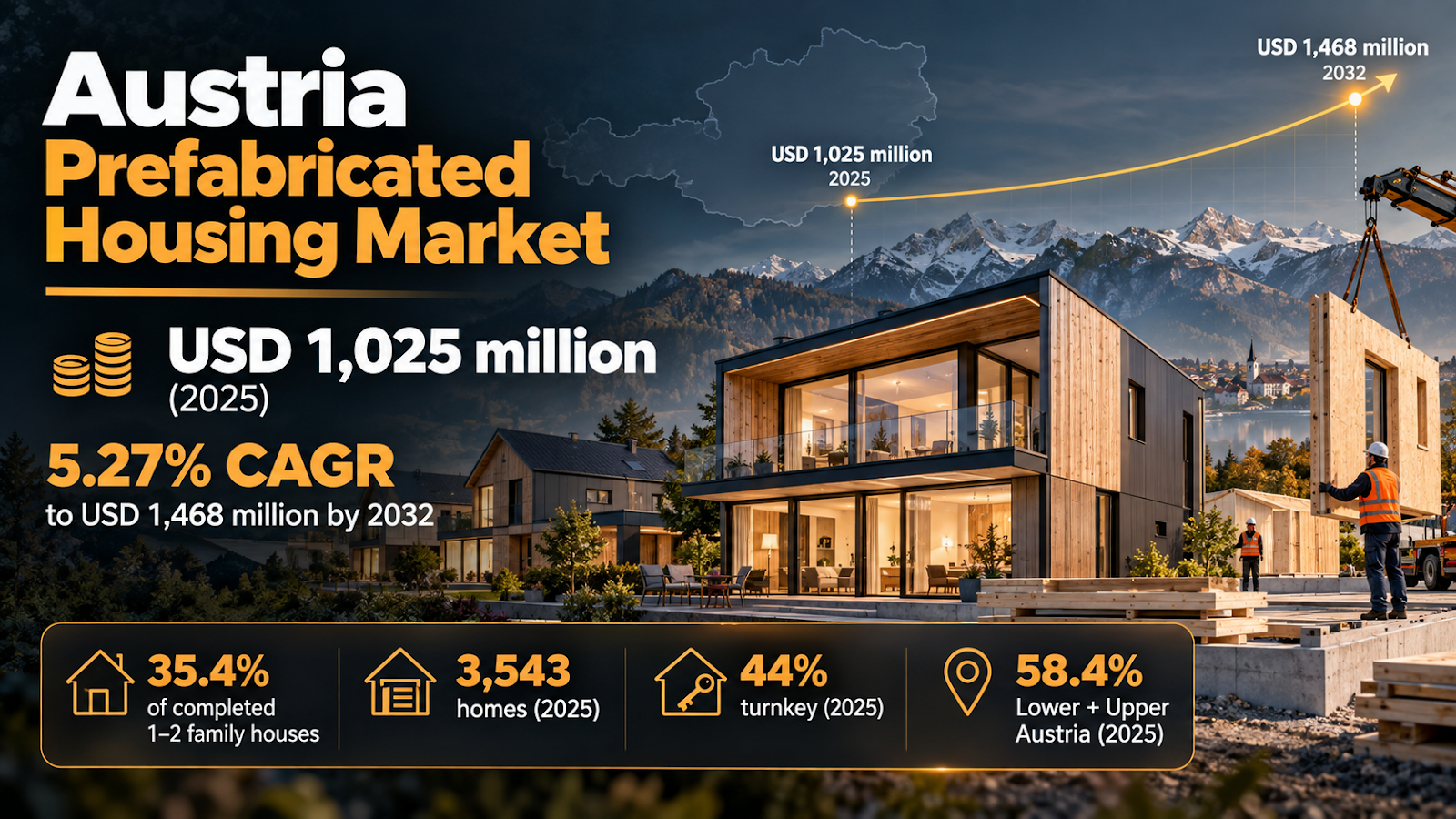
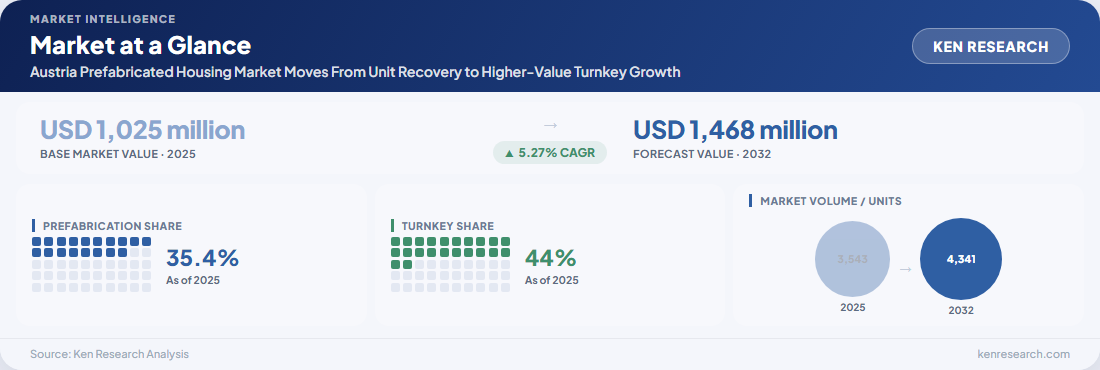
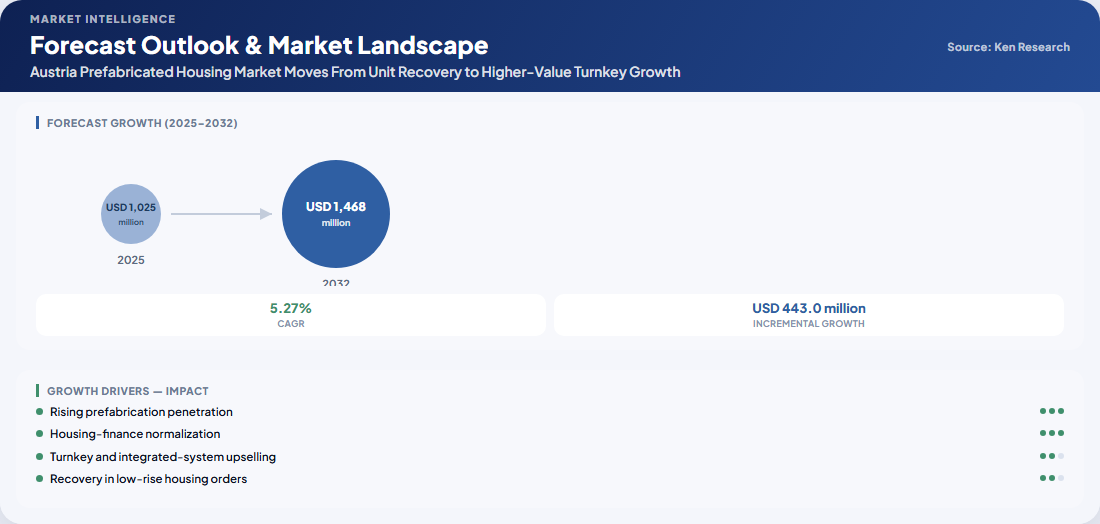
Austria’s prefabricated housing industry is entering a recovery phase in which the commercial opportunity is increasingly about capturing more value from each completed home rather than simply restoring the unit volumes of the last housing boom. Proprietary estimates from Ken Research value the market at USD 1,025 million in 2025 and project it to reach USD 1,468 million by 2032, implying a 5.27% value CAGR.
The mechanism behind that forecast matters. Market volume is modeled to increase from approximately 3,543 homes in 2025 to 4,341 homes by 2032, a materially slower trajectory than market value. The difference is expected to come from product mix, including turnkey completion, higher-performance building envelopes, integrated energy systems and a larger share of household expenditure being incorporated into the manufacturer’s contract.
The counter-thesis is that Austria is not beginning this growth cycle with a strong underlying new-housing pipeline. Residential permits remain depressed, meaning manufacturers cannot assume that financing normalization will immediately restore high factory throughput. This tension also matters beyond Austria: the Europe Prefabricated Buildings Market shows how industrialized construction can gain relevance through faster, repeatable delivery even while national construction cycles remain uneven. Austria’s reported scope covers factory-produced structural panels, timber frames and modular assemblies delivered into residential construction rather than the entire conventional building market.
The Recovery Starts From a Much Smaller Physical Housing Base
The market’s recent history explains why headline growth should not be confused with a return to the previous cycle. Ken Research models Austrian prefab volume at approximately 5,798 homes in 2022, before demand contracted sharply and volume reached roughly 3,450 homes in 2024. The estimated market value fell to USD 974 million in 2024, representing a modeled contraction of 33.7% for that year.
The wider housing market moved in the same direction. Statistics Austria reports that only 41,762 dwellings were completed in new buildings in 2024, down 20.2% from 2023. New residential buildings containing one or two dwellings fell particularly sharply, with just 10,635 buildings completed in 2024.
For prefab manufacturers, that low-rise contraction is especially important because single-family construction remains the core addressable pool. The immediate commercial question is therefore not whether Austria returns to its former construction peak, but whether prefabrication can capture more of a smaller market while suppliers improve realized revenue from the homes that do proceed.
Prefab Penetration Gives Suppliers a Second Growth Lever
Prefabrication accounted for approximately 35.4% of completed Austrian single- and two-family houses in 2025, according to the proprietary market framework. That level of adoption means prefab is already an established residential delivery method rather than an experimental construction category. It also changes how the forecast should be interpreted: suppliers do not need total Austrian housing activity to return to historic highs for category demand to improve if prefabrication continues taking share.
This is where Austria differs from a simple construction-cycle recovery story. Broader 2026 Europe Construction Market research describes a gradual improvement in construction economics as interest-rate pressure moderates, while conventional residential development remains constrained by affordability and planning conditions. For Austrian prefab operators, industrialized production can convert that environment into an advantage when buyers place a premium on schedule certainty, standardized quality and tighter total-project budgeting.
Why the Share Gain Matters Economically
- Factory standardization: repeated structural systems can reduce project-by-project variability and support more predictable production planning.
- Schedule visibility: greater factory completion can reduce exposure to some forms of on-site coordination and weather disruption.
- Budget control: standardized packages can make the final project cost easier for households and lenders to evaluate.
- Specification leverage: suppliers can add energy systems, interior packages and higher-performance components to the core structural contract.
The final point is particularly important. If penetration rises while each delivered project also contains more supplier-controlled value, market revenue can expand faster than housing units. That is the central economic bridge between Austria’s relatively modest unit forecast and the stronger projected value CAGR.
Turnkey Delivery Is Shifting the Profit Pool Beyond the Structural Shell
Turnkey homes represented roughly 44% of Austria’s prefab market in 2025 and are expected to exceed 45% by 2029 in the report framework. Although the change in share appears incremental, the revenue implication is larger because turnkey contracts transfer more of the finishing, procurement, building-services and coordination spend into the manufacturer’s commercial relationship with the buyer.
That changes competitive economics. A business selling a structural package depends heavily on factory output and structural pricing. A supplier delivering a more complete home can monetize design, procurement, building services, energy equipment, interiors, project coordination and after-sales responsibility. The manufacturer therefore competes not only on the cost of the frame but on its ability to reduce complexity for the customer.
Revenue per Home Becomes a Strategic KPI
The report’s modeled implied revenue per delivered home rises from approximately USD 289 thousand in 2025 toward USD 338 thousand by 2032. This is why unit volume alone gives an incomplete picture of the forecast. Higher specification, turnkey attachment and energy-system integration can increase realized contract value even if Austria remains below its previous physical housing peak.
For management teams, the relevant operating dashboard therefore expands beyond orders and completions. Turnkey conversion, average specification value, energy-system attachment, procurement margin and the share of customer expenditure captured inside the contract become increasingly important measures of commercial quality.
Austria Is Recovering Inside a Housing Pipeline That Is Still Historically Weak
The largest constraint remains the pipeline feeding future construction. Statistics Austria recorded 47,636 permitted dwellings across new construction and changes to existing buildings in 2025. Within new buildings specifically, approvals fell 7.1% to just 31,979 dwellings, the lowest level since the official series began in 2010.
This matters because permits transmit into completions with a lag. A manufacturer may see improving customer enquiries and financing conditions before that improvement translates into factory throughput. If the permit base remains structurally weak, competitive pressure for qualified projects can stay intense even as headline market revenue begins to recover.
Low-Rise Permits Offer a More Nuanced Signal
The national totals are not uniformly negative for the core prefab category. Ken Research notes improving momentum in permits for new one- and two-family residential buildings during 2025. That creates a better near-term signal for detached and low-rise prefab than the aggregate new-building figure alone suggests, but the rebound begins from a deeply depressed base.
The commercial implication is capacity discipline. Operators that assume a rapid return to the 2022 volume environment risk carrying factory and installation resources ahead of demand. Those able to align production with confirmed orders while increasing value per project have a more defensible path through the recovery.
Financing Is Improving, but Affordability Has Not Disappeared
Housing credit is the second major swing factor. Austria’s binding KIM-V mortgage regime expired on 30 June 2025. However, the Austrian Financial Market Authority retained reference principles for sound residential lending, including a maximum 90% loan-to-collateral ratio, debt-service payments of no more than 40% of annual net income and a maximum loan maturity of 35 years.
The result is normalization rather than unrestricted credit. Banks have more flexibility than under the expired regulation, but households still need meaningful equity and sufficient income to support mortgage repayments. That keeps affordability at the center of product strategy.
- Smaller footprints can reduce the absolute borrowing requirement without abandoning owner-occupied housing demand.
- Standardized options can limit expensive customization and reduce uncertainty around the final project budget.
- Turnkey pricing can improve financing visibility by consolidating more of the project into one defined contract.
- Energy-efficient systems can differentiate offers where households evaluate lifecycle operating costs alongside acquisition price.
This creates a useful paradox for suppliers. Turnkey delivery raises the manufacturer’s contract value, but the higher absolute ticket must still fit household financing capacity. The strongest product architectures will therefore increase supplier-controlled value while maintaining disciplined design-to-cost.
Factory Economics Make Utilization More Important Than Headline Capacity
Prefabricated housing carries an industrial cost structure that conventional site-based construction does not share to the same degree. Manufacturing plants, automated equipment, design platforms, model-home networks and specialized production staff create fixed costs that must be absorbed through a sufficiently consistent order book. When housing demand drops quickly, utilization therefore becomes a major determinant of margin.
This operating logic is also visible in the Global Modular Construction Market, where Ken Research identifies utilization, order visibility, transport radius and design reuse as critical variables linking factory capacity to economics. The lesson for Austria is that installed capacity is not an advantage by itself; the advantage comes from routing repeatable projects through that capacity efficiently.
Scale Is Raising the Productivity Benchmark
Austria’s competitive field includes established manufacturers such as ELK Fertighaus GmbH, Glorit Bausysteme GmbH, GRIFFNER, Haas Fertigbau, HARTL HAUS, VARIO-HAUS, WOLF HAUS, GENBÖCK HAUS and ETZI-HAUS. The primary research framework identifies approximately 62 participants overall, but it does not publish reliable company-level national market-share percentages for the named leaders.
Competition should therefore be understood through operating capability rather than an unsupported ranking. Factory throughput, brand trust, procurement scale, installation capacity, standardized design libraries, energy-system integration and turnkey project management are becoming increasingly important dimensions of differentiation.
- Utilization: determines fixed-cost absorption across factories and specialist teams.
- Design reuse: spreads engineering effort across more projects while preserving configurable customer choice.
- Procurement scale: matters more as manufacturers capture a larger share of finishing and building-services spend.
- Installation reliability: converts factory speed into an actual customer schedule advantage.
- After-sales accountability: becomes more important as turnkey providers assume responsibility for a larger part of the completed home.
Regional Concentration Makes Order Visibility a Geographic Issue
Lower Austria and Upper Austria together represented approximately 58.4% of Austrian prefabricated housing demand in 2025 under the proprietary market allocation. The concentration reflects established owner-occupied housing demand, timber-processing ecosystems and proximity to major manufacturing operations.
That density can be beneficial. Shorter transport routes, installer familiarity and concentrated lead generation can improve operating efficiency. But it also introduces portfolio risk: when low-rise activity weakens in the two core regions, a large share of national prefab demand is affected simultaneously.
For manufacturers, geographic expansion therefore needs to be judged against logistics economics rather than pursued simply to increase market coverage. Moving wall systems or modules farther from the plant can increase transport and installation complexity, while local permitting, subcontractor availability and customer preferences may reduce the benefit of entering a new territory. The best expansion markets are those that improve factory utilization without destroying the repeatability that gives prefabrication its cost advantage.
The Main Downside Is a Recovery in Revenue Without a Recovery in Throughput
The forecast assumes that housing finance improves, prefabrication continues gaining relevance and suppliers expand revenue per completed home. The risk is that only the last of those mechanisms materializes. If new-build permits remain depressed, industry revenue could still improve through pricing and mix while factories operate below the throughput levels required for stronger margin recovery.
That distinction matters to investors and operators because market value and manufacturing economics can diverge. A higher-priced turnkey home raises industry revenue, but a factory with insufficient orders may still carry underabsorbed fixed costs. Similarly, a higher specification can support gross profit per project while also increasing procurement complexity and working-capital exposure.
- Permit risk: a persistently weak construction pipeline limits physical installations.
- Affordability risk: equity requirements and debt-service constraints can delay household conversion.
- Utilization risk: excess capacity weakens fixed-cost absorption.
- Mix risk: customers may prefer cheaper completion levels if financing remains tight.
- Regional risk: heavy exposure to Lower Austria and Upper Austria concentrates order volatility.
- Execution risk: broader turnkey responsibility increases the operational consequences of supplier or installation delays.
The counter-thesis to an optimistic prefab outlook is therefore not that industrialized housing loses relevance. It is that share gains and premium mix may have to work harder than expected to offset a housing pipeline that remains materially below earlier-cycle levels.
What Prefab Manufacturers and Investors Should Watch Through 2032
The most useful indicators are those connecting market demand to actual factory economics. Headline residential sentiment alone will not show whether the sector is generating enough qualified orders, sufficient contract value and adequate utilization to deliver the forecast.
- New-building permits: sustained improvement from the 2025 trough would strengthen visibility for future installations.
- One- and two-family permits: these provide a more direct demand signal for Austria’s core prefab addressable market than aggregate dwelling approvals.
- Mortgage conversion: improving credit availability must translate into financed household projects rather than enquiries alone.
- Prefab penetration: further gains from the 35.4% level would allow category growth to outperform conventional low-rise construction.
- Turnkey attachment: movement beyond the approximately 44% share recorded in 2025 would support greater revenue capture per home.
- Factory utilization: stronger throughput is required for market recovery to translate into healthier manufacturing economics.
- Revenue per delivered home: progress toward the modeled USD 338 thousand level by 2032 would indicate that premium mix and integrated systems are contributing as forecast.
Market Outlook: Austria’s Next Prefab Cycle Is Likely to Be More Value-Intensive
Ken Research projects Austria’s prefabricated housing market to increase from USD 1,025 million in 2025 to USD 1,468 million by 2032, while physical volume rises from approximately 3,543 to 4,341 homes. The gap between the 5.27% value CAGR and the slower unit trajectory is the most commercially significant feature of the outlook.
The structural opportunity lies in combining category share gains with greater contract depth. Prefabrication already has meaningful penetration in Austrian low-rise housing, and manufacturers can potentially monetize more of each project through turnkey completion, energy systems, higher-performance envelopes and integrated procurement. If financing normalization also restores order conversion, these mechanisms can improve both revenue and factory utilization.
The downside case remains tied to the housing pipeline. Persistently weak permits could leave manufacturers competing for a constrained volume pool, while credit discipline limits affordability and premium turnkey specifications increase the final amount households need to finance. The companies best positioned for the next cycle are therefore likely to be those that can raise value per project without allowing cost, customization or capacity to outrun demand.
Don’t miss the next maps the shift toward turnkey housing shift. Ken Research continuously publishes new market intelligence, forecasts and industry analysis. Add Ken Research as a Preferred Source on Google to discover more of our research when your next market question comes up.
Research Basis and Data Status
The primary Ken Research dataset was published in August 2026, uses 2025 as its base year, covers a historical period of 2020–2025 and provides forecasts through 2032. Market values, prefab penetration, modeled volumes, segmentation, regional allocations, competitive-participant counts and revenue-per-home calculations referenced from that framework are proprietary estimates and should not be interpreted as official Austrian government statistics.
Research Framework
The published methodology combines desk research, primary research and validation. Desk research includes Austrian housing-permit indicators, manufacturer disclosures, construction standards and timber-housing benchmarks. Primary research covers prefab manufacturer commercial directors, residential developer procurement managers, timber-component plant managers, architects and construction managers.
- 276 stakeholder responses were normalized and weighted in the published validation process.
- Factory volumes were cross-checked against housing completions.
- Pricing was validated against turnkey contracts.
- Housing permits were reconciled with forward-demand assumptions.
Official permit and completion statistics in this article are separately attributed to Statistics Austria, while residential-lending rules are sourced from the Austrian Financial Market Authority. These official series serve as external operating context and are distinct from the proprietary market-sizing model.
Explore the Austria Prefabricated Housing Market report for detailed segmentation, competitive coverage, market methodology and forecast assumptions.


Comments
Post a Comment