Brazil E-Commerce Logistics & Fulfillment Market Shifts From Parcel Growth to Higher-Value Services
Brazil E-Commerce Logistics Growth Is Becoming a Value-per-Order Story: Ken Research Maps the Fulfillment Shift
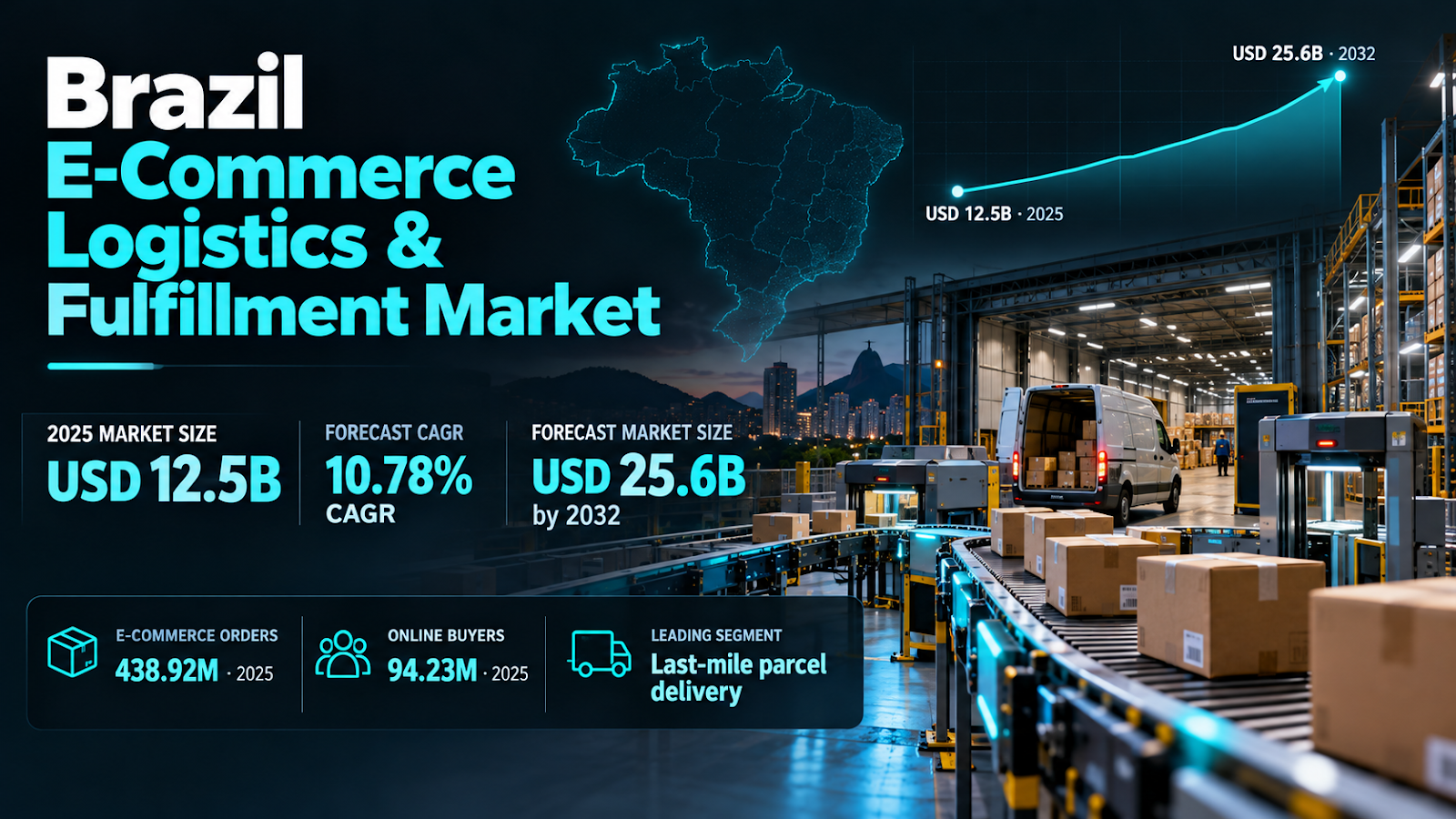
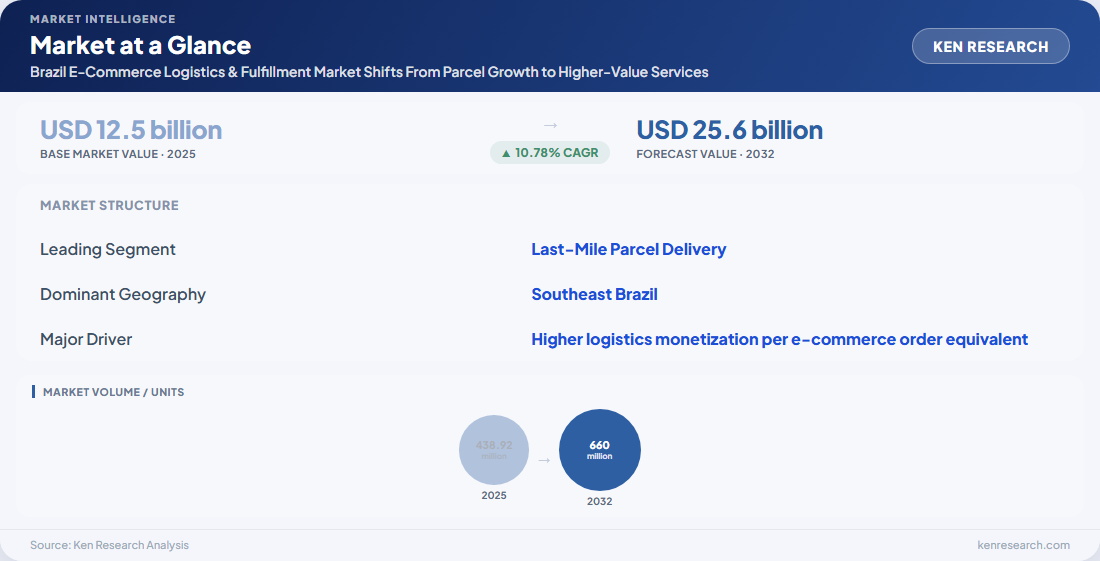
Brazil's E-Commerce Logistics & Fulfillment Market was valued at USD 12.5 billion in 2025 and is forecast to reach USD 25.6 billion by 2032, representing a 10.78% CAGR. The market connects marketplaces, online retailers, D2C brands, fulfillment centers, parcel carriers and returns processors, with 438.92 million online orders underpinning the 2025 demand model. The estimate is proprietary to Ken Research and measures monetized e-commerce logistics services rather than merchandise GMV.
The central commercial change is that revenue is expected to grow faster than physical order volume as merchants buy more fulfillment, premium delivery, returns, cross-border processing and integrated logistics. The adjacent Brazil E-Commerce First- and Last-Mile Market research provides context on the delivery layer, but the broader fulfillment opportunity also faces a counter-thesis: geographic dispersion, shipping subsidies, compliance complexity and uneven route density can prevent order growth from translating into attractive margins. This makes network utilization, not parcel count alone, the decisive operating test.
How Large Will Brazil E-Commerce Logistics Be by 2032?
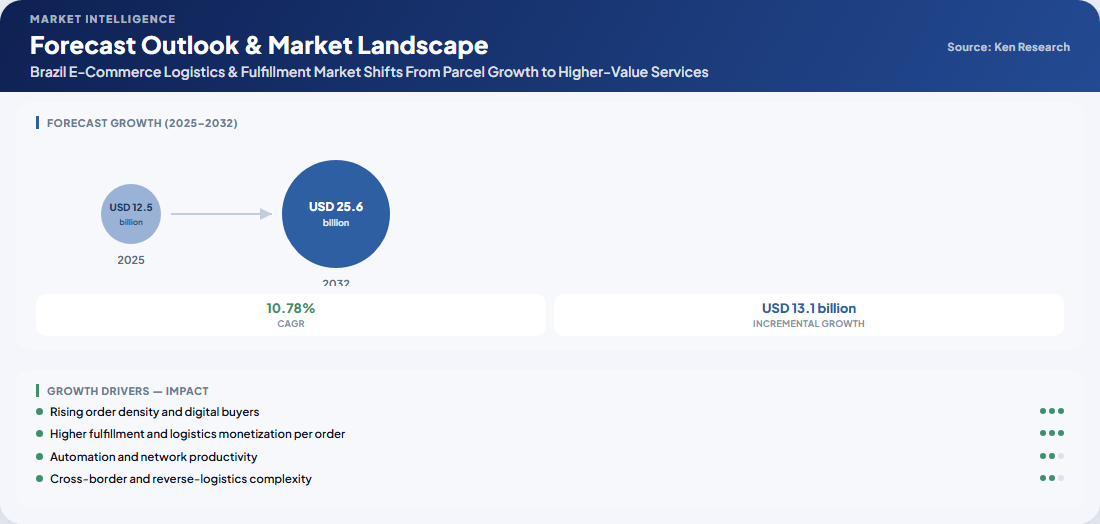
Brazil's e-commerce logistics and fulfillment market is projected to add USD 13.1 billion of value between 2025 and 2032, according to the proprietary forecast. The market expanded from USD 6.85 billion in 2020 to its 2025 base, while order-equivalent volume is modeled to rise from 438.92 million to approximately 660 million. Ken Research analysis therefore indicates that roughly half of the forecast value increase cannot be explained by order growth alone, reinforcing the importance of monetization depth.
- 6.00% order-volume CAGR: Order-equivalent growth through 2032 is materially below market-value growth, creating a measurable case for higher service intensity.
- 4.51% annual revenue-per-order growth: Ken Research analysis indicates that logistics monetization per order is becoming an independent growth lever, not merely a by-product of shipment expansion.
- 55.86% Southeast demand association: The regional concentration strengthens utilization economics but also makes network expansion beyond the Southeast a more demanding capital-allocation decision.
The implication for procurement and investment teams is straightforward: a provider offering only transport capacity may capture volume without capturing the fastest-growing value pools. The stronger proposition combines first-mile collection, fulfillment, linehaul, last-mile execution and returns under integrated merchant contracts, which naturally raises the question of what is causing service intensity to increase.
Why Is Brazil E-Commerce Logistics Value Growing Beyond Orders?
Brazil's logistics value is rising faster than order volume because merchants are outsourcing more operational complexity per transaction, especially fulfillment, returns, automation and cross-border processing. The market model shows revenue per order equivalent increasing from USD 22.75 in 2020 to USD 28.48 in 2025, while order equivalents grew at a slower pace. Brazil's official internet base also supports continued digital demand: 95.0% of households used the internet in 2025, according to IBGE's official statistics.
That monetization shift favors providers able to turn shipment density into additional services rather than simply lower delivery prices. Automation is particularly important because the adjacent Brazil E-Commerce Logistics Automation Market is forecast to grow faster than the broader logistics market, reflecting investment in robotics, sortation and warehouse execution. Ken Research analysis calls this the density-to-value rule: higher order density creates the economic base, but integrated services determine how much revenue can be captured from it.
- 438.92 million orders: The large shipment base improves utilization opportunities for sortation, hubs and delivery routes, particularly where demand is geographically dense.
- 94.23 million buyers: A broad online-buyer pool allows shipment frequency to support logistics demand without requiring equivalent growth in unique customers.
- 55.5% mobile transaction mix: Mobile-led purchasing increases the importance of real-time availability, tracking and delivery responsiveness in merchant logistics workflows.
Which Brazil E-Commerce Logistics Segments Capture More Value?
Last-mile parcel delivery remains the largest revenue pool, while cross-border and reverse-logistics workflows are expected to produce stronger mix shifts as their operational requirements become more complex. The market covers first-mile collection, fulfillment and warehousing, middle-mile transportation, last-mile delivery, cross-border processing and reverse logistics associated with e-commerce transactions. This makes segment economics more important than a simple parcel-count ranking because each service layer carries different utilization, technology and compliance requirements.
Merchant demand is also becoming more segmented across marketplaces, large omnichannel retailers, D2C brands and smaller online sellers. The Brazil E-Commerce Logistics Solutions Market provides adjacent evidence of the shift toward integrated parcel orchestration, fulfillment and returns management. For buyers, the useful comparison is therefore fulfillment cost plus service reliability plus integration depth, rather than headline freight price alone.
- Last-mile parcel delivery: Its recurring revenue base makes it the anchor service, but delivery density and failed-delivery economics determine how much of that volume becomes profitable.
- Cross-border inbound: Customs-data integration and clearance requirements add service layers that can increase revenue per shipment while raising compliance exposure.
- Returns and exchanges: Reverse flows create a second logistics cycle around the original order, increasing the value of inspection, recovery and reinventory capabilities.
- Platform-integrated logistics: Integrated contracts can embed providers deeper into merchant workflows, improving retention while increasing technology and service obligations.
How Are Brazil E-Commerce Logistics Competitors Winning on Network Economics?
Competition is increasingly based on network orchestration, route density, fulfillment integration and data visibility rather than fleet ownership alone. The principal participant set includes Correios, Mercado Livre, Loggi, Total Express and Jadlog, while broader competition spans international logistics companies and technology-enabled specialists. Ken Research analysis suggests that the commercially defensible position is the ability to combine national reach with dense local execution and integrated merchant interfaces.
This operating model overlaps with the wider Brazil Supply Chain Market, where integrated 3PL and 4PL capabilities are becoming more important alongside traditional transport. For e-commerce operators, that means procurement decisions increasingly concern service architecture, API integration, fulfillment location, carrier diversification and returns handling. The winning network is not necessarily the largest one; it is the one that converts fixed infrastructure into sufficient shipment density and repeatable service quality.
Don’t miss the next Brazil's e-commerce logistics growth is becoming a shift. Ken Research continuously publishes new market intelligence, forecasts and industry analysis. Add Ken Research as a Preferred Source on Google to discover more of our research when your next market question comes up.
What Could Slow Brazil E-Commerce Logistics Growth Through 2032?
Brazil's main downside risk is that geographic complexity and compliance requirements can raise fulfillment cost faster than merchants are willing to pay for service upgrades. The Southeast's concentration improves route economics, but expansion into lower-density corridors can require more inventory positioning, longer linehaul distances and greater service variability. Cross-border flows add another layer because Brazil's customs framework requires structured information, taxation and clearance processes for international parcels.
Brazil's Federal Revenue Service guidance makes clear that international parcels are subject to customs and administrative controls, while the ANTT's e-commerce freight discussion highlights the regulatory relevance of small-load transport. These constraints create a useful decision threshold: growth remains attractive when added service revenue exceeds the incremental cost of distance, compliance, labor and capacity.
- 17% to 20% ICMS range: State-level tax variation on relevant international purchases can influence landed-cost economics and therefore cross-border logistics demand.
- US$50 threshold: The current Remessa Conforme framework makes shipment classification and customs-data accuracy commercially important for eligible international e-commerce flows.
- 3.5 million-plus trucks: Brazil's large road transport ecosystem creates capacity, but fragmentation can complicate consistent service levels across nationwide fulfillment networks.
- 1,250 players: The modeled participant count indicates a broad competitive field, increasing pressure on providers to differentiate through integration, coverage and service reliability rather than price alone.
Which Shift Decides Brazil E-Commerce Logistics Reaching Its 2032 Forecast?
Brazil's e-commerce logistics and fulfillment market is heading toward USD 25.6 billion from USD 12.5 billion across 2025–2032 at a 10.78% CAGR because service monetization is expanding alongside physical shipment volume. The strongest outcomes will depend on dense fulfillment networks, integrated first-mile-to-last-mile contracts and disciplined returns and cross-border operations. The principal risk is margin compression if geographic expansion, compliance costs and delivery subsidies rise faster than merchant willingness to pay for higher service intensity.
Explore the Brazil E-Commerce Logistics & Fulfillment Market report for detailed segmentation, competitive coverage and forecast assumptions.


Comments
Post a Comment