Brazil Logistics Market Shifts Toward Higher-Value Contract Logistics and Cold Chain
Brazil's Logistics Opportunity Is Shifting From Moving Freight to Selling Complexity: Ken Research Examines the Margin Opportunity
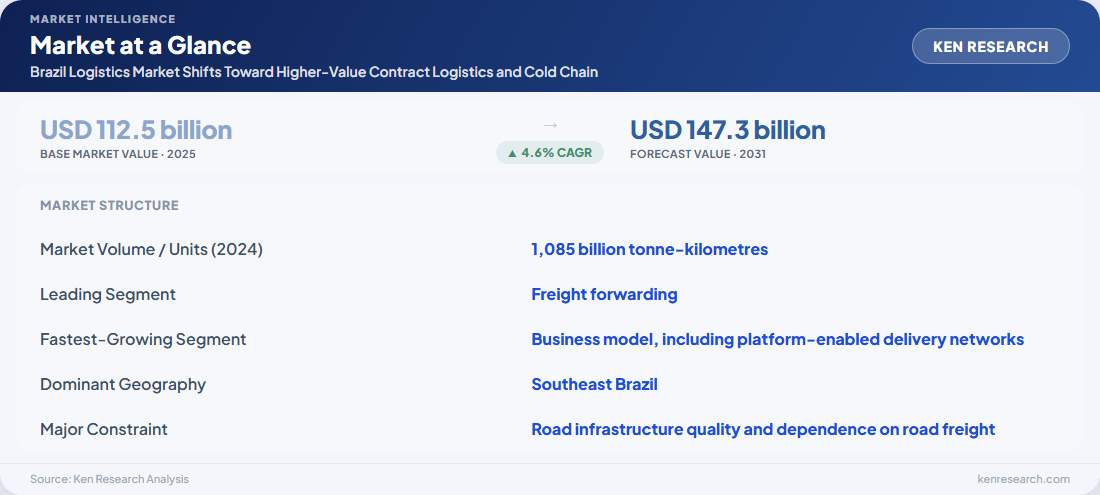
Brazil's logistics market is entering a phase in which integrated services, specialized handling and corridor efficiency matter increasingly alongside freight volumes. According to Ken Research, the market is estimated at USD 112.5 billion in 2025 and is projected to reach USD 147.3 billion by 2031, implying a CAGR of 4.6%. These are proprietary market estimates, not official government statistics. The latest report page contains conflicting horizon labels in its detailed tables, so the published summary figures should be treated as the headline forecast pending clarification.
The commercial shift is from selling transport capacity toward coordinating warehousing, inventory, delivery commitments and specialized freight handling. Brazil's expanding port activity and digital commerce create opportunities for providers that can combine these services, a transition also relevant to the Brazil E-Commerce Logistics Solutions Market. Yet fragmented infrastructure, fuel exposure and uneven road quality can absorb the gains from higher-value services. The central question for investors and procurement leaders is whether service integration can improve contribution margins faster than network complexity raises operating costs.
How Fast Is Brazil's Logistics Market Growing, and What Does the Forecast Mean?
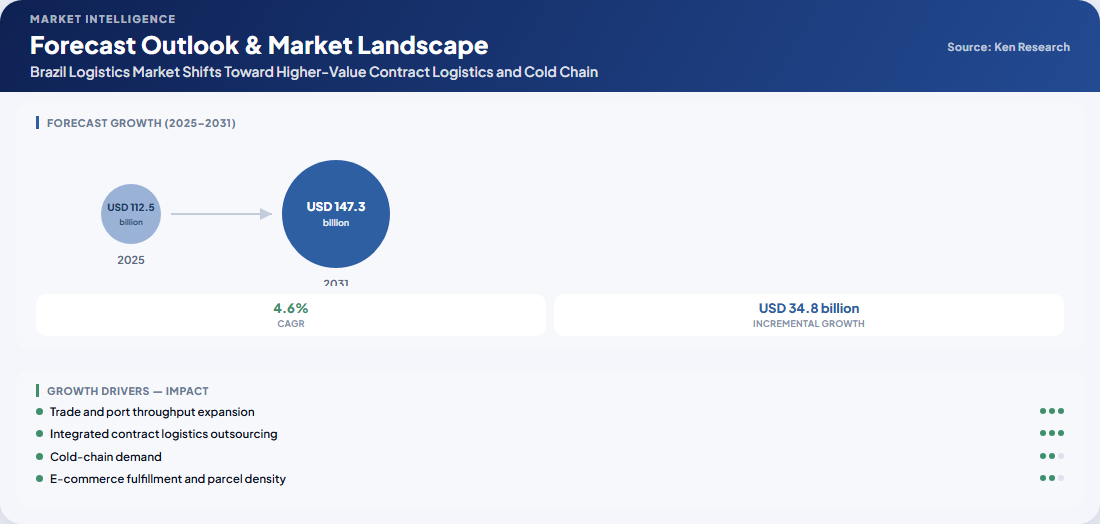
Brazil's logistics market combines substantial scale with moderate projected growth, making productivity and revenue quality more important than headline expansion alone. The current Ken Research summary estimates a move from USD 112.5 billion in 2025 to USD 147.3 billion in 2031, while its detailed tables use a different year alignment. The forecast therefore provides a directional investment framework, but publication-ready financial models should confirm the underlying base year and forecast horizon before using the figures in valuation assumptions.
- USD 34.8 billion in implied market expansion: Subtracting the headline base value from the forecast indicates the additional revenue pool implied by the published summary, not a separately reported market statistic. Providers should assess which services can capture this increment profitably.
- 1,085 billion tonne-kilometres in 2024: Ken Research reports this freight-volume measure as an indicator of Brazil's physical logistics activity. Operators should track utilization and revenue per tonne-kilometre together to distinguish improved service mix from simple increases in movement.
- 4.6% forecast CAGR: The headline growth rate points to a measured expansion trajectory rather than an automatic high-return investment case. Capital allocation should depend on contract duration, asset utilization and the cost of serving each corridor.
The useful distinction is between market expansion and value capture: revenue can rise without equivalent profit growth when fuel, labor, maintenance and empty running remain difficult to control. For strategic planning, the forecast is best treated as a scenario to test against service mix and operating efficiency. That makes the next issue more important than the topline itself: which structural demand mechanisms can improve logistics economics?
Why Are Brazil's Logistics Providers Investing in Integration and Port Connectivity?
Trade flows, port-linked distribution and e-commerce fulfillment are increasing the need to coordinate multiple logistics activities rather than procure isolated transport legs. Brazil's ports handled a record 1.32 billion tonnes of cargo in 2024, up 1.18% from the previous year, according to the Brazilian Ministry of Ports and Airports. Port throughput creates work beyond vessel handling, including inland transport, cargo consolidation, customs coordination and storage around gateway corridors.
Integration can improve economics when one provider coordinates inventory, warehouse capacity, transport scheduling and delivery performance under a common service agreement. However, greater service breadth also increases execution risk: a delayed shipment, inaccurate inventory record or poorly coordinated handoff can affect several activities at once. The adjacent Brazil Supply Chain Market provides a broader context for understanding how transport, warehousing and industry-specific distribution operate as connected parts of the same commercial system.
- 1.32 billion tonnes of port cargo in 2024: The record throughput supports demand for port-hinterland coordination, but individual investments still require corridor-level volume and capacity analysis.
- 95% of Brazilian exports by port, according to the ministry's published account: This relationship underlines the importance of port access to export logistics. Providers should evaluate inland connections and terminal dependencies when pricing international freight services.
- Multiple service stages per shipment: Integrated forwarding, storage and delivery can create more opportunities to earn revenue per customer, provided procurement teams can measure service-level performance and the full cost of execution.
The investment implication is selective integration, not indiscriminate asset expansion. Providers should prioritize corridors where recurring demand, shipment density and predictable service requirements justify additional infrastructure. Government planning also matters because the availability of alternative transport modes can change the economics of these networks, bringing the service mix and customer segments into focus.
Which Brazil Logistics Segments Offer the Strongest Commercial Opportunities?
Freight forwarding remains a core service category, while integrated third-party logistics, cold-chain handling, warehousing and express delivery offer opportunities to monetize more demanding customer requirements. Ken Research identifies business model as the fastest-growing segmentation dimension, with platform-enabled delivery networks benefiting from digital coordination and scalable fulfillment. This distinction matters because a growing business model is not necessarily the same as the fastest-growing revenue segment; investment decisions should separate these two measurements rather than treat them as interchangeable.
Manufacturers, retailers, e-commerce sellers, importers and exporters, and oilfield operators require different combinations of capacity, visibility, handling and reliability. Cold-chain customers, for example, depend on temperature integrity, while industrial shippers may prioritize specialized equipment and predictable delivery windows. The older Brazil Logistics Solutions Market report offers additional historical context, but its market estimate should not be combined with the newer headline series because the published bases differ.
- Freight forwarding: The established revenue anchor connects domestic corridors with imports and exports. Commercial advantage depends on routing expertise, shipment consolidation and control over avoidable handling costs.
- Integrated contract logistics: Bundled transport and warehousing can support longer customer relationships. Providers need transparent service-level agreements and accurate account-level profitability to avoid winning contracts that dilute margins.
- Cold-chain logistics: Temperature-sensitive goods create more demanding operating requirements and potential differentiation. Investment should follow verified customer demand, facility utilization and the cost of maintaining temperature integrity.
- Express delivery and fulfillment: E-commerce expands the need for parcel processing, returns and last-mile execution. Operators should prioritize delivery density and fulfillment productivity instead of relying solely on shipment growth.
The strongest segment is therefore not automatically the largest or the fastest growing. It is the segment where customer willingness to pay for reliability, specialization or coordination exceeds the incremental cost of providing it. That test also determines which competitive capabilities matter most as logistics providers pursue more complex contracts.
How Do Brazil's Logistics Companies Compete Beyond Freight Pricing?
Brazil's logistics competition spans rail and road operators, postal networks, integrated providers, specialist carriers and international express companies. The current Ken Research report identifies America Latina Logistica, Correios, JSL S.A., MRS Logistica and Transpetro among the major participants, while DHL, UPS and FedEx also feature in its competitive coverage. This is an unranked participant set, not a verified market-share league table. Competition depends on geographic reach, asset access, service breadth, technology and the ability to meet customer-specific delivery commitments.
For buyers, the key distinction is between a low quoted transport rate and the total cost of fulfilling a shipment reliably. Missed delivery windows, poor tracking, inventory discrepancies and fragmented invoicing can create costs that are absent from a headline freight quotation. The most useful procurement comparison therefore measures total fulfillment cost, on-time performance, claims, integration effort and flexibility under demand changes. Providers that demonstrate these outcomes can compete on value instead of entering every contract through price concessions.
The strategic consequence is that technology should be evaluated through measurable operating outcomes rather than treated as a differentiator in isolation. Dispatch optimization, shipment visibility and warehouse systems create value only when they improve utilization, reduce exceptions or strengthen service reliability. That brings infrastructure constraints and regulatory implementation into the investment decision.
What Could Weaken Brazil's Logistics Growth and Compress Margins?
Brazil's logistics market faces a structural cost challenge because road transport remains central to freight movement while road quality varies substantially. The Brazilian Institute of Geography and Statistics reported that roads accounted for 64.85% of cargo movement in 2023, while just 12.41% of the country's approximately 1.72 million kilometres of road network was paved. These official figures describe the transport system, not the size of the commercial logistics market, and help explain why maintenance, transit variability and route planning matter to profitability.
Don’t miss the next ken research examines the margin opportunity shift. Ken Research continuously publishes new market intelligence, forecasts and industry analysis. Add Ken Research as a Preferred Source on Google to discover more of our research when your next market question comes up.
Modal diversification could ease some corridor pressures, but changing the transport mix requires suitable infrastructure, reliable connections and commercially viable schedules. Brazil's BR do Mar cabotage programme, established under federal legislation, seeks to encourage coastal shipping and increase service availability. Its commercial effect depends on actual capacity, route suitability and port-to-inland connections; a policy objective alone does not guarantee lower end-to-end costs or immediate modal substitution.
- 64.85% road freight share in 2023: Dependence on roads increases exposure to fuel costs, maintenance and transit disruption. Buyers should assess route alternatives and the reliability of carrier capacity before committing to service-level guarantees.
- 12.41% of roads paved in 2023: The limited paved share of the national network highlights uneven operating conditions. Providers should incorporate route-specific variability into pricing, asset maintenance and delivery commitments.
- Multiple handoffs across transport modes: Intermodal strategies can reduce dependence on a single mode, but additional transfers can introduce delays and handling costs. Procurement teams should compare end-to-end economics rather than linehaul rates alone.
- Specialized infrastructure requirements: Cold storage and integrated fulfillment require sustained utilization to justify capital expenditure. Investors should test demand, energy costs and customer commitments before scaling fixed assets.
The downside case is that logistics revenue expands while operating costs rise just as quickly, leaving providers with little incremental contribution. The upside requires better network planning, stronger contract discipline and infrastructure that supports dependable alternatives. These conditions frame the outlook as a question of execution quality rather than a guaranteed growth outcome.
Which Decisions Will Determine Brazil's Logistics Winners Through 2031?
Brazil's logistics market is projected by Ken Research to expand from USD 112.5 billion in 2025 to USD 147.3 billion in 2031, at a forecast CAGR of 4.6%, subject to clarification of the report's inconsistent detailed year labels. The most defensible commercial priorities are integrated services where customers value reliability, specialized segments where service requirements support differentiation, and corridor investments backed by credible utilization. The main risk is that infrastructure friction, fuel exposure and contract pricing prevent additional revenue from translating into stronger margins.
For operators, investors and procurement leaders, the decision framework is straightforward: measure contribution per shipment, test the full cost of fulfillment, validate demand before adding fixed capacity, and monitor whether multimodal connectivity delivers real operating benefits. The market's scale creates multiple routes to growth, but profitable expansion depends on matching each service to the right customer, corridor and cost structure. For detailed market segmentation, competitive coverage and forecast assumptions, explore the Brazil Logistics Market report from Ken Research.


Comments
Post a Comment