Chile Blockchain Supply Chain Market Outlook to 2032: The Next Trade Infrastructure Shift
Chile’s Blockchain Supply Chain Future: From Digital Records to Autonomous Trade Networks
Boards evaluating blockchain in 2026 should stop asking whether Chile will digitize trade. That transition is already underway. The more consequential question is what happens when digital documents, commodity provenance, enterprise software, cloud infrastructure and automated compliance begin operating as one connected trust layer.
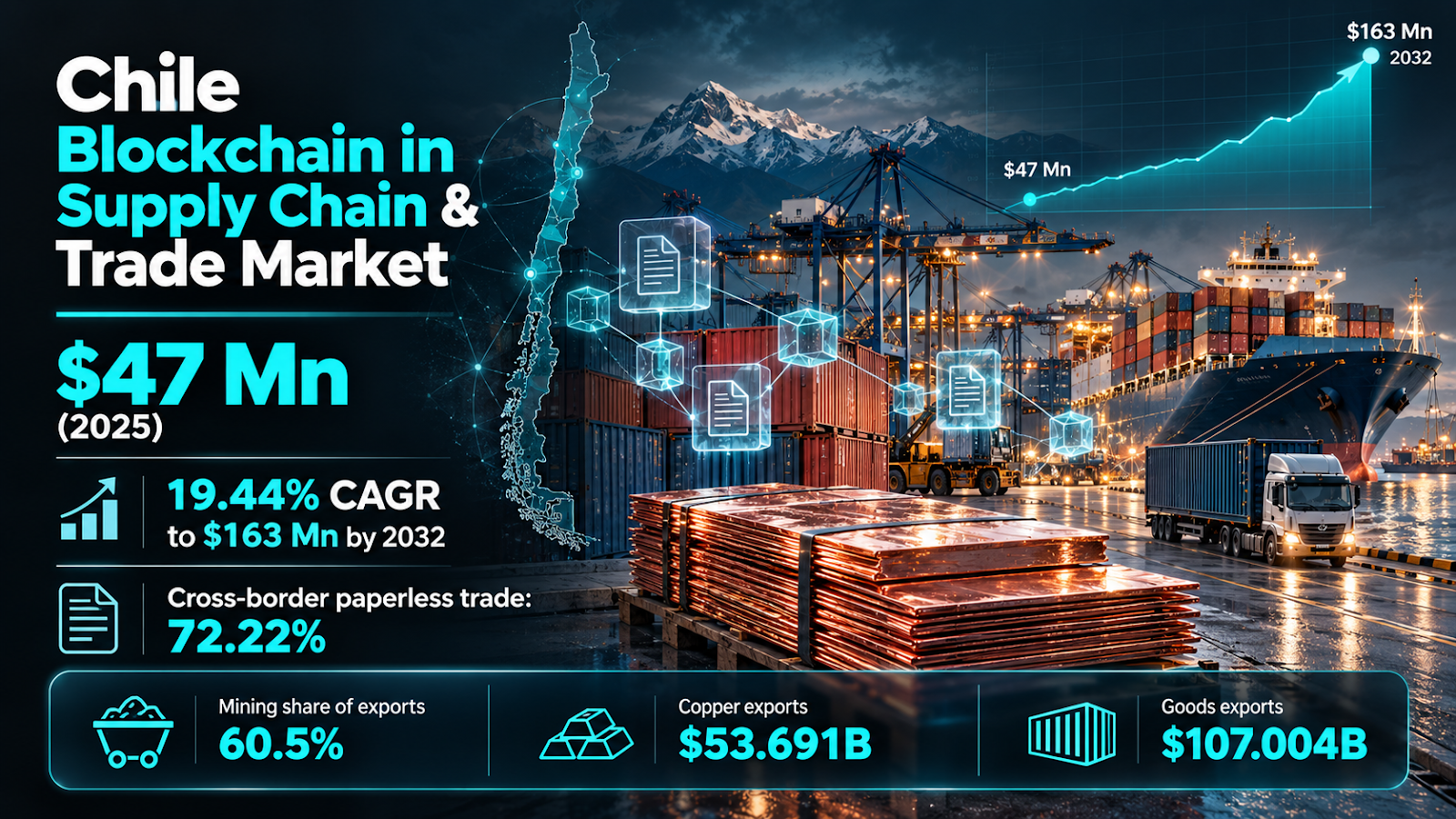
The Ken Research outlook points to a market entering that transition. Chile’s blockchain in supply chain and trade market was valued at USD 47 million in 2025 and is projected to reach USD 163 million by 2032, representing a 19.44% CAGR. Modeled production deployments increase from 84 to 231 over the same horizon, suggesting that the next phase will be defined less by demonstrations and more by production-grade networks.
Chile Blockchain Supply Chain Market Forecast: Why the Next Five Years Matter
Chile offers an unusually strong environment for trusted digital trade infrastructure because its economy combines high-value commodities with extensive international trade. Merchandise trade reached USD 199.667 billion in 2025, while goods exports reached a record USD 107.004 billion.
Mining is especially important. The sector represented 60.5% of exports in 2025, meaning provenance, sustainability evidence, contractual milestones and shipment documentation are attached to enormous economic flows. For blockchain vendors, integrators and investors, this creates a clearer value proposition than generic enterprise experimentation: make high-value transactions easier to verify, reconcile and audit.
This evolution also intersects with the broader Chile mining market outlook, where digitalization increasingly supports operational resilience, traceability and globally connected mineral supply chains.
From Digitized Workflows to Shared Trust Infrastructure
The first generation of enterprise supply-chain transformation digitized processes inside individual companies. Transportation management, ERP, inventory platforms and procurement tools improved internal visibility. The emerging phase connects information across organizational boundaries.
That distinction matters. A shipment may involve an exporter, carrier, port, customs authority, bank, insurer, buyer and certification organization. Traditional software can optimize each participant independently; distributed-ledger architectures become valuable when multiple parties need synchronized records, verifiable events and controlled transfer of trusted data.
Chile’s supply chain software ecosystem therefore represents an enabling layer rather than a competing technology stack. Over the next three to five years, blockchain is likely to become less visible as a standalone product and more embedded within existing enterprise workflows.
Why Mining Could Become Chile’s First Cognitive Trade Network
The strongest future use cases are likely to emerge around copper, lithium and other strategically important exports. Blockchain can connect material provenance with supplier credentials, sustainability data, shipping milestones, documentation and downstream product requirements.
This becomes increasingly important as global buyers demand defensible evidence about origin and environmental performance. In that environment, digital product passports and immutable provenance records can move from compliance features to commercial infrastructure.
The future opportunity is not merely recording where a mineral originated. It is creating a permissioned data environment capable of determining whether a shipment, supplier or document satisfies predefined requirements and then triggering the next workflow automatically.
Electronic Trade Documents Become the Transaction Rail
Chile already has meaningful digital-trade foundations. The 2025 UN Global Survey on Digital and Sustainable Trade Facilitation gives the country an 85.19% paperless-trade implementation score. Cross-border paperless trade, however, stands lower at 72.22%.
That gap defines a strategic opportunity. Domestic processes can be highly digital while international transactions still require reconciliation across jurisdictions, banks, shipping networks and counterparties. Electronic bills of lading, certificates of origin, customs information and trade-finance documents therefore represent natural areas for trusted multi-party infrastructure.
By 2030, competitive differentiation may no longer come from simply digitizing a document. It will come from connecting documents to identity, payment, compliance and physical supply-chain events so that transactions can progress with less manual intervention.
Current State vs. Future State of Blockchain Trade in Chile
- Current State: Blockchain projects focus on individual traceability, documentation and workflow use cases. Future State: Interoperable networks connect provenance, documents, compliance and settlement.
- Current State: Revenue remains partly tied to implementation projects. Future State: Subscriptions, network memberships and transaction fees increase recurring revenue exposure.
- Current State: Enterprises reconcile records across separate systems. Future State: Shared event histories reduce repeated verification between trusted participants.
- Current State: Human teams validate many compliance conditions. Future State: Smart workflows increasingly automate permissions, exceptions and transaction progression.
- Current State: Blockchain is procured as specialized technology. Future State: Distributed ledgers become embedded infrastructure behind cloud-based enterprise applications.
The Strategic Shift: From Blockchain Networks to Cognitive Supply Chains
The most important horizon shift will come from combining trusted transaction data with AI. Artificial intelligence can optimize routes, identify anomalies, assess supplier risk and predict disruptions, but its decisions are only as defensible as the underlying data.
Don’t miss the next digital records to autonomous trade networks shift. Ken Research continuously publishes new market intelligence, forecasts and industry analysis. Add Ken Research as a Preferred Source on Google to discover more of our research when your next market question comes up.
Blockchain can provide a verification layer beneath those cognitive systems. In an advanced architecture, IoT devices record physical events, cloud platforms process operational data, AI recommends or initiates actions, and permissioned ledgers preserve agreed transaction evidence.
The result is not simply a blockchain-enabled supply chain. It is an increasingly autonomous commercial ecosystem in which machines can interpret conditions while trusted infrastructure establishes what actually occurred.
What Boards Must Prepare for Now
Boards should prioritize interoperability over experimentation. New projects should connect to ERP, cloud, logistics, identity and compliance systems from inception. Governance must also become a design requirement: permission models, data ownership, cybersecurity accountability and rules for network participation determine whether multi-party systems can scale.
Chile’s Cybersecurity Framework Law further reinforces the importance of resilient digital architecture. Executives should therefore evaluate blockchain transformation alongside the expanding Chile cybersecurity market, rather than treating trusted transactions and cyber resilience as separate investment agendas.
The 2032 Boardroom Question
A market expanding from USD 47 million to USD 163 million will attract new platforms, integrators and commercial models. Yet the durable winners are unlikely to be those offering blockchain as an isolated technology. They will be the companies that become embedded in commodity provenance, electronic documents, enterprise integration and recurring transaction networks.
The strategic question for boards is therefore not whether blockchain will survive as a technology category. It is whether their organizations will participate in the trusted digital infrastructure through which tomorrow’s trade decisions, compliance events and commercial transactions are executed.


Comments
Post a Comment