Kenya Dairy Products Market Shifts Toward Higher-Value Products and Formal Distribution
Kenya’s Dairy Market Is Moving Beyond Volume: Ken Research Examines the Race for Better Milk Realization
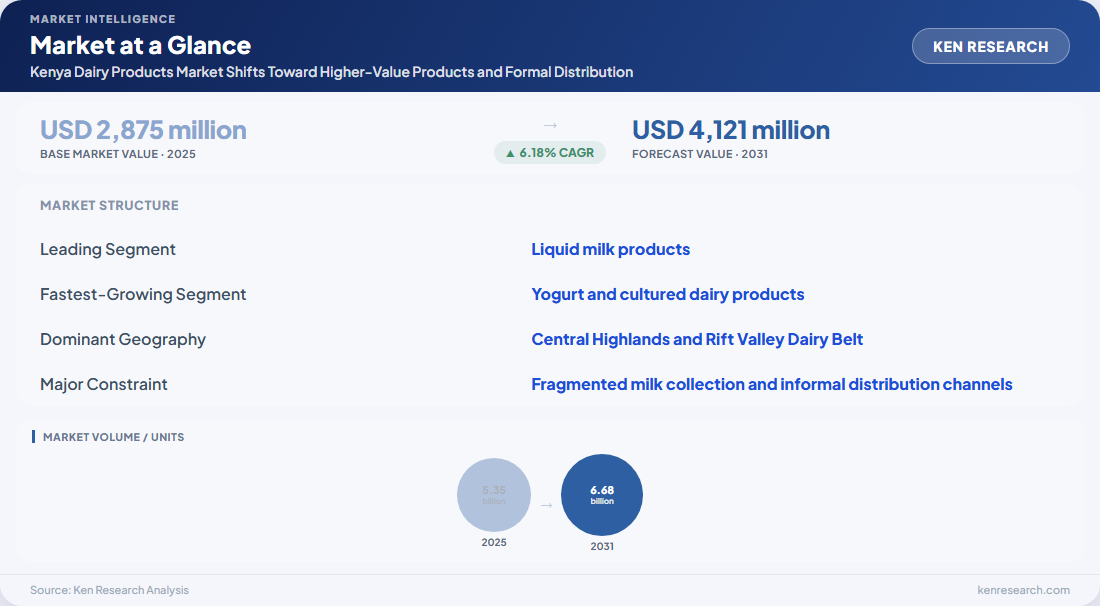
Kenya dairy products market is entering a commercially important phase in which the ability to collect, process, package and distribute milk reliably will increasingly determine who captures value. According to Ken Research, the market was valued at USD 2,875 million in 2025 and is forecast to reach USD 4,121 million by 2031, representing a compound annual growth rate (CAGR) of 6.18% over 2026–2031. The outlook points to a large, recurring consumer market where incremental growth will depend on both milk availability and the economics of moving dairy into higher-value commercial channels.
The underlying shift is not simply that Kenyan households consume dairy. It is that more of the value chain can be captured through dependable collection, standardized quality, packaged products and differentiated formats. Urban refrigeration, processor investment and consumer access to fresh, long-life and cultured dairy can support this transition. Yet the commercial opportunity varies sharply by location, household purchasing power and the ability of processors to maintain supply throughout the year.
Execution remains the counterweight to the growth forecast. Fragmented milk sourcing, feed costs, seasonal supply fluctuations and affordability constraints can reduce margins even as market revenue expands. Demand for specialized nutrition products also needs to be assessed independently of general dairy consumption. The adjacent Kenya Baby Food and Infant Nutrition Market provides useful context on the wider nutrition category, but its outlook should not be treated as a direct proxy for dairy sales.
Market scope matters when interpreting the forecast. The Kenya dairy products market estimate covers domestic raw and processed dairy products sold through formal and informal channels, together with imported dairy products consumed locally; exports are excluded. Its commercial footprint therefore extends beyond branded packaged milk to a broader ecosystem of producers, cooperatives, processors, traders, retailers and foodservice buyers.
Market value is growing faster than milk-equivalent volume
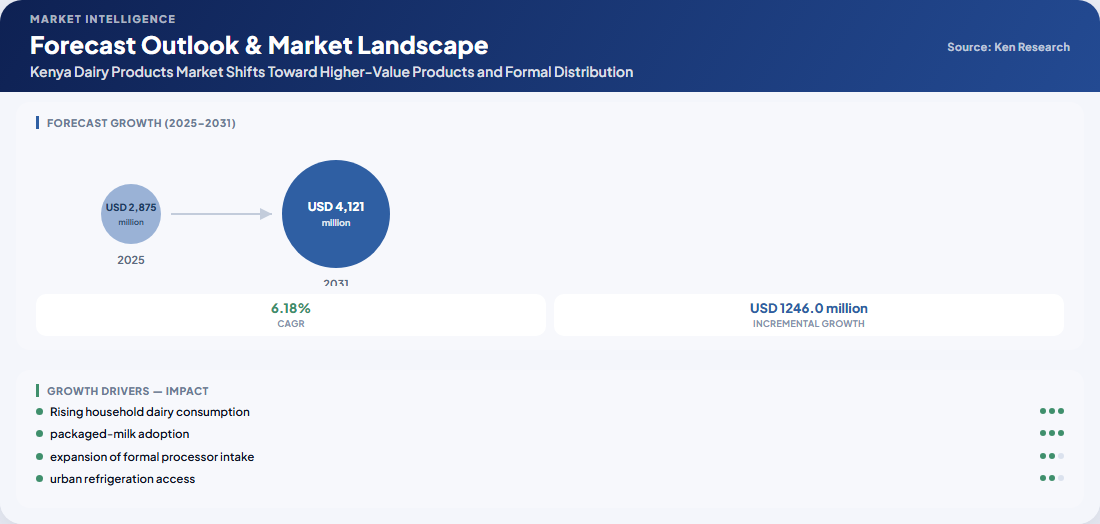
The market forecast implies an increase of USD 1,246 million between the 2025 base year and 2031. The report also estimates that milk-equivalent volume will rise from approximately 5.35 billion litres in 2025 to 6.68 billion litres by 2031. These figures describe different dimensions of market development: physical volume reflects the underlying dairy pool, while revenue also responds to product mix, processing, packaging and realized prices.
This distinction matters for business planning. Volume expansion creates opportunities for milk collection, processing capacity and distribution density. Revenue growth above the rate of physical-volume expansion, meanwhile, makes it important to understand whether the value increase comes from premium products, improved channel realization, higher prices or a combination of these factors. A processor cannot assume that market-level revenue growth will translate directly into higher profitability.
Historical market value growth was estimated at 6.48% CAGR during 2020–2025, followed by the forecast 6.18% CAGR for 2026–2031. The moderation is consistent with a market that remains attractive but increasingly requires disciplined execution rather than reliance on headline growth alone.
For investors and operators, the useful question is how much incremental revenue can be converted into sustainable operating earnings. That requires examining procurement costs, factory utilization, spoilage, packaging expenses, product returns and the cost of reaching fragmented retail outlets. Market expansion establishes the opportunity; unit economics determine how much of it a company can retain.
The informal milk economy is the industry's biggest conversion opportunity
Kenya's dairy system combines smallholder production, cooperative collection, informal milk trading, industrial processing and modern retail. Informal channels remain commercially significant because they connect producers and consumers without requiring every litre to pass through an industrial processor. They also create a challenge for businesses seeking consistent quality, traceability, branded distribution and predictable procurement volumes.
Formalization is therefore better understood as a change in how milk is handled and monetized than as a simple replacement of one seller by another. Cooling facilities, testing, scheduled collection and reliable transport can help convert dispersed production into a more consistent industrial input. Better coordination can also reduce rejected milk, improve factory utilization and give farmers clearer incentives to meet quality requirements.
The broader Africa Dairy Products Market forecast highlights the scale of the continental opportunity, projecting growth from USD 65,861 million in 2025 to USD 89,628 million by 2032. Kenya's position within this broader landscape depends on local execution, however. Regional market growth does not eliminate the need to build viable collection routes, maintain cold storage or offer prices consumers can afford.
What formalization changes for each participant
- Farmers and cooperatives: Better cooling, quality testing and organized collection can support more dependable market access and quality-linked payment arrangements.
- Processors: More consistent raw-milk supply can improve production planning, reduce quality losses and increase the utilization of installed capacity.
- Retailers and distributors: Standardized products and more reliable replenishment can improve stock management, availability and consumer confidence.
- Investors: Collection infrastructure, testing, cooling and route-to-market services may offer opportunities alongside investments in finished dairy brands.
These gains are not automatic. Cooling equipment requires dependable energy, maintenance and sufficient milk throughput to justify investment. Collection networks also need transparent pricing and trusted relationships with farmers. A formal channel that adds handling costs without improving quality, reliability or consumer value may struggle to compete with informal alternatives.
Liquid milk protects the volume base while cultured products expand the value opportunity
Liquid milk remains the core product category because it serves frequent household consumption, foodservice preparation and institutional demand. Fresh packaged milk and UHT formats meet different distribution and storage needs: chilled products depend more heavily on cold-chain execution, while shelf-stable products can reach markets where refrigeration is less reliable. The choice between these formats is consequently an operational decision as much as a consumer proposition.
Yogurt and cultured dairy products are identified in the market report as a faster-growing product opportunity over the forecast period. These products give processors scope to differentiate through texture, flavour, pack size and positioning. They can also improve revenue per unit of milk input when pricing, formulation, shelf life and production costs are managed effectively.
That opportunity should not be confused with guaranteed premium pricing. Consumer demand depends on household budgets, product availability, perceived freshness and trust in the brand. Products positioned above everyday milk prices need a clear reason for consumers to buy them repeatedly, rather than only during promotional periods.
Product strategy should match the economics of the channel
- Fresh milk: Prioritize rapid turnover, consistent quality and reliable refrigerated distribution.
- UHT milk: Evaluate shelf-life advantages against processing, packaging and production-line investment.
- Yogurt and fermented milk: Focus on repeat purchase, product consistency, pack affordability and efficient cold-chain coverage where required.
- Cheese, butter, cream and specialist products: Match production capacity to verified demand from households, hospitality, food manufacturers and institutional buyers.
- Milk powders and ingredients: Assess their role in supply balancing and input procurement without assuming that every processor has the scale to compete efficiently in these categories.
The strongest portfolios are likely to combine high-frequency core products with selected higher-value formats. A broad catalogue can help serve different customer groups, but excessive complexity can increase inventory requirements, changeover costs and the risk of unsold stock. Category expansion should therefore follow demonstrated demand and the manufacturer's ability to produce and distribute consistently.
Cold-chain reliability and procurement density will shape regional economics
Kenya's dairy production is concentrated in the Central Highlands and Rift Valley dairy belt. This concentration supports collection density and gives processors access to established production areas, but it can also expose procurement networks to localized feed, weather and transport disruptions. The commercial objective is to secure dependable milk volumes without building a cost base that is too large for the available supply.
For processors, collection geography affects the delivered cost of raw milk. Longer routes, low volumes per collection stop, unreliable refrigeration and inconsistent quality can erode the economics of otherwise attractive products. For distributors, the corresponding challenge is maintaining availability across markets with different levels of retail density, refrigeration and purchasing power.
Regional expansion should therefore be assessed route by route. A city or county may offer attractive consumer demand but remain uneconomic to serve with a highly perishable product if delivery frequency, retailer throughput and return logistics are weak. Shelf-stable formats may be better suited to some routes, while chilled dairy can be more attractive in dense markets with dependable replenishment.
Technical resources from the Food and Agriculture Organization's dairy production and products programme provide general context for milk handling and production systems. For Kenya-specific investment decisions, such guidance should be combined with verified national production statistics, local operating data and the actual condition of collection and distribution infrastructure.
Competition is a contest for supply access, brand trust and distribution execution
The Kenya dairy products market includes established processors, farmer-owned cooperatives, specialist dairy businesses and smaller regional operators. Brookside Dairy Limited, New Kenya Cooperative Creameries Limited, Githunguri Dairy Farmers Co-operative Society, Meru Central Dairy Co-operative Union and Bio Food Products Limited are identified among the major market participants in the published Ken Research report.
These participants operate with different business models and supply-chain strengths. A cooperative can combine farmer relationships with processing and branded sales, while a larger processor may compete through a broader product portfolio, distribution reach and production scale. Smaller specialists may have opportunities in focused product categories or regional channels where local relationships and a clear proposition matter more than national reach.
The available market summary identifies major companies but does not establish verified percentage market shares for each participant. A precise ranking by revenue share should therefore not be inferred from company prominence alone. Competitive assessment should distinguish market presence, processing capacity, procurement access, geographic reach and product specialization from measured share of market sales.
For new entrants, the key question is not whether Kenya consumes enough dairy to support another brand. It is whether the entrant can secure reliable inputs, meet applicable quality requirements, deliver products at an acceptable cost and earn repeat purchases. Partnerships with cooperatives, distributors or institutional buyers may reduce some barriers, but they do not remove the need for dependable operating economics.
Affordability, feed costs and quality control are the main tests of growth
A positive market forecast does not guarantee that all product categories will grow at the same pace or that processors will pass every input-cost increase on to consumers. Feed, animal health, energy, packaging, transport and refrigeration all influence the economics of dairy production and distribution. If these costs rise faster than realized selling prices, margins can contract even while nominal market value increases.
Affordability is especially important in a high-frequency food category. Households may continue purchasing dairy while shifting toward smaller packs, less expensive products or informal alternatives. Premiumization can create additional revenue, but it needs to coexist with price points that sustain repeat consumption. Overestimating consumers' willingness to pay can leave processors with expensive inventory and insufficient throughput.
Quality control creates a related operational trade-off. Testing, traceability, hygienic handling and suitable storage can increase near-term costs, but poor control can lead to product losses, inconsistent quality and reduced consumer confidence. Businesses that integrate quality requirements into procurement and production planning are better positioned to build a durable formal-channel proposition.
Four questions for commercial due diligence
- Supply resilience: Can the business secure sufficient raw milk throughout seasonal fluctuations, and at what delivered cost?
- Consumer economics: Do product prices and pack sizes fit the purchasing patterns of the target customer?
- Distribution productivity: Are delivery routes, refrigeration assets and retailer relationships generating adequate throughput?
- Compliance and quality: Can the company consistently meet applicable food-safety, handling, labelling and product requirements?
Official Kenyan agricultural and statistical publications are the appropriate starting points for checking national production, policy and regulatory developments. The Kenya National Bureau of Statistics and the Ministry of Agriculture and Livestock Development should be consulted for the relevant published data and current policy documents. These sources serve a different purpose from a proprietary market-sizing model and should not be blended without clear definitions.
Investment priorities should follow proven unit economics, not market growth alone
The forecast creates potential opportunities across several parts of the dairy value chain. However, investment priorities should reflect the specific constraint a business can solve, the customers willing to pay for that solution and the utilization required to make the investment viable.
- Collection and cooling: Assess locations where greater collection density and better milk handling can reduce losses or improve processor access to supply.
- Processing and packaging: Match capacity investments to forecast demand, product mix, line utilization and the economics of shelf-stable versus chilled formats.
- Value-added products: Test demand for yogurt, fermented dairy and other differentiated formats before committing to a large product range.
- Distribution: Prioritize routes where sales density, retailer turnover and replenishment reliability support sustainable delivery costs.
- Data and quality systems: Use procurement records, quality testing and inventory visibility to improve planning, reduce avoidable losses and support consistent standards.
These priorities also need to be evaluated against the broader dairy industry's movement toward product differentiation. The Global Dairy Products Market outlook provides context on the role of functional and specialty dairy in the wider industry. For Kenyan operators, the relevant lesson is not to copy global product trends indiscriminately, but to identify formats that fit local consumer needs, ingredient availability, price expectations and distribution capabilities.
Kenya dairy products market outlook through 2031
The Kenya dairy products market is forecast to grow from USD 2,875 million in 2025 to USD 4,121 million in 2031, at a 6.18% CAGR. Rising household demand, a substantial milk-production base and opportunities to expand formal processing provide a supportive foundation. Cultured dairy, packaged formats and improved collection systems could create additional commercial value, provided that companies can maintain affordability and reliable supply.
The central strategic tension is between the scale of Kenya's recurring dairy demand and the cost of converting dispersed milk production into consistent, branded products. Growth will not be captured equally by every processor or product category. Businesses with strong procurement relationships, disciplined product portfolios, efficient distribution and credible quality systems are better positioned to translate market expansion into durable performance.
For businesses evaluating market entry, expansion or investment, the next step is to examine the full market-sizing framework, product segmentation, distribution structure, competitive participants and forecast assumptions. The Kenya Dairy Products Market report provides the detailed market assessment needed to evaluate these decisions against the projected outlook through 2031.
Don’t miss the next the race for better milk realization shift. Ken Research continuously publishes new market intelligence, forecasts and industry analysis. Add Ken Research as a Preferred Source on Google to discover more of our research when your next market question comes up.


Comments
Post a Comment