Kenya Fertilizer Market Policy Shifts Creating New Growth Opportunities for Agri-Input Leaders
Kenya Fertilizer Crop Inputs Market: How Government Policy Is Creating the Next Agricultural Growth Wave
Government policy has become the defining market force shaping Kenya’s fertilizer and crop-input ecosystem. As food security priorities, farmer affordability programmes and agricultural modernization initiatives accelerate, input suppliers are moving into a market where regulatory alignment is becoming a competitive advantage rather than only a compliance requirement.
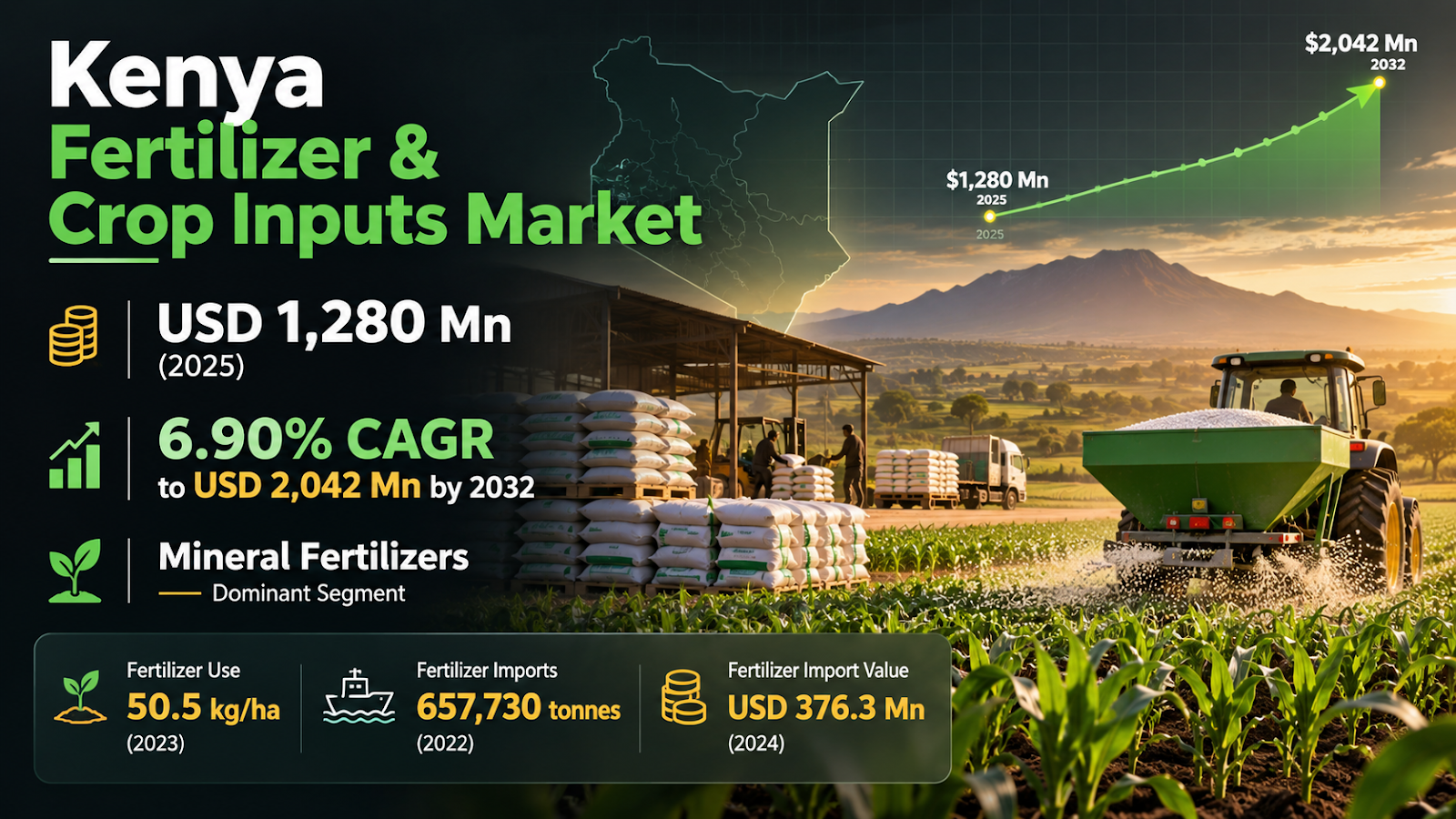
The Kenya Fertilizer & Crop Inputs Market was valued at USD 1,280 million in 2025 and is projected to reach USD 2,042 million by 2032, expanding at a CAGR of 6.90%. The market includes mineral fertilizers, crop protection products, certified seeds and biological or specialty agricultural inputs.
Policy Shift: Fertilizer affordability programmes are reshaping market access
The Kenyan government’s fertilizer support initiatives are changing the relationship between farmers, suppliers and distribution networks. Public intervention is improving affordability while creating predictable seasonal demand cycles for qualified suppliers.
- Government-backed fertilizer subsidy programmes are increasing access to essential agricultural inputs by reducing affordability barriers for farmers, creating higher demand visibility for manufacturers, importers, logistics providers and agro-dealers.
- The 2025 agricultural budget framework allocated KES 8 billion toward the fertilizer subsidy programme, demonstrating continued policy focus on input accessibility and food security objectives.
- Companies participating in policy-supported supply channels must strengthen compliance systems, inventory planning and distribution partnerships because government-linked demand requires operational reliability at scale.
Market Impact: Regulation is accelerating formalization across the input ecosystem
Government policy is not only influencing fertilizer volumes; it is also changing how value is captured across the agricultural supply chain. Digital farmer registration, subsidy governance and formal distribution networks are increasing transparency while reducing inefficiencies.
Kenya’s agricultural ecosystem is gradually shifting from fragmented input sales toward coordinated platforms combining procurement, logistics, farmer engagement and agronomic support. This creates opportunities for companies that can integrate physical distribution with digital capabilities.
- Suppliers with strong county-level dealer networks can capture greater market share because last-mile availability remains a critical factor during planting seasons and subsidy distribution cycles.
- Companies investing in authenticated products, agronomic advisory services and farmer education can differentiate beyond price competition in a market where trust and productivity outcomes increasingly influence purchasing decisions.
- Digital agricultural systems create new opportunities for targeted input delivery by improving visibility into farmer demand patterns and resource allocation.
Strategic Action: Early movers should align with the new regulatory architecture
The relationship between government policy and market outcomes is direct: policy determines affordability, procurement structures influence demand flows, and compliance frameworks determine which companies can participate effectively.
For corporate leaders, the opportunity is not limited to selling fertilizer. The next growth phase will involve building integrated agricultural input ecosystems.
1. Build policy-aligned distribution capabilities
Companies entering Kenya’s fertilizer market should prioritize partnerships with authorized distributors, regional warehouses and agro-dealer networks. Distribution capability will increasingly determine who can convert policy-driven demand into commercial growth.
2. Expand beyond conventional fertilizer categories
Mineral fertilizers remain the largest revenue pool, but specialty nutrition, biological inputs and improved crop solutions represent emerging value pools. Suppliers that combine fertilizer portfolios with crop protection, seeds and advisory services can improve customer retention.
3. Prepare for stronger compliance requirements
As agricultural regulation evolves, companies must maintain product registration discipline, quality assurance processes and transparent supply chains. Compliance capability will become a market-entry advantage for international and domestic operators.
Don’t miss the next creating the next agricultural growth wave shift. Ken Research continuously publishes new market intelligence, forecasts and industry analysis. Add Ken Research as a Preferred Source on Google to discover more of our research when your next market question comes up.
Regulatory Catalyst: Why strategic alignment matters now
Kenya’s fertilizer market opportunity is being created through the interaction of three forces: government intervention, agricultural productivity goals and private-sector innovation.
The market’s growth trajectory provides opportunities for fertilizer companies, crop-input manufacturers, investors and logistics providers. However, success will depend on understanding policy direction and adapting operating models accordingly.
- Investors should evaluate companies based on policy readiness, distribution depth, supply-chain resilience and ability to participate in formal agricultural programmes.
- Input manufacturers should diversify supply sources and develop differentiated products to reduce exposure to commodity price volatility.
- Agricultural technology providers should focus on digital platforms that improve farmer access, subsidy transparency and input efficiency.
Conclusion: Policy intelligence will define future winners in Kenya agriculture
The Kenya Fertilizer & Crop Inputs Market is entering a phase where government policy is becoming a strategic market driver. Subsidy programmes, agricultural modernization initiatives and formal distribution systems are creating new opportunities for companies capable of aligning commercial strategy with national priorities.
Organizations that understand regulatory shifts early can position themselves across procurement networks, specialty input growth and digitally enabled agricultural services.
Access the Ken Research Policy Impact Toolkit to align your corporate strategy with the latest regulatory frameworks immediately.


Comments
Post a Comment