Nigeria Fintech & Neobank Market Outlook 2031: From Digital Payments to Cognitive Finance
Beyond Digital Banking: Nigeria’s Fintech Ecosystem Is Moving Toward Cognitive Finance
The next chapter of Nigeria’s fintech story will not be defined simply by how many wallets are downloaded, transfers are processed or accounts are opened. It will be defined by how intelligently financial platforms can convert transaction activity into continuous, context-aware financial relationships.
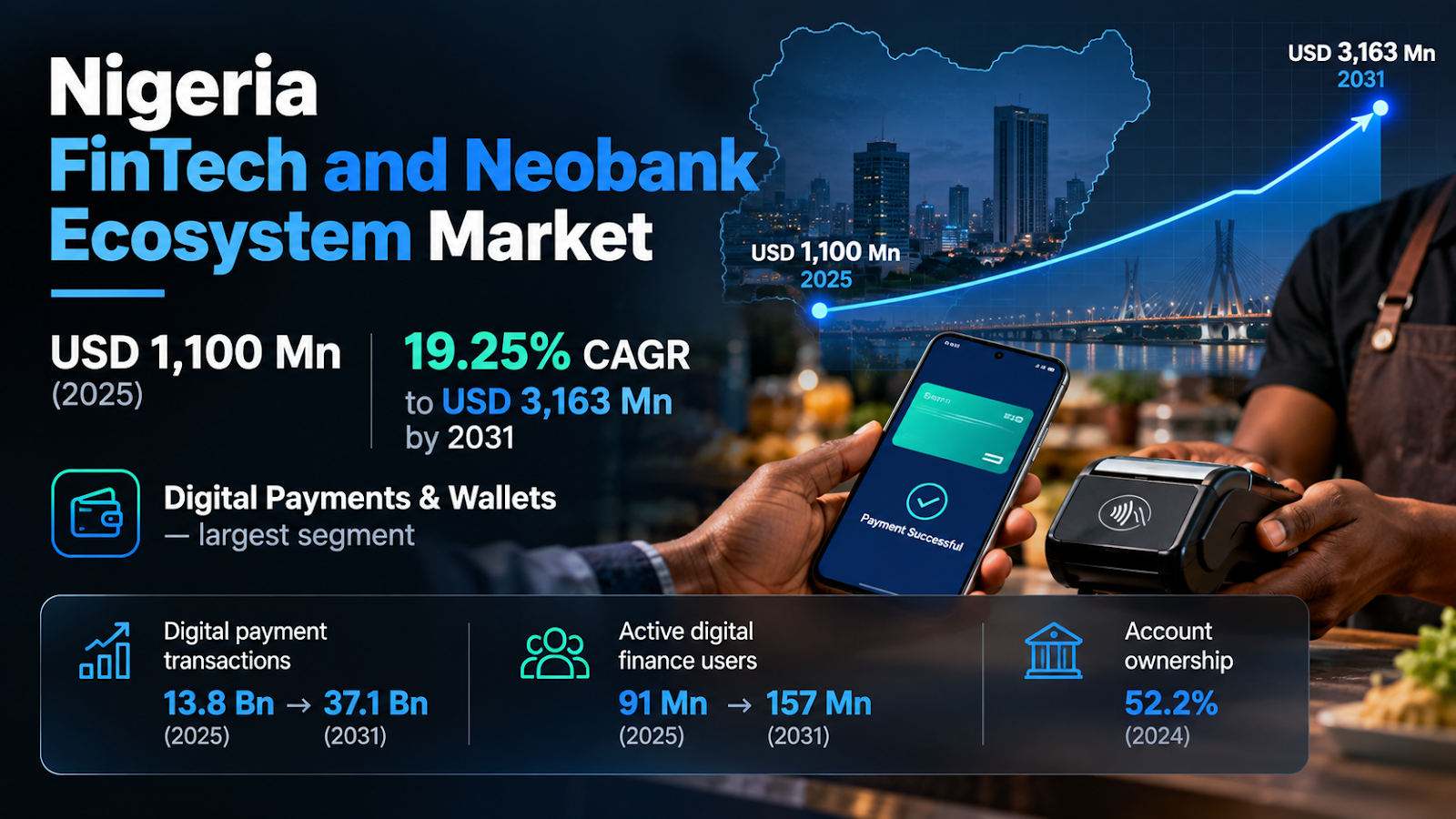
Ken Research estimates that the Nigeria FinTech and Neobank Ecosystem Market generated USD 1.10 billion in 2025. The market is forecast to reach USD 3.163 billion by 2031, representing a 19.25% CAGR. That expansion follows a 24.68% historical CAGR from 2020 to 2025, signalling that the industry is moving from an explosive acquisition phase toward a more sophisticated monetization cycle.
Nigeria Fintech and Neobank Market Forecast Through 2031
The headline forecast matters, but its composition matters more. Digital payments and wallets remain the ecosystem’s primary acquisition engine, while Ken Research expects growth increasingly to come from merchant acquiring, digital credit, subscriptions, savings, insurance distribution, cross-border payments and embedded financial infrastructure.
Digital payment transactions are modeled to increase from approximately 13.8 billion in 2025 to 37.1 billion by 2031. Active digital-finance users could reach roughly 157 million across overlapping consumer and business relationships. The strategic implication is clear: transaction volume creates distribution, but deeper financial relationships create economic value.
This direction is reinforced by the adjacent Nigeria Digital Banking and Neobanks Market outlook, where recurring savings, merchant services, responsible credit and embedded-finance partnerships emerge as increasingly important sources of monetization.
Why the Next Nigeria Digital Finance Cycle Will Look Different
Nigeria has already built much of the behavioral foundation required for the next phase. EFInA reported that formal financial inclusion increased from 56% in 2020 to 64% in 2023, while financial exclusion declined to 26%. Meanwhile, the Central Bank of Nigeria has pursued a payments strategy focused on electronic adoption, infrastructure resilience, innovation and financial inclusion.
For executives, this means the strategic question changes. The market is no longer only asking, “Can consumers transact digitally?” The emerging question is, “How many financial decisions can a platform intelligently support around each customer, merchant and transaction?”
Current State vs. Future State of Nigeria’s Fintech Ecosystem
- Current State: Payment-led acquisition. Future State: Relationship-led monetization. Payments become the entry point for lending, savings, merchant software, insurance and treasury services.
- Current State: Standalone financial applications. Future State: Embedded finance. Payments, verification, accounts and credit move directly into commerce, payroll, logistics and enterprise-software journeys.
- Current State: Rule-based risk controls. Future State: Cognitive risk orchestration. AI models increasingly combine transaction behavior, identity signals and account patterns to support fraud detection and underwriting.
- Current State: Reactive customer service. Future State: Proactive financial guidance. Intelligent systems can anticipate cash-flow gaps, savings opportunities and merchant working-capital requirements.
- Current State: Platform-specific data. Future State: Consent-driven financial interoperability. Open-banking infrastructure makes approved customer data portable across participating providers.
Four Nigeria Fintech Market Shifts Boards Should Prepare for Now
1. AI Moves From Interface to Operating System
Generative assistants will be visible, but the deeper transformation will happen below the interface. AI can increasingly influence fraud monitoring, credit decisioning, collections prioritization, merchant segmentation and personalized product selection. The competitive advantage will come from proprietary data loops and disciplined risk governance rather than chatbot novelty.
2. Digital Identity Becomes Core Financial Infrastructure
As remote onboarding and financial automation expand, trusted identity becomes foundational. The Nigeria Digital Identity and eKYC Platforms Market highlights growing demand for biometric verification, authentication, identity management and fraud-prevention capabilities. In the next market cycle, identity infrastructure will increasingly determine how quickly fintechs can onboard users without compromising compliance or trust.
3. Open Banking Expands the Competitive Surface
CBN’s open-banking guidelines establish responsibilities for participants, customer-consent principles and an Open Banking Registry. As implementation deepens, financial products can become more interoperable. Banks, fintechs and non-financial digital platforms may compete around the same customer relationship, forcing boards to rethink whether their defensible asset is the account, the interface, proprietary data, distribution or decision intelligence.
4. Merchant Finance Becomes a Strategic Battleground
Consumer transfers created scale; merchants can create depth. Business accounts, working-capital credit, payment acceptance, invoicing, reconciliation, payroll and treasury tools can turn fintech platforms into operating infrastructure for Nigerian enterprises. This is where transaction data and AI-driven underwriting can reinforce one another.
Don’t miss the next ecosystem is moving toward cognitive finance shift. Ken Research continuously publishes new market intelligence, forecasts and industry analysis. Add Ken Research as a Preferred Source on Google to discover more of our research when your next market question comes up.
Where the Next Fintech Profit Pools Will Form
Cross-border finance represents another significant layer. The Nigeria Remittance and Cross-Border Transfers Market is forecast to expand as digital channels, direct-to-account settlement and API connectivity improve. When combined with merchant services and embedded finance, cross-border capabilities can help platforms serve exporters, freelancers, digital businesses and diaspora-linked households through broader financial relationships.
The broader direction is toward an ecosystem in which identity verifies the participant, payment rails capture activity, AI interprets behavior, APIs distribute products and embedded finance delivers the next best financial action inside the customer’s existing workflow.
What Should Be on the Board Agenda for 2027-2031?
Boards should therefore assess their strategies against four capabilities: proprietary distribution, decision-grade data, regulatory resilience and multi-product monetization. Management teams should also test whether technology architecture can support real-time personalization, interoperable APIs and increasingly autonomous risk decisions without sacrificing explainability, privacy or operational control.
The USD 3.163 billion 2031 forecast is not simply a growth story. It signals a structural transition from digital financial access toward intelligent financial orchestration. Companies that remain dependent on subsidized transfers or isolated products risk competing on increasingly compressed economics. Platforms that connect transactions, identity, credit, merchant workflows and intelligence can build far more durable relationships.
Explore the full Nigeria FinTech and Neobank Ecosystem Market report for detailed forecasts, segmentation, competitive intelligence and strategic scenarios. Schedule a strategic foresight session with Ken Research analysts to align your long-term vision with market realities.


Comments
Post a Comment