Nigeria Fleet Management Analytics Market Outlook 2032: The Rise of Cognitive Fleets
Nigeria Fleet Management Analytics Market: Building the Cognitive Fleet of 2032
By 2032, Nigeria’s most sophisticated commercial fleets will no longer be managed primarily through maps, phone calls and retrospective spreadsheets. Vehicles will increasingly behave like connected operating assets: continuously transmitting location, fuel, maintenance, driver and route data into platforms that predict what should happen next.
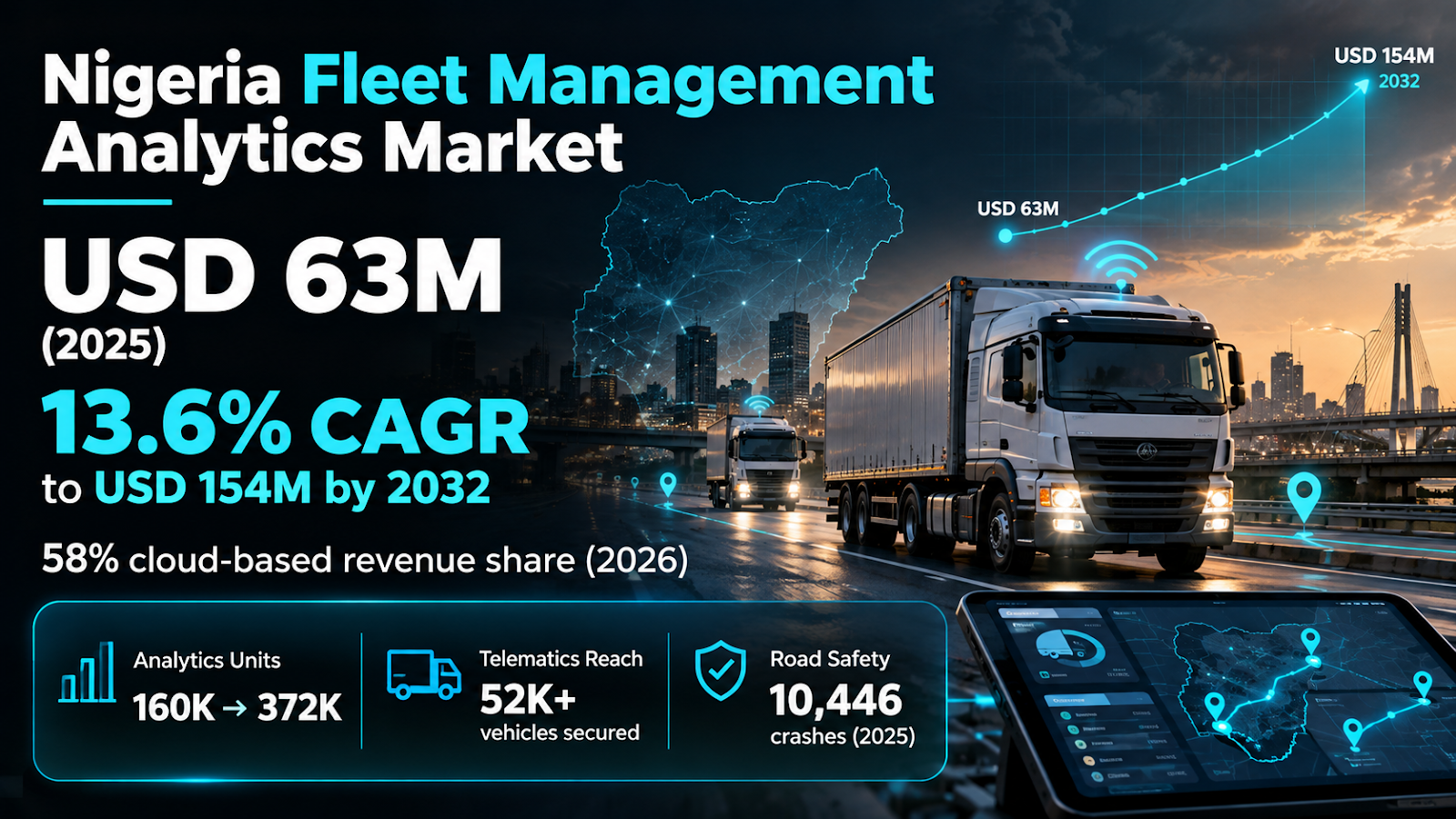
That shift creates a materially different strategic market. The Nigeria Fleet Management Analytics Market is estimated at USD 63 million in 2025 and is projected to reach USD 154 million by 2032, representing a 13.6% CAGR. Analytics-enabled fleet subscriptions are expected to expand from roughly 160,000 vehicles to 372,000 over the same period.
For boards, the important question is therefore not whether Nigerian fleets will become more digital. It is where economic value migrates as basic GPS visibility becomes standard and intelligence moves higher up the technology stack.
Nigeria Fleet Management Analytics Market Forecast: From Tracking Devices to Cognitive Fleet Infrastructure
Fleet management has historically answered a simple question: where is the vehicle? The next generation will answer more valuable questions: Which vehicle is likely to fail? Which driver is creating avoidable risk? Which route will destroy margin through idling or congestion? When should maintenance be scheduled? Which operating pattern suggests fuel leakage?
This evolution mirrors the broader Africa Fleet Management Analytics Market, where efficiency, cost reduction, safety and expanding logistics activity are accelerating analytics adoption. Nigeria already sits among the region’s leading fleet-technology markets.
The result is a shift from device economics toward intelligence economics. GPS hardware remains necessary, but predictive maintenance, video telematics, driver scoring, fuel-loss detection, workflow integration and automated compliance reporting offer stronger opportunities for recurring software value.
Current State vs. Future State of Fleet Analytics in Nigeria
- Current State: GPS location and theft recovery. Future State: AI-assisted operational decisions and exception management.
- Current State: Maintenance triggered by mileage or breakdown. Future State: Predictive servicing based on vehicle-health signals and utilization.
- Current State: Standalone tracking portals. Future State: APIs connecting fleet data with ERP, transport management, finance and maintenance systems.
- Current State: Driver monitoring after incidents. Future State: Continuous risk scoring using behavioral and video telemetry.
- Current State: Fleet software purchased as an IT tool. Future State: Analytics evaluated against fuel savings, asset uptime, safety and cost per delivery.
That transition is particularly important because value growth is expected to slightly exceed vehicle-subscription growth. Ken Research models annual value per subscribed vehicle rising from approximately USD 394 in 2025 to USD 414 in 2032 as higher-value analytics modules deepen the software relationship.
AI Fleet Analytics in Nigeria Will Depend on a Larger Cloud Technology Stack
The cognitive fleet is ultimately a cloud-computing story. Vehicle data must be transmitted, stored, integrated and analyzed before algorithms can turn raw telemetry into operational decisions.
Nigeria’s digital infrastructure is moving in that direction. The Nigeria Cloud and Data Center Services Market is projected to rise from USD 323 million in 2025 to USD 783 million by 2031 at a 15.92% CAGR. The Nigerian Communications Commission also recorded more than 124 million broadband subscriptions by July 2026.
For fleet platforms, stronger cloud availability creates the architecture for always-on dashboards, remote software upgrades, machine-learning models and multi-location fleet control. Over time, the competitive benchmark will move from who can install a tracker to who can integrate the broadest operational dataset and convert it into measurable decisions.
Predictive Fleet Management Growth Will Follow Nigeria’s Logistics Economy
Transportation and logistics will remain the central demand engine because road-intensive supply chains expose operators directly to fuel consumption, maintenance costs, delivery reliability and asset utilization.
The adjacent Nigeria Logistics and Warehousing Market identifies road freight as 61.35% of sector revenue in 2025. This makes even modest improvements in routing, vehicle utilization, fuel efficiency or downtime commercially meaningful across large fleets.
The opportunity extends beyond logistics. Oil and gas operators need safety and journey controls. FMCG distributors need route and delivery visibility. Construction and mining fleets need uptime. Government operators need accountability and utilization data. Each vertical creates a different analytics workflow, favoring platforms that can configure intelligence around operating outcomes rather than selling generic tracking functionality.
Boards Must Treat Fleet Data as Governed Infrastructure
The deeper fleet analytics becomes, the more sensitive its data becomes. Driver identities, location histories, behavioral scores, video feeds and employment-related performance indicators can create significant governance obligations.
Don’t miss the next Nigeria's fleet management analytics market: building the shift. Ken Research continuously publishes new market intelligence, forecasts and industry analysis. Add Ken Research as a Preferred Source on Google to discover more of our research when your next market question comes up.
Nigeria’s Data Protection Act requires organizations handling personal data to process it lawfully, securely and accountably. Future fleet-platform procurement will therefore increasingly extend beyond hardware specifications toward access controls, retention policies, processor relationships, cybersecurity and privacy-by-design.
This is strategically important for AI. A fleet platform cannot become a trusted decision engine if customers cannot trust how its underlying data is collected, secured and governed.
What CXOs Should Build Before the Market Reaches 2032
Boards should start with architecture rather than devices. Fleet technology investments made today should support APIs, cloud migration, multiple sensor types and modular analytics. A closed tracking system may solve today’s visibility problem while becoming tomorrow’s integration bottleneck.
Second, measure value at the vehicle level. The critical metrics are not logins or dots on a map but fuel cost per kilometre, utilization, unplanned downtime, accident frequency, maintenance cost and on-time delivery.
Third, build an AI-ready data foundation. Nigeria’s wider transportation analytics ecosystem is already expanding beyond descriptive reporting toward predictive and prescriptive applications. Companies that structure clean operational histories today will have a better foundation for predictive models tomorrow.
The strategic destination is clear: by the early 2030s, the strongest fleet-management platforms will not merely report what happened. They will detect risk, anticipate maintenance, recommend actions and increasingly automate routine operating decisions.
For investors, founders and fleet-intensive enterprises, that means the next value pool lies above GPS tracking—in the intelligence layer connecting vehicles, drivers, maintenance, logistics and enterprise workflows. Schedule a strategic foresight session with Ken Research analysts to align your long-term vision with market realities.


Comments
Post a Comment