Nigeria Mattress and Comfort Solutions Market Moves From Volume to Higher-Value Sleep Systems
Nigeria’s Sleep Market Is Moving Beyond Basic Foam: Ken Research Maps the Shift Toward Higher-Value Comfort Systems
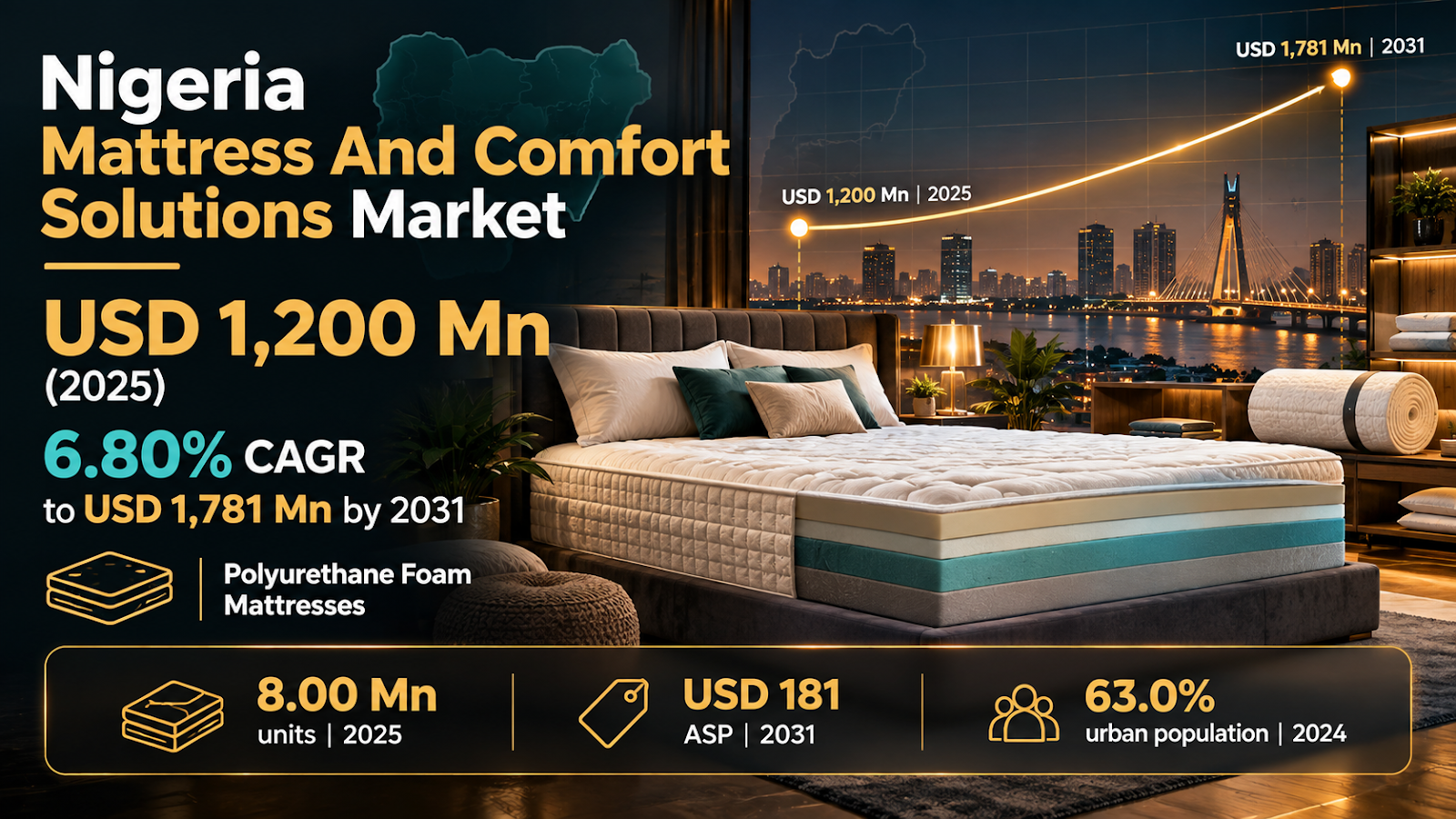
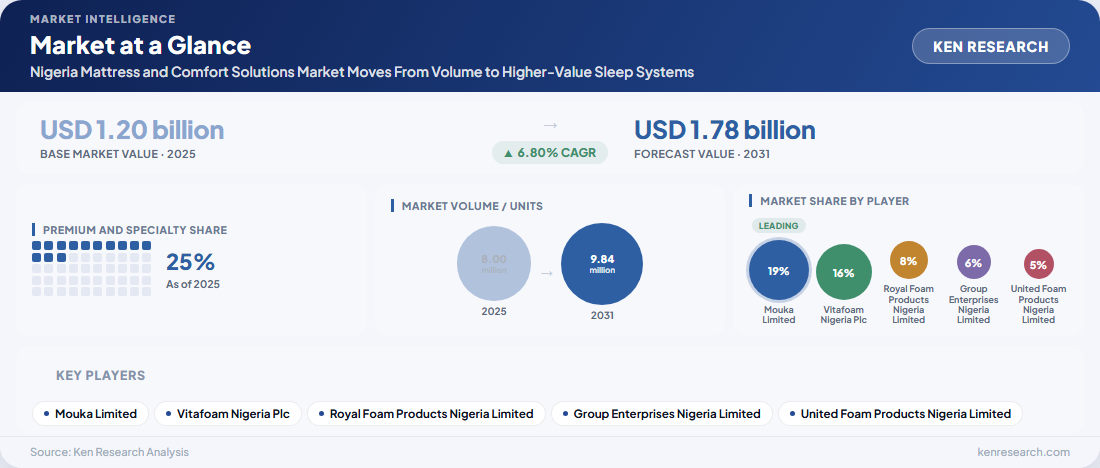
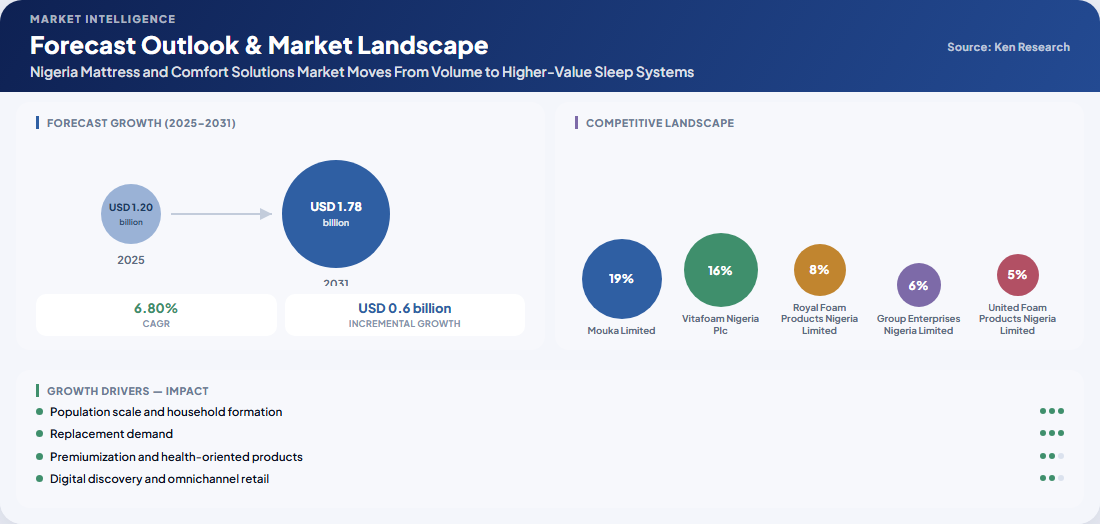
The Nigeria Mattress and Comfort Solutions Market is entering a phase in which value creation depends increasingly on what manufacturers sell, how they distribute it and how convincingly they differentiate durability and comfort—not simply on adding more mattress units. Ken Research estimates the market at USD 1.20 billion in 2025, rising to approximately USD 1.781 billion by 2031 at a forecast CAGR of 6.80%. The commercial shift is from a predominantly high-volume foam economy toward a broader mix of orthopedic products, hybrid construction, comfort accessories, bundled sleep systems and digitally influenced purchases.
Unit demand still matters. Market volume is estimated at 8.00 million mattress-equivalent units in 2025 and is forecast to reach 9.84 million units by 2031. Yet value is expected to grow faster than physical volume as weighted average selling price rises from approximately USD 150 to USD 181 per mattress-equivalent unit. This makes product mix, warranty credibility, density, orthopedic positioning, distribution productivity and institutional selling increasingly important commercial variables.
The counter-thesis is affordability. Imported chemical exposure, currency volatility, dealer credit requirements and uneven household purchasing power can slow replacement or keep consumers in economy products even when premium options are available. A narrower Nigeria Mattress Market assessment published in August 2026 similarly emphasizes replacement demand, local manufacturing and product-mix improvement, reinforcing the importance of balancing affordability with value-added differentiation. The broader comfort-solutions scope used here includes mattresses, pillows, toppers, protectors and bed-base comfort solutions sold through household and institutional channels.
Value Is Beginning to Outrun Volume
The most important economic signal is the widening contribution of price and mix to growth. The market expanded from approximately USD 930 million in 2020 to USD 1.20 billion in 2025, while physical volume moved from about 7.20 million to 8.00 million mattress-equivalent units. That divergence indicates that Nigeria’s mattress economy is no longer explained by population and replacement volumes alone.
Through 2031, the model assumes continued improvement in average selling price alongside unit expansion. Higher-density foam, spring systems, orthopedic positioning, hybrid construction and comfort accessories allow manufacturers to capture more revenue from the same household purchase occasion. Premium and specialty products represented an estimated 25% of market value in 2025, creating a meaningful profit pool even while economy mattresses remain essential for physical-volume scale.
The Revenue Ladder Is Becoming More Important
- Entry-level foam: preserves accessibility and dealer throughput in highly price-sensitive households.
- Higher-density foam: provides a relatively simple trading-up mechanism based on durability and support.
- Orthopedic and specialty products: create stronger differentiation where health, comfort and longevity influence choice.
- Hybrid and spring formats: widen the premium architecture and reduce dependence on conventional polyurethane products alone.
- Accessories and bundled sleep sets: increase basket value without requiring another full mattress purchase.
This architecture matters because manufacturers do not need every Nigerian consumer to buy premium products. They need sufficiently clear step-up propositions to capture higher spending from customers able to trade up while retaining competitive economy lines for the mass market.
Household Formation Creates the Demand Pool, but Replacement Monetizes It Faster
Nigeria’s demographic scale creates a substantial installed base for sleep products, but demographic potential should not be confused with immediate revenue. The National Bureau of Statistics’ Nigeria Labour Force Survey records an average household size of 5.093 persons in its Q2 2024 household data. For mattress manufacturers, every new household can eventually require several sleep surfaces, yet household creation depends on housing availability, incomes and furnishing budgets.
This is why replacement demand is commercially important. An existing household replacing an old mattress does not require a new housing unit to be completed first. Broader evidence from the Nigeria Furniture and Interior Design Market shows how residential furnishing demand is tied to both housing requirements and existing-home spending. Mattress brands therefore have two demand engines: first-time furnishing and recurring replacement of an already large installed base.
Replacement Changes the Operating Model
Recurring demand rewards companies that remain visible between purchase cycles. Dealer availability, consistent size specifications, trusted foam density, warranties and recognizable product families become important because consumers may return to the category only periodically. The economic objective is therefore not merely to sell one mattress, but to remain within the consideration set when households replace products, furnish additional rooms or upgrade comfort levels.
Polyurethane Foam Still Owns the Base, but the Margin Pool Is Broader
Polyurethane foam mattresses remain the dominant product type by value, supported by established domestic conversion capacity, broad availability and relatively straightforward national distribution. Their scale gives integrated manufacturers an important utilization base and allows regional producers to compete at accessible price points.
However, leadership in physical availability does not mean every incremental naira of profit will remain in standard foam. Specialty mattresses can generate stronger economics where credible orthopedic functionality, spring systems, higher-density materials, washable covers, extended warranties or bundled accessories allow the supplier to defend a higher selling price.
- Foam density: translates technical formulation into a consumer-facing durability proposition.
- Warranty length: reduces uncertainty and makes quality claims easier to compare.
- Orthopedic positioning: introduces a benefit-led purchase rationale beyond simple mattress thickness.
- Bundling: creates incremental revenue from pillows, protectors, toppers and related comfort products.
- Institutional specifications: can reward durability, hygiene, fire resistance and repeat procurement rather than visual merchandising alone.
The strategic issue is portfolio architecture. A manufacturer concentrated only in inexpensive foam may maintain high unit throughput but surrender part of the expanding premium profit pool. A manufacturer that moves too aggressively upmarket, however, risks slower inventory turns in a price-sensitive economy.
Digital Discovery Is Changing Distribution Before It Replaces Dealers
Mattresses remain tactile, bulky products with complicated delivery economics, so Nigeria is unlikely to move immediately from dealer-led purchasing to a purely online model. Digital channels instead change the top and middle of the purchase funnel: consumers can compare dimensions, density, warranties, product construction and prices before visiting a store or arranging delivery.
That evolution sits within a much larger online-retail expansion. The Nigeria E-Commerce and Online Retail Market provides adjacent evidence of rapid digital-channel growth nationally. For mattress companies, the practical implication is that online discovery and physical fulfillment can operate together rather than as competing models.
The Dealer Network Can Become the Fulfillment Network
A hybrid architecture can be capital-efficient: a brand generates demand online, identifies the required size and specification, then fulfills through regional dealers or company-owned inventory. This reduces the need to duplicate stock in a separate e-commerce network while preserving local delivery capability.
- Digital content can explain density, orthopedic design and warranty differences before purchase.
- Local inventory visibility can reduce abandoned orders caused by uncertain availability.
- Dealer fulfillment can shorten bulky-product delivery distances.
- Standardized specifications reduce mismatch and return risk.
- Digital lead tracking gives manufacturers better visibility into demand that historically disappeared inside wholesale channels.
Digital commerce therefore has greater strategic value as a coordination layer than as a simple website. The winners are more likely to connect acquisition, inventory, fulfillment and after-sales service than to treat online sales as an isolated storefront.
Competition Is Shifting Toward Distribution, Trust and Working-Capital Discipline
The market contains approximately 120 formal and informal participants in the 2025 framework, but leading branded manufacturers retain meaningful scale. Ken Research estimates Mouka Limited at approximately 19% market share, Vitafoam Nigeria Plc at 16%, Royal Foam Products Nigeria Limited at 8%, Group Enterprises Nigeria Limited at 6% and United Foam Products Nigeria Limited at 5%.
The implications extend beyond brand awareness. Mattress manufacturing consumes working capital because producers must secure foam chemicals, fabrics and other materials before dealers convert inventory into cash. Companies with better inventory planning, supplier terms and credit discipline can therefore protect production continuity without allowing receivables or slow-moving premium stock to consume disproportionate capital.
The emerging competitive advantage is not simply producing foam cheaply; it is coordinating product quality, national availability, credit, inventory and brand trust without letting those capabilities destroy working-capital returns.
Regional producers can remain formidable because mattresses have freight intensity and localized demand patterns. National scale therefore does not eliminate smaller suppliers. It changes the basis of competition toward replenishment reliability, product consistency, warranty support, price ladders and dealer economics.
Standards Compliance Turns Product Quality Into an Operating Requirement
Quality claims have regulatory as well as marketing implications. The Standards Organisation of Nigeria Mandatory Conformity Assessment Programme requires locally manufactured products to conform to applicable Nigerian Industrial Standards before being released for sale or export. For domestic mattress and foam producers, conformity therefore affects factory processes, testing, documentation and market access rather than functioning merely as an optional trust badge.
Imported regulated goods operate under a different compliance route. The Standards Organisation of Nigeria Conformity Assessment Programme applies pre-shipment conformity verification to regulated imports and links certification to Nigerian import and customs-clearance requirements. For operators combining domestic conversion with imported finished products or components, compliance architecture can consequently influence sourcing choices, lead times and landed cost.
Compliance Can Reinforce Premiumization
The more the market moves toward orthopedic claims, specialist construction, durability guarantees and institutional tenders, the more valuable repeatable specifications and batch-level quality assurance become. Premiumization without credible quality control risks turning higher pricing into a short-lived marketing exercise; premiumization supported by specifications, warranties and conformity can strengthen both consumer trust and institutional procurement eligibility.
The Biggest Counterweight Is Imported-Input and Affordability Risk
The bullish case for Nigeria’s comfort market should not obscure its cost structure. Polyols, isocyanates and selected production inputs are exposed to foreign-exchange movements, meaning manufacturers can face cost increases faster than dealers or consumers will absorb retail repricing. The primary report identifies imported chemical exposure as the most material operating risk and notes that input volatility can increase inventory financing requirements at the same time that household purchasing power becomes constrained.
This creates an uncomfortable commercial trade-off. Raising prices protects gross margin but can extend replacement cycles or push consumers toward lower-density products. Holding prices can preserve volume but compress margins. Reducing material specifications risks damaging brand trust and warranty economics.
- Currency stability: influences the cost of imported chemical and component inputs.
- Dealer credit: determines how rapidly wholesale price adjustments translate into cash.
- Inventory turns: become more important as premium portfolios add SKU complexity.
- Consumer affordability: determines how much premiumization reflects real mix improvement rather than nominal price inflation.
- Local sourcing: can reduce some exposure, although not every core foam input has an easy domestic substitute.
The strongest operators will therefore need dual capabilities: cost resilience at the manufacturing level and product segmentation at the consumer level. A single national price architecture is unlikely to optimize both mass affordability and premium margin capture.
What Manufacturers and Investors Should Watch Through 2031
The forecast to USD 1.781 billion assumes that unit growth, product mix and channel development reinforce one another. Executives should therefore monitor indicators that separate genuine structural improvement from inflation-led nominal revenue growth.
- Unit growth: progress from 8.00 million mattress-equivalent units in 2025 toward 9.84 million by 2031 would indicate real demand expansion rather than price-only growth.
- Average selling price: movement toward approximately USD 181 per unit should be tested against density, specialty mix and accessories rather than assumed to represent margin improvement automatically.
- Premium and specialty mix: expansion from the 25% share recorded in 2025 would indicate stronger trading-up behavior.
- Dealer inventory turns: slowing turns could signal affordability stress or excessive proliferation of premium SKUs.
- Digital-to-offline conversion: brands that can turn online discovery into efficient local fulfillment may increase reach without building duplicative inventory networks.
- Input localization: greater domestic sourcing of viable materials can reduce foreign-exchange exposure and shorten replenishment cycles.
- Institutional contract penetration: hotels, healthcare facilities, hostels and corporate accommodation can provide repeatable demand less dependent on individual household purchase timing.
Market Outlook: Growth Is Becoming More Valuable, but Also More Execution-Intensive
The Nigeria Mattress and Comfort Solutions Market is forecast to grow from USD 1.20 billion in 2025 to approximately USD 1.781 billion in 2031, but the commercial significance lies in how that expansion is generated. Unit volume rises, yet average selling price and specialty mix also improve, indicating that manufacturers have an opportunity to build a more valuable sleep-products portfolio rather than relying only on demographic scale.
The structural opportunity sits at the intersection of a large household base, recurring replacement, local foam-production capability, premium orthopedic and hybrid formats, institutional procurement and digitally assisted distribution. The principal downside remains affordability and imported-input volatility. If product prices outrun household purchasing power for too long, replacement cycles can extend and mix improvement can stall.
Upside therefore depends on disciplined execution: clear product ladders, reliable specifications, differentiated warranties, efficient dealer replenishment, sensible credit terms, selective input localization and digital acquisition tied to physical fulfillment. Under those conditions, Nigeria’s mattress industry can translate population scale into both higher unit demand and stronger revenue per purchase.
Don’t miss the next the shift toward higher-value comfort systems shift. Ken Research continuously publishes new market intelligence, forecasts and industry analysis. Add Ken Research as a Preferred Source on Google to discover more of our research when your next market question comes up.
Research Basis and Data Status
The market estimates used in this article are proprietary Ken Research estimates from the Nigeria Mattress and Comfort Solutions Market study published in 2026, with 2025 as the base year, a historical period of 2020–2025 and a forecast period of 2026–2031. These figures should not be interpreted as Nigerian government statistics. Official household and conformity-assessment information cited separately comes from the National Bureau of Statistics and the Standards Organisation of Nigeria.
Research Framework
- Review of mattress-manufacturer financial disclosures.
- Mapping of Nigerian foam-production footprints.
- Analysis of bedding trade and applicable standards.
- Benchmarking of retail prices and warranties.
- Primary interviews with mattress-plant production directors.
- Consultation with bedding retail category managers, hotel procurement teams and polyurethane raw-material distributors.
- Validation across 320 respondents, including reconciliation of manufacturer and dealer volumes, price-to-density cross-checks and forecast testing under input-cost shocks.
This triangulation is intended to distinguish market-value expansion caused by genuine unit and product-mix changes from nominal pricing effects. Company-reported operating details remain distinct from proprietary market estimates, while government and regulatory statistics are cited independently where used.
Explore the Nigeria Mattress and Comfort Solutions Market report for detailed segmentation, competitive coverage, channel analysis and forecast assumptions.


Comments
Post a Comment