Nigeria Online Retail Marketplaces: From Order Growth to Profitable Scale
Nigeria's Online Retail Marketplaces Are Scaling Beyond Transactions: Ken Research Examines the Profitability Test
Nigeria's online retail marketplaces market is entering a phase in which transaction growth must translate into more durable operating returns. The August 2026 Ken Research market assessment estimates the market at USD 7,050 million in 2025, with a forecast of USD 17,641 million by 2032, representing a compound annual growth rate (CAGR) of 14.00%. These proprietary estimates use a marketplace-led physical-goods gross merchandise value (GMV) basis, making the relationship between completed orders, basket value and fulfillment efficiency central to the commercial outlook.
The underlying change is a shift from acquiring customers to generating repeat purchases and monetizing merchant relationships, logistics coordination and advertising. Yet higher transaction volume does not automatically produce stronger margins when delivery costs, returns, import prices and consumer affordability remain under pressure. The broader Nigeria E-Commerce and Online Retail Market provides useful context because marketplaces compete within a wider digital retail ecosystem that includes direct-to-consumer sellers and inventory-led retailers. For marketplace operators, the decisive question is whether transaction density can grow faster than the cost of serving each order.

How Large Is Nigeria's Online Retail Marketplaces Market Through 2032?
Nigeria's online retail marketplaces market is projected to expand substantially through 2032, although the forecast implies a more measured growth phase than the market's earlier adoption period. The underlying model records historical CAGR of 23.84% during 2020–2025, compared with the forecast CAGR of 14.00% during 2025–2032. This deceleration is commercially important: future performance depends less on first-time digital adoption alone and more on repeat ordering, merchant productivity and reliable delivery.
- USD 10,591 million in additional market value: Ken Research analysis, calculated as the difference between the base-year and forecast values, indicates the scale of the opportunity if the modeled trajectory materializes. Investors should distinguish potential transaction growth from revenue and contribution actually retained by platform operators.
- 23.84% historical CAGR: The earlier expansion rate provides context for the transition toward a larger market with more demanding growth economics. Business plans should not assume that historical adoption-led growth will continue unchanged.
- 14.00% forecast CAGR: The projected pace makes repeat purchasing, fulfillment productivity and seller monetization increasingly important performance measures. Operators should test expansion plans against contribution per order rather than GMV alone.
The model covers multi-vendor marketplaces, classifieds-led and category-specialist platforms, and cross-border physical-goods retail serving Nigerian buyers. It excludes standalone brand-owned direct-to-consumer sites, travel, food delivery, digital goods and pure business-to-business wholesale. This narrower scope matters when comparing estimates: a broader online retail market includes transactions that marketplace-focused models do not count. The next question is which structural forces can convert this addressable market into sustainable demand.
Why Is Mobile Commerce Changing Nigeria's Marketplace Economics?
Mobile connectivity is expanding the addressable audience for Nigerian marketplaces, but conversion depends on whether consumers can complete purchases affordably and receive goods reliably. The Nigerian Communications Commission's official industry statistics track mobile subscriptions and broadband access, two important infrastructure indicators for digital commerce. These measures should not be mistaken for unique online shoppers: multiple subscriptions can belong to one person, and connectivity alone does not establish purchasing power or willingness to transact.
The market model estimates 193.2 million marketplace orders in 2025, making order density a useful lens for evaluating the relationship between demand and operating cost. Ken Research analysis suggests that the strongest model combines accessible mobile shopping with dependable payment confirmation, accurate product information and fulfillment options suited to different locations. The Nigeria E-Commerce Payments and Logistics Market adds relevant context because payment infrastructure and delivery coordination determine whether digital discovery becomes a completed transaction.
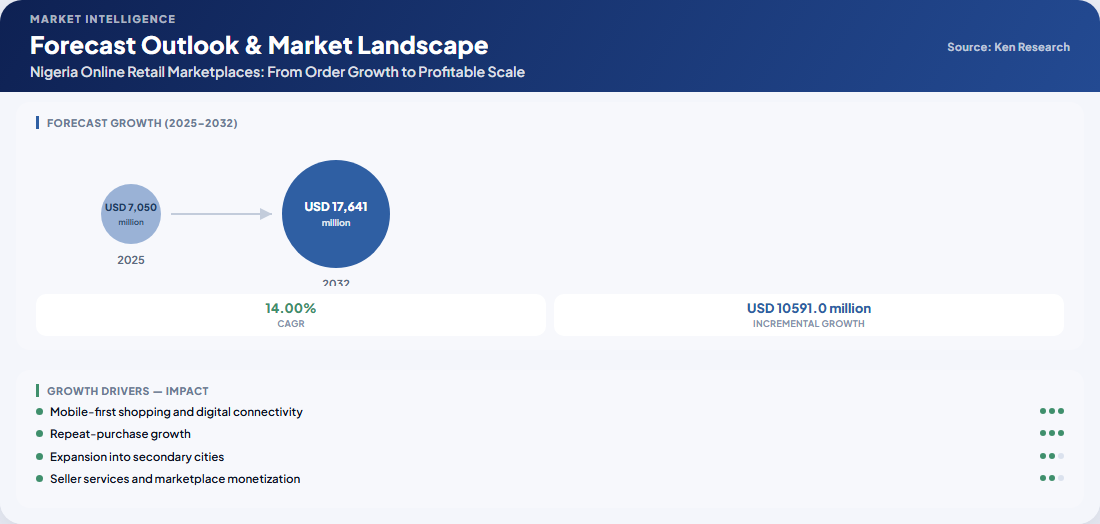
- Mobile-first checkout: Lightweight product pages, transparent final prices and dependable payment confirmation reduce friction between product discovery and completed orders.
- Order density: More deliveries within a practical service area can improve route productivity and reduce the cost burden per parcel, provided failed deliveries and returns remain controlled.
- Seller monetization: Advertising, merchant services and fulfillment support can create additional income streams without requiring proportional growth in merchandise handling.
- Geographic reach: Pickup points and distributed seller inventory can make secondary-city expansion more viable when home delivery is expensive or addresses are difficult to verify.
The commercial implication is that connectivity creates potential demand, not guaranteed profitability. Platforms must measure the entire order journey, from customer acquisition and payment authorization to delivery completion and returns, before assuming that additional traffic improves unit economics. That operating discipline also determines which marketplace formats and buyer groups are most attractive.
Which Nigeria Marketplace Segments and Buyers Matter Most?
Nigeria's marketplace opportunity spans general-merchandise platforms, classifieds-led transactions, specialist retailers and cross-border shopping, with each model requiring a different balance of trust, inventory control and fulfillment. Ken Research identifies the fulfillment model as the fastest-growing segmentation dimension in its 2025–2032 framework, while Lagos Metropolitan Area is the dominant geography in the base-year assessment. These classifications indicate where operating-model decisions matter, but they do not establish a quantified revenue share for each segment.
Merchant requirements vary by transaction type: established retailers need predictable order processing and settlement, smaller sellers need affordable customer acquisition, and consumers need confidence in product quality, pricing and delivery. The Nigeria FMCG E-Commerce and Last-Mile Market provides adjacent context for understanding why product availability and last-mile execution are especially relevant when digital channels serve frequently purchased goods. Marketplace operators should evaluate segments by repeat frequency, average basket economics, return exposure and the service costs needed to retain each buyer group.
- General merchandise: Broad assortments can increase purchase occasions, but catalogue quality and seller reliability become harder to standardize as listings expand.
- Classifieds and recommerce: These models can limit platform inventory exposure, while verification, transaction trust and dispute handling remain critical to successful exchanges.
- Category specialists: Focused product knowledge and more consistent fulfilment expectations can support customer loyalty, particularly where product specifications influence buying decisions.
- Cross-border retail: International assortment can broaden consumer choice, but currency movements, import costs, delivery times and return complexity can weaken value propositions.
For commercial planning, the useful distinction is not simply between product categories; it is between transactions that generate repeat behavior and those that require repeated acquisition spending. A segment with high GMV may still produce weak contribution if delivery, customer service and returns absorb its economic value. That makes platform positioning and competitive differentiation the next critical test.
How Do Nigeria's Online Marketplaces Compete Beyond Price?
Nigeria's online marketplace competition includes Jumia Nigeria, Konga, Jiji Nigeria, Temu and Kara Nigeria, but the available market assessment does not establish comparable market-share percentages for these participants. Their business models differ: multi-category marketplaces depend on merchant assortment and fulfillment, classifieds-led platforms emphasize matching buyers and sellers, and cross-border operators compete through product selection and price positioning. Treating these companies as an unranked participant set is more defensible than assigning leadership based on unsupported share estimates.
Competition increasingly depends on the complete service proposition rather than discounts alone. Product authenticity, seller onboarding, checkout reliability, delivery coverage and complaint resolution influence whether buyers return and whether merchants remain active. Nigeria's Federal Competition and Consumer Protection Commission's consumer-rights guidance outlines requirements relevant to price disclosure, accurate representations and product returns. These obligations make clear information and consistent dispute handling operational capabilities, not merely customer-service enhancements.
Don’t miss the next ken research examines the profitability test shift. Ken Research continuously publishes new market intelligence, forecasts and industry analysis. Add Ken Research as a Preferred Source on Google to discover more of our research when your next market question comes up.
For investors and commercial leaders, the key comparison is contribution quality: how much value remains after the variable costs associated with attracting, processing and fulfilling an order. Operators should monitor repeat-purchase rates, seller retention, delivery success and returns alongside GMV. These measures help distinguish a platform gaining durable commercial traction from one buying temporary volume through discounts, while also exposing the risks that could interrupt the forecast trajectory.
Can Nigeria's Online Retail Marketplace Forecast Withstand the Main Risks?
Nigeria's marketplace growth forecast depends on consumer affordability, dependable digital transactions and the ability to fulfill orders at costs that buyers and sellers can sustain. Inflation and currency depreciation can raise imported-product prices, weaken discretionary spending and complicate merchant replenishment. Delivery failures, fraud and return costs can then compound pressure on already-sensitive basket economics. The central counter-thesis is that nominal market expansion could outpace improvement in platform profitability, particularly if acquisition spending and service costs rise alongside order volume.
- Consumer affordability: Track basket values, conversion rates and repeat purchases to determine whether rising prices are suppressing completed transactions.
- Fulfillment productivity: Monitor delivery success, cost per completed order, pickup utilization and return rates to identify deteriorating unit economics.
- Foreign-exchange exposure: Review import-dependent assortment, supplier repricing and stock availability to anticipate margin pressure and potential customer churn.
- Trust and compliance: Track product complaints, refund resolution, misleading listings and seller verification to reduce disputes and protect repeat demand.
These indicators should inform market-entry decisions, investment pacing and expansion into new locations. The strongest strategy is to scale in stages, validating order density and service reliability before extending delivery promises or increasing promotional expenditure. The regulatory dimension also matters: the Federal Competition and Consumer Protection Act establishes Nigeria's central framework for consumer protection and competition, reinforcing the need for transparent transactions and fair commercial practices. The final decision is therefore how to pursue growth without allowing execution risk to consume its value.
Where Will Nigeria's Online Retail Marketplace Value Sit by 2032?
Nigeria's online retail marketplaces market is projected to grow from USD 7,050 million in 2025 to USD 17,641 million in 2032, at a CAGR of 14.00%, as mobile-led purchasing and broader merchant participation support higher transaction activity. The strategic winners are likely to combine reliable seller supply, efficient fulfillment and repeat-purchase economics with additional monetization from advertising and merchant services. However, the forecast remains conditional: affordability pressure, currency volatility, weak delivery productivity and inadequate consumer trust could limit realized growth and profitability.
Explore the Nigeria Online Retail Marketplaces Market report for detailed segmentation, competitive coverage, forecast assumptions and strategic market intelligence.


Comments
Post a Comment