Poland Facility Management Market Moves Toward Integrated, Higher-Value Services
Poland Facility Management Is Moving From Labor Scale to Service Complexity: Ken Research Maps the Value Shift
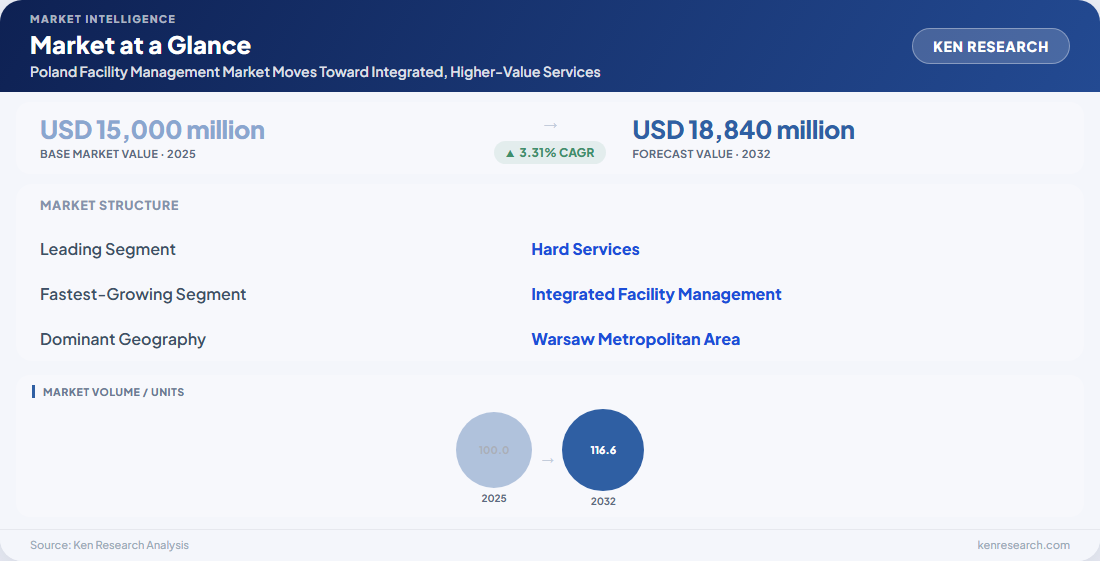
The Poland Facility Management Market is entering a mature-growth phase where value depends less on adding labor and more on outsourcing, technical complexity and integrated delivery. Ken Research estimates the market at USD 15,000 million in 2025, rising to USD 18,840 million by 2032 at a 3.31% CAGR. The latest August 2026 version uses 2025 as its base year and 2025–2032 as its forecast period.
The commercial shift matters because outsourced FM already represents 63.02% of 2025 activity, while Integrated Facility Management is the fastest-changing delivery model. The scope covers recurring technical maintenance, cleaning, security, workplace support, energy management and integrated services for commercial, industrial, public and institutional assets, excluding pure construction and standalone equipment sales. The counter-thesis is margin pressure: labor scarcity, contract pricing and execution complexity can dilute growth even as demand broadens. The 2026 Poland Facility Management & Building Technology Market provides adjacent evidence of the same convergence between FM procurement and building technology.
How large will Poland facility management be by 2032?
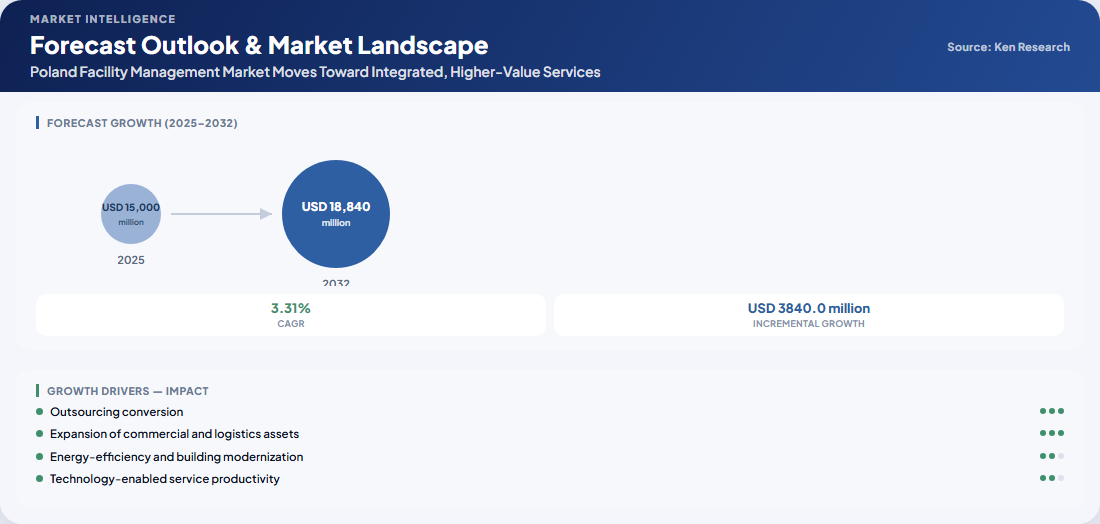
The Poland facility management market is forecast to grow from USD 15,000 million in 2025 to USD 18,840 million in 2032, representing a 3.31% CAGR. The latest 2026 market framework also shows a slower forecast trajectory than the modeled 4.21% historical CAGR for 2020–2025, indicating that Poland is moving from expansion driven by normalization toward productivity and service-mix gains. This makes contract quality more important than headline market growth.
- USD 3,840 million: Ken Research analysis implies this absolute increase between 2025 and 2032, giving providers a sizable incremental revenue pool without requiring frontier-market growth rates.
- 116.6 activity index: The modeled service-volume index rises from 100.0 in 2025 to 116.6 in 2032, implying value growth will outpace pure activity expansion.
- 3.12% in 2025: The latest annual growth rate was below the historical peak, reinforcing the case for procurement conversion, integration and higher-value services rather than volume-only expansion.
Poland's scale is therefore its primary strategic advantage, while its moderate growth rate changes the entry equation for providers. The opportunity is less about creating new FM demand from scratch and more about capturing outsourced contracts, consolidating fragmented services and increasing revenue per managed asset. That leads directly to the question of which operating mechanisms can sustain value growth when physical service activity expands more slowly.
Why is Poland facility management becoming more integrated?
Outsourcing and technical complexity are making integrated facility management more commercially attractive because buyers can transfer coordination across maintenance, workplace services, energy data and compliance to one provider. The market's outsourced share was 63.02% in 2025, while Integrated Facility Management is identified as the fastest-changing delivery model. Ken Research analysis therefore suggests a simple rule for procurement teams: the more fragmented the asset portfolio, the greater the potential value of centralized SLA and CAFM governance.
Energy modernization adds another layer because facility operators increasingly manage upgraded HVAC, controls and building systems after retrofit projects are completed. Poland's National Fund for Environmental Protection and Water Management opened a 2026 program supporting energy-efficiency improvements, renewable energy installations and heating-source replacement in qualifying multifamily buildings. The NFOŚiGW program announcement illustrates how retrofit activity can create follow-on requirements for commissioning, monitoring and lifecycle maintenance rather than only one-time construction work.
- 63.02% outsourced share: The high outsourcing intensity creates a natural cross-selling base for bundled technical, soft and energy services.
- 56.18% hard-services share: Technical maintenance remains the commercial anchor, allowing providers to attach cleaning, workplace and sustainability services around mission-critical contracts.
- 3,400 providers: The broader FM ecosystem identified by the report remains fragmented, creating room for national platforms to compete through procurement leverage and standardized delivery.
Which buyers and segments matter most in Poland FM?
Hard services remain the leading service-type segment in Poland because HVAC, electrical, fire-safety and building-system uptime are recurring requirements that cannot easily be deferred. The market also identifies delivery model as its fastest-changing segmentation dimension, with integrated contracts gaining importance among corporate occupiers, property owners and investors, public-sector authorities and industrial site operators. The 2026 Poland Real Estate Market adds useful context because property activity is concentrated in major metropolitan areas where FM requirements are denser.
Warsaw is the dominant demand geography, supported by modern office concentration and national corporate activity, while Krakow, Wroclaw and other regional hubs diversify the addressable contract base. Statistics Poland's Statistical Yearbook of Warsaw provides the official statistical framework for understanding the capital's economic and property environment. Ken Research analysis implies that geographic density is commercially important because dispatch efficiency, technician utilization and multi-site account coverage can improve simultaneously when contracts cluster within major metros.
How will Poland FM competition change as contracts integrate?
Competition in Poland's facility management market is centered on service breadth, technical capability, workforce coverage and the ability to manage multi-site contracts rather than on market share alone. The major participant set includes ISS Facility Services, Sodexo Polska, Impel Group, ENGIE Services and VINCI Facilities Polska, while the report identifies a wider fragmented provider base. The 2025 Poland Construction Market is a useful adjacency because building investment creates the installed assets that later generate recurring maintenance requirements.
- 5 major named providers: The reported participant set includes ISS Facility Services, Sodexo Polska, Impel Group, ENGIE Services and VINCI Facilities Polska, but no verified market-share percentages are published for ranking them.
- 6.23 million sqm: Warsaw's modern office stock at the end of 2025 illustrates why dense portfolios can reward providers with strong local dispatch and account-management capability.
- 36.6 million sqm: Poland's warehouse and logistics stock at the end of 2025 broadens demand beyond offices toward assets requiring continuous technical response and safety systems.
- 5.9% year-on-year: Warehouse and logistics space expanded at this rate in 2025, increasing the addressable asset base for technical, cleaning and facility-support contracts.
The competitive implication is that scale alone will not secure the higher-value pool. Providers need certified technical talent, nationwide or regional coverage, CAFM capability, procurement leverage and credible energy-performance reporting, while buyers gain bargaining power by bundling previously fragmented services. Official construction-price data also shows why execution discipline matters: Statistics Poland reported a 5.5% year-on-year increase in construction and assembly prices in June 2026, reinforcing the importance of contract indexation and workforce productivity.
Don’t miss the next Poland's facility management is moving from labor shift. Ken Research continuously publishes new market intelligence, forecasts and industry analysis. Add Ken Research as a Preferred Source on Google to discover more of our research when your next market question comes up.
What could slow Poland facility management growth through 2032?
The principal downside risk is that revenue growth may not translate into equivalent operating-profit growth if labor shortages, wage pressure and fragmented delivery increase the cost of fulfilling contracts. Ken Research's forecast already assumes service activity grows more slowly than market value, which makes productivity a critical variable rather than a secondary efficiency measure. If buyers remain focused primarily on lowest-cost contracts, providers may struggle to recover the investment required for CAFM, analytics and technical talent.
The risk is also asymmetric across service models: integrated contracts can improve account economics, but they increase implementation complexity and expose providers to broader SLA obligations. Ken Research analysis suggests that procurement teams should therefore test whether a provider can sustain response coverage, technical skills and measurable service outcomes before transferring multiple service lines under one contract.
- Workforce capability: Technical recruitment and retention should be monitored because hard-service reliability depends on scarce electrical, HVAC, automation and maintenance skills.
- Contract indexation: Buyers and providers should track whether labor and service-cost movements are adequately reflected in contract economics rather than absorbed through margin.
- Integration payback: CAFM, energy monitoring and bundled-service investments should be evaluated against measurable reductions in vendor fragmentation, downtime and energy-related operating costs.
- Outsourcing conversion: The strongest upside exists where property owners and occupiers move from isolated services toward bundled or integrated procurement, while slower conversion would limit forecast acceleration.
Where will Poland facility management value sit by 2032?
The Poland facility management market is heading toward USD 18,840 million by 2032 from USD 15,000 million in 2025, a 3.31% CAGR, because outsourcing, technical complexity and integrated delivery should expand value faster than underlying service activity. Winners will combine hard-service reliability with CAFM, energy-performance capability and multi-site procurement leverage, while the main risk is margin compression from labor and execution costs. The decisive commercial test is whether integration produces measurable operating value for buyers.
Explore the Poland Facility Management Market report for detailed segmentation, competitive coverage and forecast assumptions.


Comments
Post a Comment