South Africa Electric Vehicle Charging Infrastructure Market: Growth Depends on Utilization
South Africa’s EV Charging Boom Faces Its Real Test: Profitable Utilization, Not Just More Plugs, Ken Research Finds
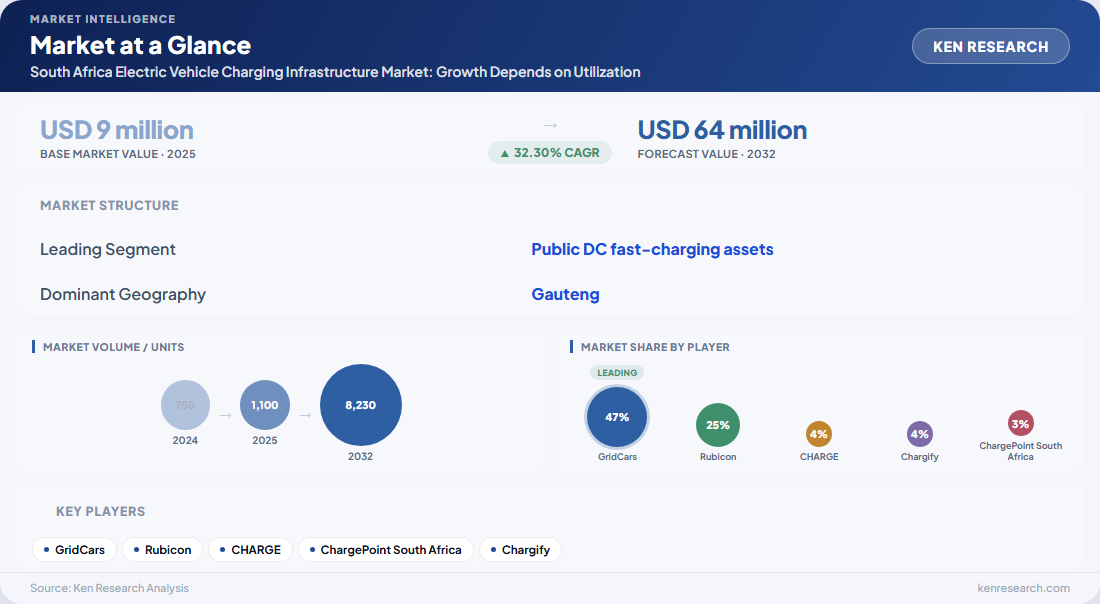
South Africa’s electric vehicle charging infrastructure market is moving from an early network-building phase toward a more commercially demanding stage in which asset utilization and service economics matter as much as deployment. Ken Research estimates the market at USD 9 million in 2025, with a forecast of USD 64 million by 2032, representing a compound annual growth rate (CAGR) of 32.30%. The market includes charging equipment, installation, charging services, management software and field maintenance, creating revenue opportunities across hardware and recurring operations.
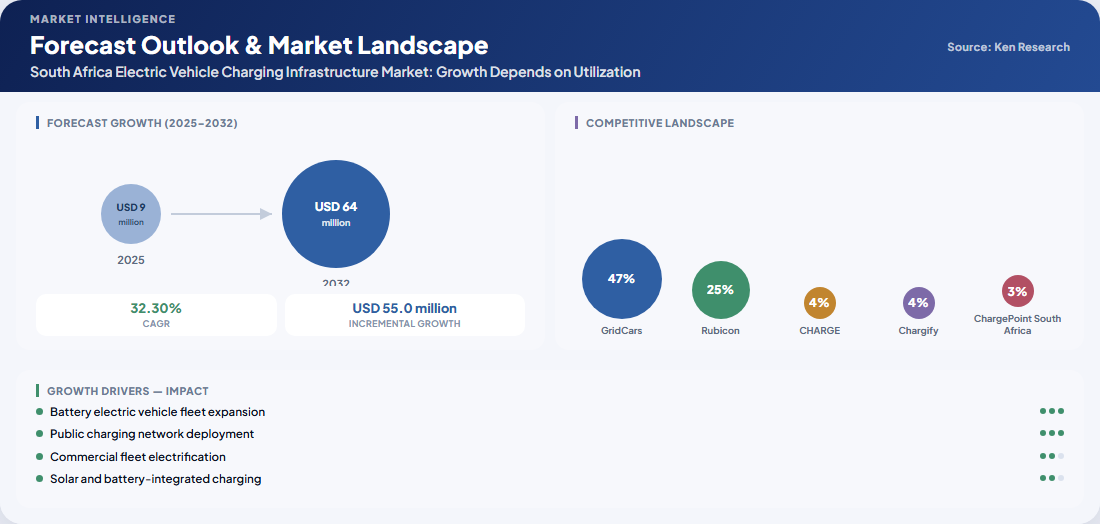
The commercial mechanism is the expansion of charging access alongside a still-small electric vehicle fleet: more connectors create future capacity, but only sustained charging demand can turn that capacity into attractive returns. Public DC fast-charging assets, fleet-depot projects and integrated energy solutions are important opportunities, while weak utilization, expensive grid connections and imported-equipment exposure can undermine project economics. The adjacent South Africa Electric Bus and Fleet Adoption Market adds useful context because commercial fleet electrification can create concentrated demand around depots and predictable operating schedules.
How large will South Africa’s EV charging infrastructure market become by 2032?
South Africa’s EV charging infrastructure market is forecast to rise from USD 9 million in 2025 to USD 64 million in 2032, according to the latest August 2026 Ken Research report. The implied increase is USD 55 million, calculated from the published endpoints rather than reported as a separate market estimate. This expansion depends on the conversion of infrastructure investment into installed assets, active charging sessions and service revenue, not simply the number of announced projects.
- 32.30% forecast CAGR: The projected pace indicates a rapidly expanding market from a small base, making execution quality and forecast assumptions especially important when assessing investments.
- 750 public connectors in 2024: The reported installed network provides an initial platform for expansion, but national totals alone cannot establish the utilization of individual sites.
- 8,230 projected public connectors in 2032: This forecast implies substantial network expansion, increasing the importance of site selection, power availability and maintenance capacity.
Ken Research’s forecast implies that the market will become more valuable as equipment deployment broadens and higher-capacity charging, software and maintenance contribute to project spending. However, the market value forecast should not be confused with guaranteed operator profitability: infrastructure revenue can increase while individual stations remain underused. The next question is whether policy and vehicle adoption can create sufficient throughput to support the planned network.
Why is South Africa’s EV charging infrastructure expanding despite limited vehicle adoption?
South Africa’s charging infrastructure is expanding because network coverage, electric vehicle adoption and fleet electrification reinforce one another, although the timing of investment and demand remains misaligned. Ken Research reports approximately 3,543 passenger battery electric vehicles operating nationally at the end of 2024, alongside home charging accounting for about 80% of charging activity. That home-charging share makes private installations commercially important even while public DC charging attracts investment for corridor coverage and commercial use.
The policy direction also connects charging infrastructure with domestic automotive production, industrial competitiveness and the transition to new-energy vehicles. South Africa’s Department of Trade, Industry and Competition describes charging development, fleet transition and electricity-grid enhancement as elements of the broader policy framework in its Electric Vehicle White Paper. For infrastructure investors, the commercial implication is that vehicle manufacturing incentives and charging demand are related but distinct: support for production does not automatically guarantee local charging utilization.
- 25,456 passenger BEVs by 2030: This is GreenCape’s cited development-pathway projection, not an official observed fleet count or a guaranteed outcome; it provides a scenario for charger attachment and service demand.
- Approximately 80% home-charging activity: Residential charging creates opportunities for wallbox supply, installation and energy management, while limiting the share of charging sessions immediately available to public operators.
- Grid access and renewable integration: Solar generation and battery storage can support sites where grid constraints complicate deployment, but they introduce additional capital, maintenance and system-design requirements.
The demand equation therefore has two sides: expanding the vehicle fleet creates charging requirements, while sufficient coverage can reduce practical barriers to adoption. Investors should assess these together instead of assuming infrastructure deployment will automatically produce utilization. The strongest opportunities are likely to emerge where fleet commitments, accessible sites and available power create a more dependable revenue base.
Which charging segments and locations matter most to South African buyers?
Public DC fast-charging assets are identified by Ken Research as the dominant segment in the market’s published summary, while public DC fast charging is also expected to be among the fastest-growing areas through 2032. These assets serve drivers and commercial fleets that need shorter charging times, particularly along intercity routes and at high-traffic destinations. Private AC chargers remain important for homes and workplaces, where vehicles can remain connected for longer periods and installation economics differ from those of public stations.
Geographically, Gauteng is identified as the dominant market, with the Western Cape and KwaZulu-Natal also relevant to deployment planning. Concentrating initial investment in established metropolitan demand centres and connecting national-road corridors can support service coverage and maintenance efficiency. For energy resilience and connection planning, the South Africa Smart Grid and Renewable Integration Market provides adjacent context on the wider systems needed to connect distributed energy assets and manage electricity demand.
- Public DC fast charging: Higher-capacity equipment can command larger project budgets, but returns depend on session volumes, electricity costs, connection capacity and maintenance reliability.
- Private AC charging: Residential and workplace installations can generate equipment and installation revenue with different utilization requirements from public charging networks.
- Fleet-depot charging: Contracted vehicle demand can make energy throughput more predictable, improving procurement planning and reducing exposure to uncertain public traffic.
- Gauteng and major corridors: Established demand hubs can help operators concentrate maintenance resources and build recognizable networks, provided site-level competition does not dilute utilization.
For procurement teams, the appropriate choice depends on dwell time, vehicle duty cycle, available power and the cost of delivering each charging session. For investors, the key distinction is between installed capacity and productive capacity: the former describes what a network can supply, while the latter reflects the service it can sell. That distinction also shapes which operators can compete effectively as the market expands.
How are South African charging operators competing for profitable infrastructure?
South Africa’s charging market combines network operators, equipment suppliers, energy integrators and vehicle-linked charging initiatives, with GridCars and Rubicon among the named participants in Ken Research coverage. Competition depends on site access, network coverage, hardware reliability, interoperability, customer support and the ability to manage charging operations over time. Equipment sales can generate upfront revenue, whereas charging services, software and maintenance offer opportunities for recurring income if operators can attract and retain users.
The report’s company profiles identify GridCars, Rubicon, CHARGE, ChargePoint South Africa and Chargify, but the commercial significance of each participant depends on its operating model and target customer. A network-focused provider may prioritize roaming, public connector coverage and energy throughput, while an integrator may differentiate through equipment procurement, installation and energy-management capabilities. The official South African government’s statement on electric vehicle production support provides policy context for the broader transition, but it should not be interpreted as evidence of market share or guaranteed charging demand.
Don’t miss the next just more plugs, ken research finds shift. Ken Research continuously publishes new market intelligence, forecasts and industry analysis. Add Ken Research as a Preferred Source on Google to discover more of our research when your next market question comes up.
For buyers, supplier evaluation should extend beyond charger purchase price to uptime commitments, spare-parts availability, software compatibility and service response times. For investors, scale matters only when it improves site economics through stronger utilization, lower operating costs or more reliable customer acquisition. A further comparison of operator capabilities is available in the South Africa Electric Vehicle Charging Infrastructure Providers Competition Benchmarking report, which focuses on network footprint, platform capabilities and growth strategy.
Which shift will determine South Africa’s EV charging forecast through 2032?
South Africa’s EV charging infrastructure market is heading toward a larger, more service-intensive network, with the 2025 base of USD 9 million projected to reach USD 64 million by 2032 at a CAGR of 32.30%. The forecast is most credible if passenger EV adoption advances, fleet operators commit to charging contracts and new sites secure viable grid connections. Conversely, low utilization, affordability constraints and higher-than-expected installation costs could delay payback and weaken investment returns even as the installed network expands.
The strategic priority is to invest around demonstrable demand rather than infrastructure volume alone: match DC fast charging to corridor and fleet requirements, expand AC installations where home and workplace demand supports them, and assess solar-plus-storage solutions against site-specific power constraints. Ken Research analysis indicates that utilization, power availability and recurring service capability are the central tests of commercial resilience. For detailed segmentation, competitor coverage and forecast assumptions, explore the South Africa Electric Vehicle Charging Infrastructure Market report.


Comments
Post a Comment