South Africa Fertilizer Market Outlook 2025–2032: Policy Shifts Reshaping Crop Nutrition Strategy chatgpt-prompt-1791257609689-bl…
South Africa Fertilizer and Crop Nutrition Market: Regulation Is Becoming the New Competitive Moat
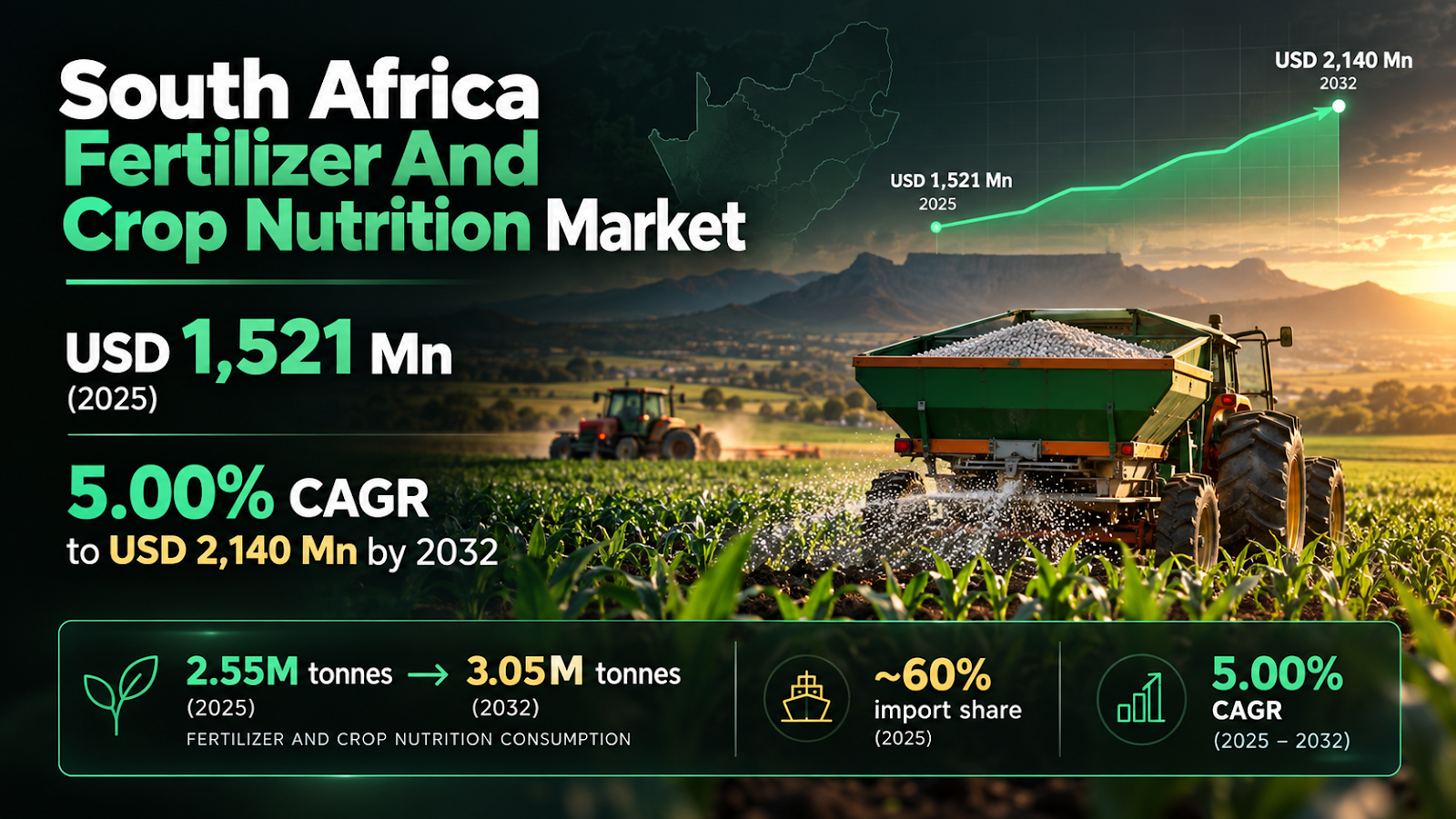
South Africa’s fertilizer industry is entering a phase in which regulation, public agricultural investment and nutrient-efficiency policy will influence corporate returns almost as strongly as crop acreage or fertilizer prices. According to Ken Research, the South Africa fertilizer and crop nutrition market was valued at USD 1,521 million in 2025 and is projected to reach USD 2,140 million by 2032, representing a 5.00% CAGR. Yet physical consumption is expected to expand more slowly, from approximately 2.55 million tonnes to 3.05 million tonnes. The resulting gap between value and volume growth makes one conclusion increasingly important for executives: future advantage will come from compliance-ready, higher-value and agronomy-supported nutrition rather than commodity tonnage alone.
Policy Shift: Government Is Strengthening the Agricultural Support Architecture
South Africa’s 2026/27 agricultural budget demonstrates the scale of government intervention around production resilience. The Department of Agriculture has been allocated R7.84 billion, including R3.28 billion for food security and farmer-support programmes and R2.59 billion for agricultural production, biosecurity and natural-resource management. More than 30% of the departmental budget is expected to flow to provincial and local implementation mechanisms.
This matters directly to fertilizer manufacturers, blenders and distributors because public support influences infrastructure, extension services, production capacity and farmer access to agricultural inputs. The Comprehensive Agricultural Support Programme is particularly relevant: more than R1.14 billion has been allocated for infrastructure, irrigation rehabilitation, production support and mechanisation.
- Fertilizer suppliers should treat public agricultural programmes as demand-shaping infrastructure rather than simply government expenditure, because improved irrigation, mechanisation and extension coverage can increase the economic viability of more sophisticated nutrient programmes.
- Companies serving emerging and commercializing producers should align distribution and agronomy capabilities with provincial implementation priorities, particularly where government-backed infrastructure lowers barriers to intensified crop production.
Policy Shift: Fertilizer Compliance Is Becoming a Strategic Capability
The regulatory perimeter is also evolving. In 2026, the South African Government invited comments on proposed amendments to regulations under the Fertilizers, Farm Feeds, Agricultural Remedies and Stock Remedies Act. For corporate leaders, the signal is bigger than an individual amendment: registration, product specifications, documentation and market-access compliance must be managed as strategic capabilities.
This is especially important as suppliers expand from conventional fertilizers into micronutrients, biological products, specialty formulations and integrated crop-input portfolios. The adjacent South Africa Fertilizer & Crop Inputs Market analysis shows why regulatory planning should increasingly be integrated with product-development and market-entry decisions.
- Portfolio owners should create a regulatory readiness matrix covering every formulation, registration requirement, supporting technical file and expected commercialization timeline before allocating expansion capital.
- Early movers that institutionalize compliance can shorten commercial-response times when regulations or customer specifications change, while competitors relying on reactive registration processes risk losing seasonal selling windows.
Market Impact: Policy Favors Productivity, Not Commodity Volume
The economic structure of the market reinforces this regulatory direction. Approximately 60% of fertilizer inputs are internationally sourced, while potassium fertilizer remains fully import-dependent. This exposes suppliers to exchange rates, shipping conditions, port performance and working-capital volatility.
At the same time, specialty and enhanced-efficiency fertilizers are expected to be the fastest-growing product area. Market revenue per tonne is projected to increase from USD 596 in 2025 to approximately USD 702 by 2032. That is strategically significant because it implies that value creation is progressively shifting toward nutrient-use efficiency, diagnostics, micronutrients, foliar applications, biological solutions and prescription agronomy.
This transition intersects with the South Africa AgriTech & Precision Farming Market, where variable-rate application, farm analytics and digital agronomy are creating the infrastructure for more precise nutrient decisions.
Strategic Action: Build Around the Regulated Farm Input Stack
Executives should therefore avoid treating fertilizer strategy as an isolated product-market decision. Nutrients increasingly sit inside a regulated farm-input stack involving seed genetics, crop protection, precision technology, soil diagnostics, financing and agronomic services. The South Africa Seed Market provides an adjacent example of how regulated agricultural inputs compete through technical performance, distribution depth and producer trust rather than price alone.
Don’t miss the next South Africa's fertilizer and crop nutrition market: regulation shift. Ken Research continuously publishes new market intelligence, forecasts and industry analysis. Add Ken Research as a Preferred Source on Google to discover more of our research when your next market question comes up.
- Manufacturers should prioritize localized blending, formulation flexibility and diversified sourcing where economics permit, because a market with roughly 60% import exposure rewards supply assurance as well as product performance.
- Distributors should evolve toward advisory-led models that combine soil information, crop-specific prescriptions and dependable fulfillment, allowing them to defend margins while helping growers manage fertilizer as a major production cost.
- Investors should evaluate regulatory capability, agronomist coverage, specialty-product pipelines and working-capital resilience alongside conventional metrics such as plant capacity and distribution footprint, because these capabilities increasingly determine who captures premium market growth.
The Asymmetric Advantage Belongs to Companies That Move Before Compliance Becomes Urgent
South Africa’s fertilizer opportunity is not simply a 5.00% CAGR story. Government funding is reinforcing agricultural production capacity, regulatory scrutiny continues to shape product commercialization, and market value is shifting toward formulations that deliver greater productivity per unit of nutrient. Companies that align product development, registration, sourcing, agronomy and provincial go-to-market strategies now can create an asymmetric advantage before the next regulatory or input-cost shock forces competitors to react.
Access the Ken Research Policy Impact Toolkit to align your corporate strategy with the latest regulatory frameworks immediately.


Comments
Post a Comment