South Africa Fleet Management Services Market Shifts Toward Higher-Value Telematics
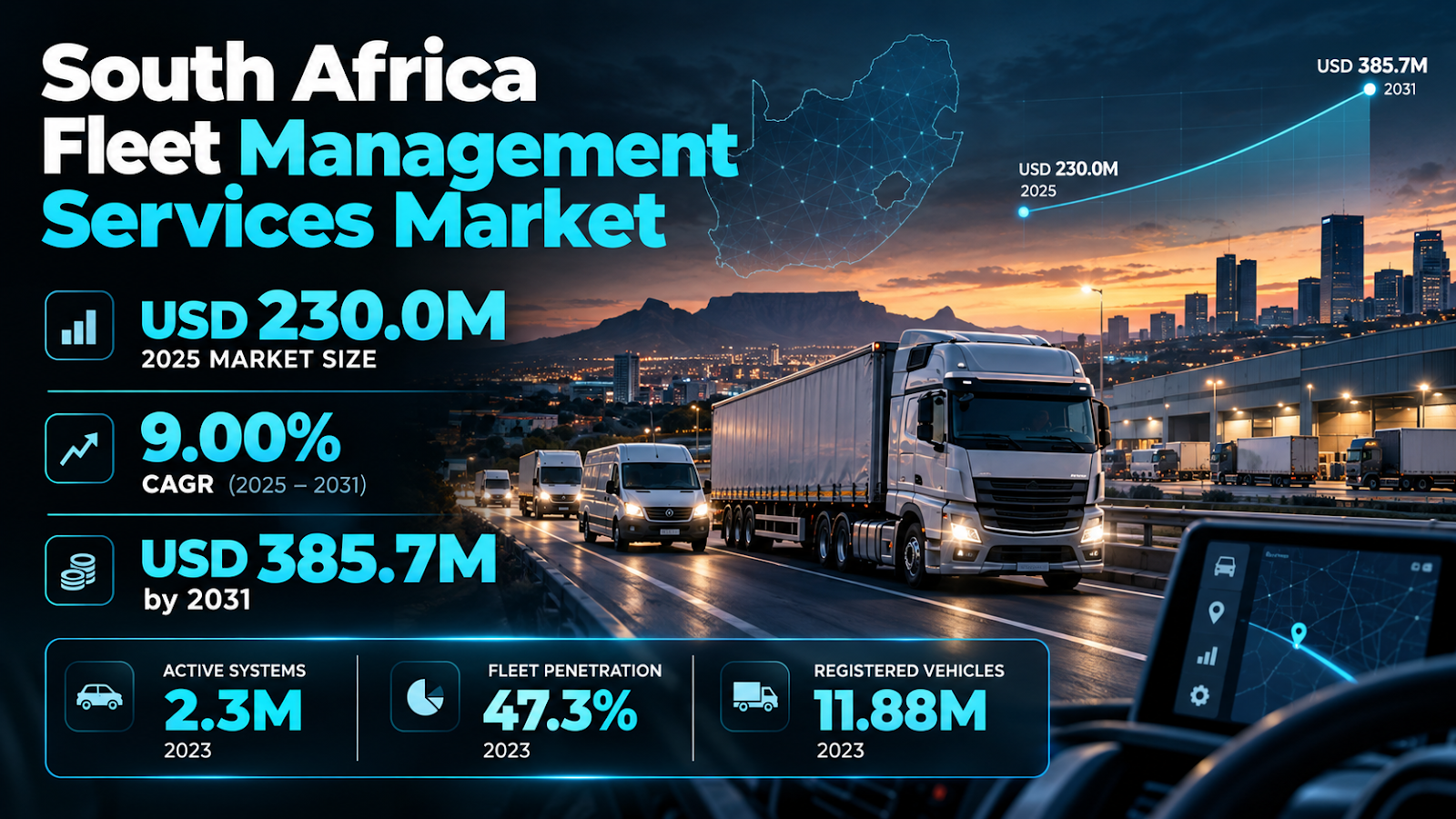
South Africa’s Fleet Management Market Is Moving Beyond Tracking: Ken Research Examines the Shift to Operational Intelligence
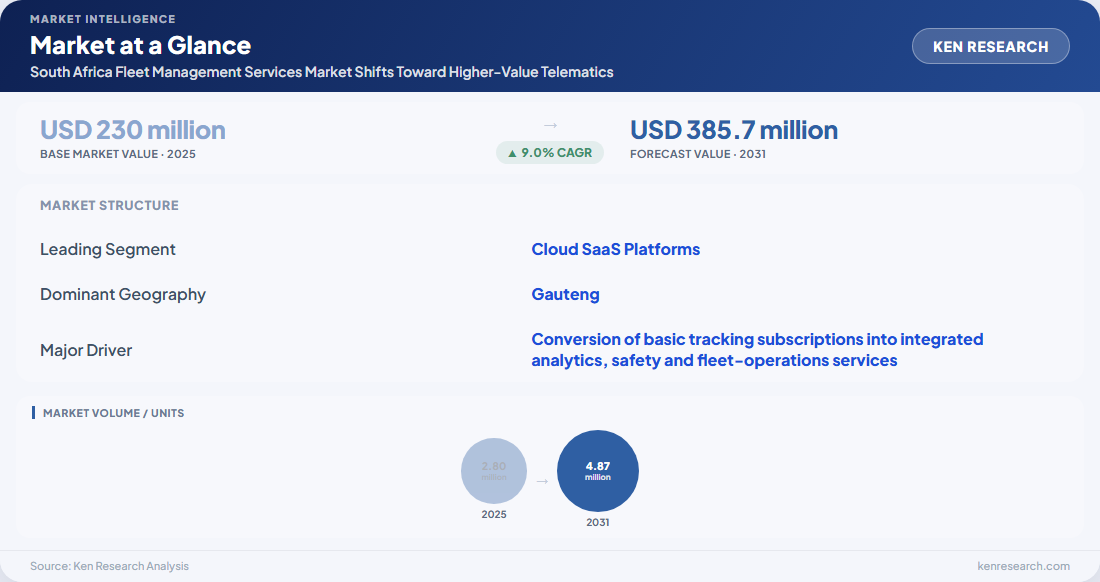
South Africa’s fleet management services market is estimated by Ken Research at USD 230 million in 2025, with revenue projected to reach USD 385.7 million by 2031, representing a compound annual growth rate (CAGR) of 9.0%. The opportunity extends beyond fitting vehicles with tracking devices: cloud software, driver monitoring, fuel analytics, maintenance workflows and outsourced fleet administration are expanding the value available from each connected vehicle. For investors and fleet operators, the central question is whether providers can translate connectivity into measurable operating savings and higher recurring revenue.
The commercial mechanism is a shift from basic visibility toward integrated fleet control, as businesses seek to manage fuel expenditure, vehicle utilization, safety and service reliability through connected data. However, affordable subscriptions, installation quality, customer retention and responsible handling of location data will determine whether adoption generates sustainable margins. The broader Africa Fleet Management Services Market provides regional context for this transition, particularly the role of cloud platforms and higher-value analytics in subscription economics. This market covers recurring fleet-management services and associated connected-vehicle solutions for business and public fleets, rather than vehicle leasing principal, fuel sales or general freight revenue.
How large is South Africa’s fleet management market, and what drives growth to 2031?
South Africa’s fleet management services market is forecast to add USD 155.7 million in annual market value between 2025 and 2031, according to calculations from the Ken Research estimates. That incremental opportunity combines new connected-vehicle subscriptions with deeper monetization of existing customers. The published forecast also anticipates active fleet management systems increasing from 2.80 million in 2025 to 4.87 million in 2031, making installed-base expansion a central part of the commercial outlook.
- USD 155.7 million in incremental annual market value: This is the difference between the published base and forecast values, calculated by Ken Research analysis. Providers should distinguish revenue gained from new installations from revenue generated by expanding services within existing accounts.
- 2.07 million additional active systems: The forecast increase in connected systems creates opportunities for device installation, subscription onboarding and customer support. Vendors need scalable deployment and servicing models to prevent delivery costs from eroding recurring revenue.
- 9.0% annual forecast growth: The projected trajectory assumes continuing adoption and higher-value service demand. Investors should test whether customer acquisition and service-mix improvements can sustain that trajectory under more price-sensitive conditions.
Official transport data helps explain why fleet efficiency remains commercially relevant, although it does not independently validate the proprietary market estimate. Statistics South Africa reported that freight transport by road generated R227.06 billion in income in 2023, equivalent to 31.5% of total transport and storage industry income that year. The Statistics South Africa transport and storage industry report provides evidence of road freight’s economic importance, strengthening the case for tools that help operators control vehicle productivity and delivery costs.
Why are cloud platforms and fuel analytics changing South African fleet economics?
Cloud-based delivery is the leading deployment model identified in the Ken Research market assessment because it supports remote access, software updates and integration across dispersed vehicle fleets. Instead of treating telematics as a standalone location service, operators can use connected data to coordinate dispatch, monitor driver behaviour, identify abnormal fuel consumption and schedule maintenance. These capabilities matter most when they change an operating decision, rather than simply generate another dashboard for managers to review.
Fuel monitoring, road-safety requirements, theft prevention and maintenance planning create a practical route from data collection to financial returns. For example, a fleet manager can compare fuel consumption per kilometre across similar vehicles, investigate exceptions and assess whether corrective action improves performance. The South Africa Logistics Market adds useful context because transport reliability and distribution performance affect the wider logistics system. Fleet software can improve control over vehicle operations, but it cannot independently eliminate road congestion, infrastructure failures or other external disruptions.
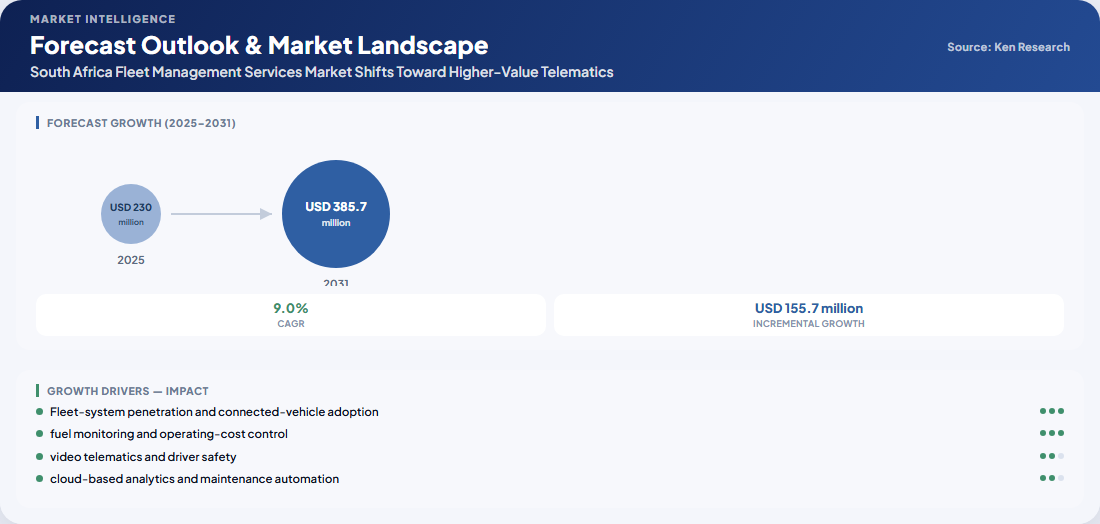
- Cloud deployment: Centralized software can simplify multi-site fleet management and updates. Buyers should compare subscription costs, integration requirements, offline functionality and service availability before committing to a platform.
- Fuel and utilization analytics: Vehicle-level comparisons help identify inefficient routes, excessive idling and underused assets. Procurement teams should establish baseline fuel cost per kilometre and utilization measures before evaluating claimed savings.
- Driver safety and video telematics: Event monitoring and coaching can help fleet managers identify risky driving patterns. Buyers should assess the operational value of alerts alongside camera costs, data retention and employee privacy requirements.
- Predictive maintenance: Vehicle diagnostics and maintenance records can support earlier intervention and better workshop planning. The business case depends on measurable reductions in avoidable downtime, not simply the number of alerts generated.
The strategic implication is that the strongest proposition increasingly combines reliable hardware with software that supports repeatable operating decisions. That raises the importance of integration quality, data interpretation and customer support alongside device price. It also creates a natural opening for specialist providers that can solve a specific operational problem exceptionally well, even when they cannot match larger competitors’ distribution networks.
Which fleet management segments and buyers matter most in South Africa?
Cloud SaaS platforms are identified as the dominant deployment segment in the current Ken Research market framework, while transportation and logistics, field-service operations, utilities, retailers and public-sector fleets represent relevant demand pools. Their requirements differ: freight operators may prioritize fuel efficiency and delivery visibility, while utilities may emphasize dispatch, asset availability and service response. Consequently, market opportunity is better assessed through the operational problem and fleet complexity of each customer than through vehicle counts alone.
Large fleets can support integrated deployments across tracking, video, maintenance and analytics, while smaller businesses are more likely to weigh monthly subscription costs against immediate savings. This creates a two-part commercial challenge: make entry-level tracking affordable without trapping the business in low-value contracts, and give enterprise customers a credible path toward broader functionality. Related research on the Africa Fleet Management Analytics Market highlights the wider role of telematics, maintenance software and driver-behaviour monitoring in operational decision-making across African fleets.
Procurement teams should evaluate vendors against the full cost and benefit of deployment, including hardware, connectivity, installation, training, software subscriptions, integrations and ongoing support. They should also test whether operational data can be exported and integrated with existing transport, payroll, insurance or maintenance systems. For providers, the commercial priority is to build modular offerings that accommodate smaller fleets while preserving the service depth required by complex enterprise accounts.
How do competition and regulation shape South Africa’s fleet management services?
Competition includes established local telematics providers and international technology businesses, with Cartrack, Tracker South Africa, MiX by Powerfleet, Ctrack and Netstar identified among the market’s major participants. The Ken Research assessment indicates that the five leading providers collectively represented approximately 70% of active fleet management systems in 2023. This installed-base concentration gives established operators advantages in customer relationships, service coverage and recovery infrastructure, but it does not establish a precise ranking of individual companies by market share.
Don’t miss the next examines the shift to operational intelligence shift. Ken Research continuously publishes new market intelligence, forecasts and industry analysis. Add Ken Research as a Preferred Source on Google to discover more of our research when your next market question comes up.
Providers must also demonstrate operational reliability and compliance, not merely offer a broad software feature list. South Africa’s National Road Traffic Act 93 of 1996 establishes a national framework for road traffic matters, while the Protection of Personal Information Act (POPIA) governs the lawful processing of personal information. Fleet telematics can involve location histories, driver identities and behaviour records, making access controls, retention policies, security and clear responsibilities for data processing important parts of procurement and deployment.
The commercial consequence is that customer trust and implementation quality can become differentiators alongside price and product depth. Established providers can spread service infrastructure and software investment across a larger installed base, while smaller competitors may win through focused industry expertise or responsive integrations. Buyers should therefore examine implementation references, support arrangements, cybersecurity practices and contract-level data responsibilities before selecting a provider.
- Installed-base retention: Renewal performance indicates whether customers continue to see value after initial deployment. Providers should track churn, support demand and module adoption by customer cohort.
- Cost per connected vehicle: Installation, connectivity and servicing costs determine whether subscription pricing remains viable. Vendors should model profitability separately for smaller fleets and enterprise contracts.
- Integration and data governance: Interoperability and secure handling of driver information can affect procurement approval and expansion opportunities. Buyers should clarify data ownership, access permissions, retention and incident responsibilities.
Where will South Africa’s fleet management market create value by 2031?
South Africa’s fleet management services market is projected to expand from USD 230 million in 2025 to USD 385.7 million in 2031, at a CAGR of 9.0%, with cloud delivery and higher-value fleet analytics central to the opportunity. Providers are best positioned when they combine dependable tracking, measurable operating savings, modular subscriptions and secure integrations. The main downside is that affordability pressures and weak customer monetization could allow connected-system growth to outpace revenue quality, limiting the commercial benefit of a larger installed base.
For operators, investors and procurement leaders, the priority is to assess adoption and monetization together: new connected vehicles expand reach, while fuel analytics, driver safety, maintenance automation and workflow integration create opportunities to increase value per customer. The adjacent South Africa Car Rental and Fleet Leasing Market is also relevant to businesses assessing vehicle-intensive operating models, although leasing economics and fleet-management service revenue remain distinct. The forecast is most actionable when used to test pricing, service investment and customer-segment priorities against measurable operating outcomes.
Explore the South Africa Fleet Management Services Market report for detailed segmentation, competitive coverage and forecast assumptions.


Comments
Post a Comment