Switzerland Hotel Market 2032: M&A, Digital Distribution and Hospitality Investment Opportunities
Switzerland Hotel Market Ecosystem: Where Hospitality, Real Estate and Digital Travel Are Creating Hidden Investment Alpha
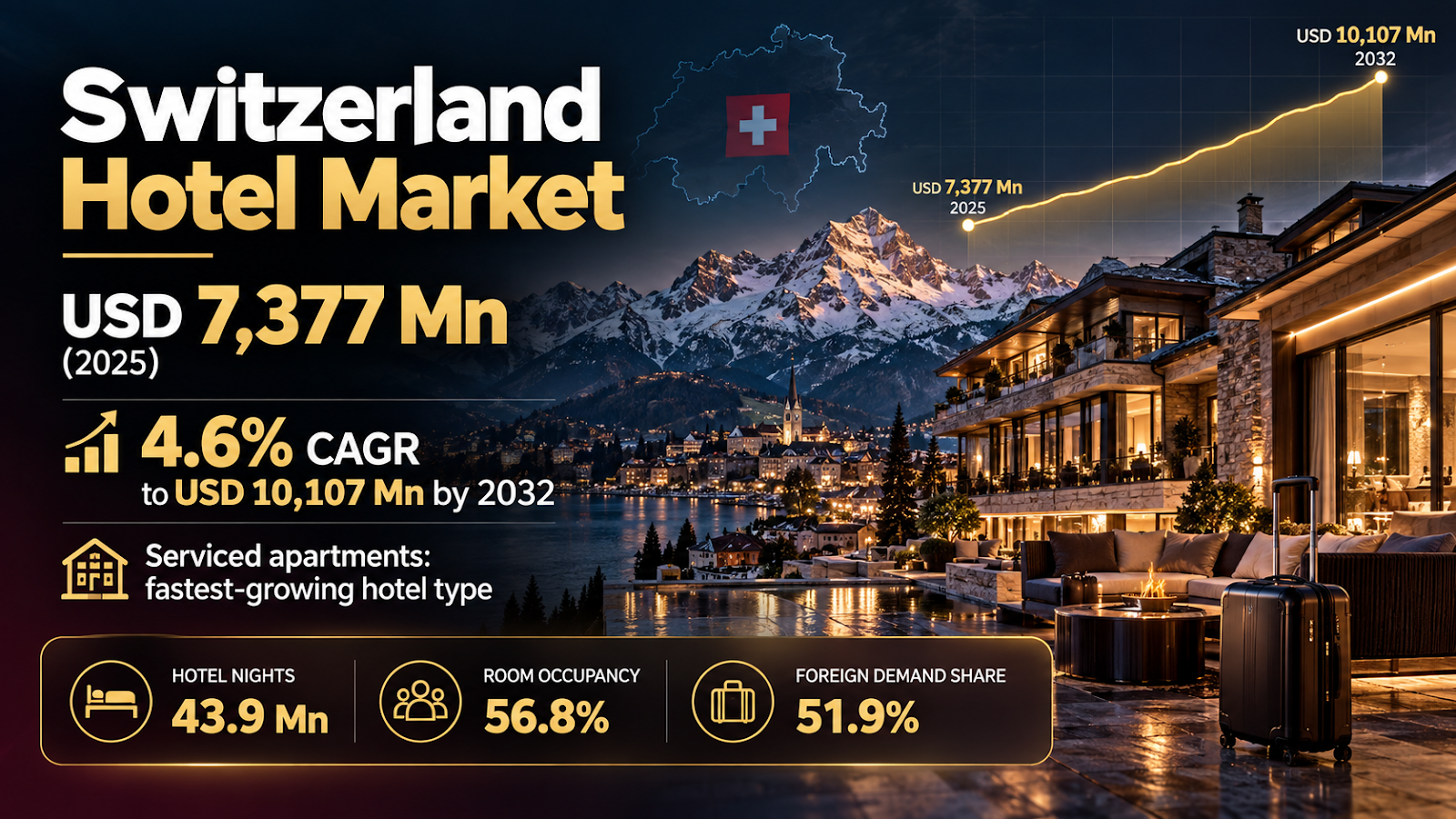
Switzerland’s hotel sector is becoming less a collection of accommodation assets and more an interconnected platform spanning property investment, luxury tourism, technology, online distribution, wellness and extended-stay living. According to Ken Research, the Switzerland hotel market was valued at USD 7,377 million in 2025 and is projected to reach USD 10,107 million by 2032, representing a 4.6% CAGR. The critical investment signal is that value is expected to expand faster than physical demand, shifting strategic attention from adding rooms toward improving asset productivity, guest mix and revenue capture.
Hotel Real Estate Is Converging with Luxury Tourism and Asset Repositioning
Switzerland entered 2025 with approximately 142,600 hotel rooms and limited scope for rapid greenfield expansion. That constraint changes the investment thesis. Rather than competing primarily through new capacity, owners can generate value by repositioning existing buildings, upgrading service levels and moving properties toward higher-yield luxury, wellness or extended-stay formats.
The economics support this approach. Five-star properties generated approximately USD 488 per occupied night in 2025 compared with about USD 129 for three-star hotels. For real-estate investors, this creates a bridge between traditional property appreciation and operating-business transformation. The broader real-estate ecosystem therefore becomes increasingly relevant to Swiss hospitality strategy as capital allocation, asset management and hotel operations converge.
M&A Target: Independent Hotels with Repositioning Potential
Independent hotels represented approximately 69.8% of Swiss establishments in 2025. That fragmented ownership structure creates potential acquisition, management-contract and brand-conversion opportunities for operators capable of adding revenue management, loyalty infrastructure and international distribution without destroying local identity.
Tourism Growth Is Connecting Swiss Hotels with Global Premium Consumer Flows
Official tourism data reinforce the importance of international demand. Switzerland recorded 42.8 million hotel overnight stays in 2024, up 2.6%, while foreign hotel demand climbed 5.1% to 22.0 million nights. The wider tourist-accommodation ecosystem reached 60.1 million overnight stays. By 2025, Ken Research estimates hotel nights had increased to 43.9 million, including 22.8 million foreign nights.
This matters because overseas travelers can support more than room revenue. Luxury accommodation intersects with premium dining, wellness, transportation, retail and destination experiences. Hotels positioned around Zürich, Geneva and high-value Alpine destinations can therefore evolve into monetization platforms serving multiple categories of visitor expenditure rather than relying solely on nightly rates.
Joint-Venture Structure: Hospitality Plus Wellness and Experiences
Owners do not necessarily need to build every capability internally. Partnerships with wellness operators, specialist tour providers, mobility businesses and premium food concepts can expand revenue per guest while limiting fixed-capital commitments.
Serviced Apartments Are Merging Hospitality with Residential and Corporate Mobility
Serviced apartments represent one of the clearest examples of dissolving sector boundaries. Ken Research identifies the format as the fastest-growing hotel-type segment, with indicative growth of roughly 6.6% through 2031. The model sits between traditional hotels, rental housing and corporate relocation, allowing investors to capture longer stays with potentially lower housekeeping and distribution intensity.
This creates strategic opportunities around underperforming urban hotels, mixed-use developments and properties near business districts. Investors assessing the broader Switzerland hospitality ecosystem should therefore evaluate whether conventional rooms can be reconfigured into kitchenette-equipped extended-stay inventory serving consultants, relocating professionals and longer-duration international visitors.
Online Travel and Hotel Technology Are Converging into a Distribution-Control Battle
Approximately 50.4% of Swiss hotel bookings were generated through online travel agencies in 2025, while direct digital bookings are projected to grow at approximately 7.65% CAGR through 2031. This turns hotel technology from a back-office expense into an investment variable.
The Europe online travel market demonstrates how accommodation is increasingly embedded within a digital commerce layer covering transport, mobility, experiences and other trip components. For hotel owners, acquiring or partnering with revenue-management, CRM, booking-engine and guest-data platforms can improve direct conversion and reduce intermediary leakage.
M&A Target: Technology Platforms Serving Fragmented Hotel Operators
The independent-hotel tail creates an addressable market for shared technology platforms. Consolidators that combine hotel assets with centralized revenue management, digital marketing and procurement could capture operating synergies unavailable to stand-alone properties.
Labor Scarcity Is Linking Hotel Investment with Automation and Operating Technology
Swiss tourism supported 187,770 full-time-equivalent jobs in 2024, equivalent to 4.2% of total employment. Hospitality remains labor intensive, making workforce availability a direct constraint on how much existing physical capacity can actually be monetized.
With national room occupancy forecast to move from 56.8% in 2025 toward 61.8% by 2032, owners may increasingly favor automation in scheduling, check-in, housekeeping coordination and guest communication. The attractive acquisition target is therefore not technology that merely reduces headcount, but systems that allow premium service levels to scale despite labor scarcity.
Don’t miss the next travel are creating hidden investment alpha shift. Ken Research continuously publishes new market intelligence, forecasts and industry analysis. Add Ken Research as a Preferred Source on Google to discover more of our research when your next market question comes up.
Key Intersections Defining Switzerland’s Next Hospitality Investment Cycle
- Hotel real estate and luxury tourism are converging around renovation-led asset repositioning, allowing investors to pursue higher room yields without relying on substantial additions to national room supply.
- Serviced apartments are connecting hospitality with corporate mobility and residential living, creating extended-stay models with different labor, housekeeping and customer-acquisition economics.
- Hotels and travel technology are converging as operators attempt to shift bookings from high-commission intermediaries toward direct digital relationships that preserve customer data and net revenue.
- Hospitality and wellness are increasingly complementary revenue pools, particularly where premium international visitors can support higher spending across accommodation, dining, health and destination experiences.
- Fragmented independent ownership creates opportunities for acquisitions, brand affiliations, technology roll-ups and shared-service platforms that improve purchasing, distribution and revenue-management productivity.
The Hidden Alpha Lies in Controlling More of the Guest and Asset Economics
The strongest Switzerland hotel investment thesis is therefore not simply “more tourism.” Market value is forecast to expand faster than overnight stays, meaning returns should increasingly depend on who can extract more value from constrained assets. For founders, investors and strategic buyers, the highest-potential targets sit at the intersections: independent hotels suitable for repositioning, serviced-apartment conversions, hospitality technology platforms, wellness partnerships and multi-property operating structures.


Comments
Post a Comment