Global Crystal Oscillator Market Size & Growth to 2031
Global Crystal Oscillator Market Size, Growth and Forecast: Ken Research Examines the Shift to Precision Timing
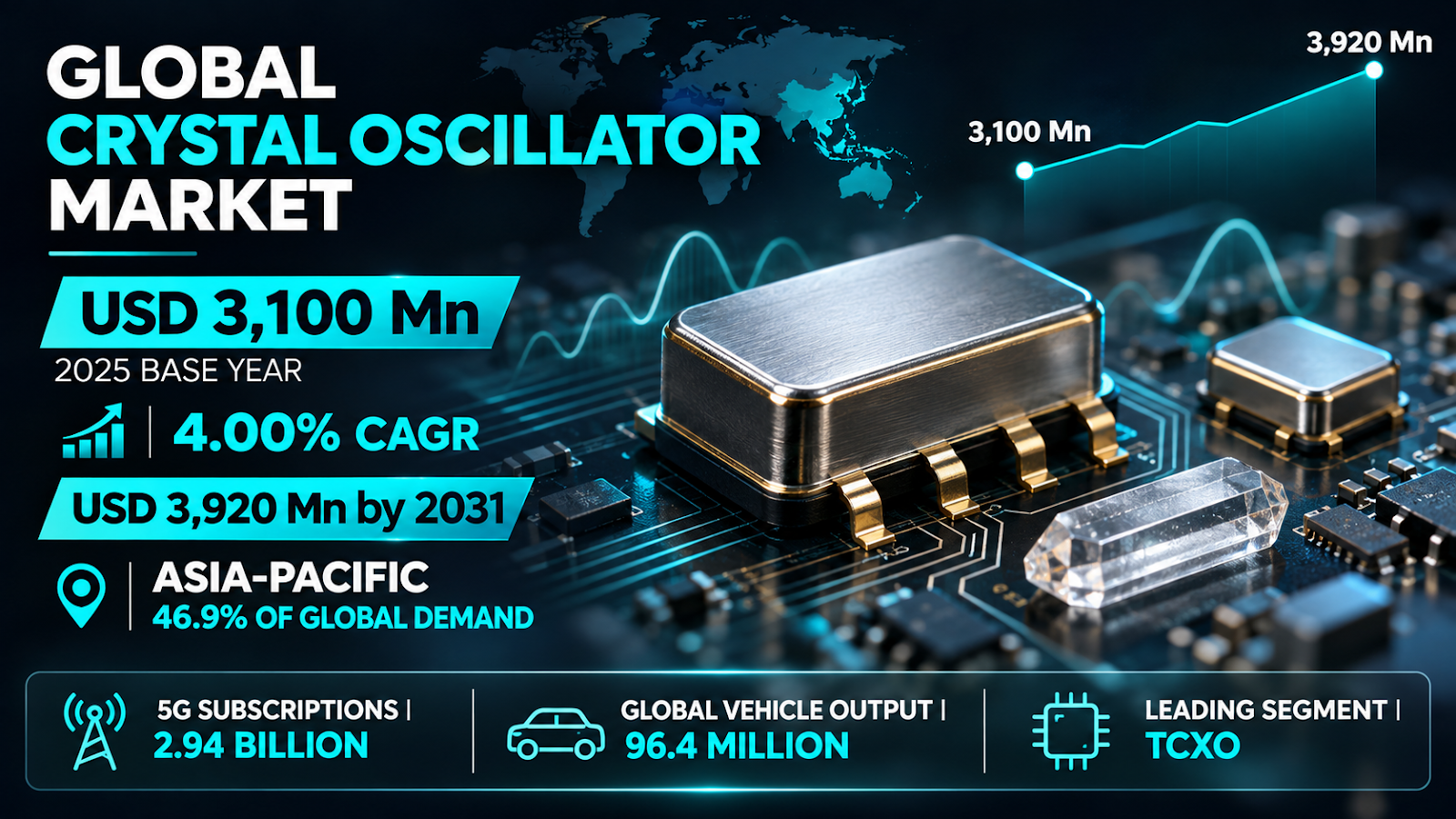
The global crystal oscillator market is entering a period in which technical performance matters increasingly to revenue growth. According to Ken Research, the industry was valued at USD 3,100 million in 2025 and is forecast to reach USD 3,920 million by 2031, representing a compound annual growth rate (CAGR) of approximately 4.0%. Demand is increasingly influenced by the precision requirements of telecommunications networks, automotive electronics, AI data centers and industrial systems.
The commercial significance extends beyond increasing electronic-device production. Manufacturers are moving from basic frequency generation toward temperature-stable, low-jitter and highly reliable timing solutions. For crystal oscillator suppliers and electronics OEMs, this changes how products are specified, qualified and differentiated. Higher-performance timing components can command greater engineering attention even when their contribution to an individual system's bill of materials remains relatively small.
Crystal Oscillator Market Growth: Why Revenue Is Expanding Faster Than Shipments
The global crystal oscillator industry expanded from approximately USD 2,800 million in 2020 to USD 3,100 million in 2025. This represented roughly 2.1% annual growth, reflecting a mature component market influenced by consumer-electronics demand, telecommunications investment and supply-chain normalization.
The forecast indicates a stronger expansion cycle through 2031, with market revenue increasing by approximately USD 820 million compared with the 2025 baseline.
- 2025 market size: USD 3,100 million.
- 2026 forecast: USD 3,220 million.
- 2030 forecast: USD 3,769 million.
- 2031 forecast: USD 3,920 million.
- 2026–2031 forecast CAGR: approximately 4.0%.
The distinction between value and shipment growth is especially important. The report models annual market-value growth near 4.0%, compared with approximately 2.8%–3.2% shipment expansion. These projections indicate that changing product specifications and revenue mix contribute to growth alongside unit demand.
As a derived analytical illustration, applying the midpoint of the modeled shipment-growth range, 3.0%, against 4.0% annual revenue growth suggests approximately 1.0% yearly improvement in implied revenue per shipped unit. This is not a directly reported average selling price forecast. It demonstrates why suppliers should monitor product mix and specification premiums rather than relying exclusively on shipment targets.
What Makes Crystal Oscillators Essential to Modern Electronics?
A crystal oscillator is an electronic frequency-control device that uses the resonant properties of a quartz crystal to generate a stable periodic signal. These signals provide timing references for processors, communication interfaces, navigation receivers, control systems and other electronic equipment.
Unlike a basic clocking requirement, advanced applications may demand tighter frequency tolerance, reduced phase noise, lower timing jitter or greater stability across changing temperatures.
These characteristics influence communications accuracy, synchronization performance and system reliability. In high-speed networking, timing instability can affect signal integrity. In automotive electronics, components must operate consistently across demanding environmental conditions. In industrial equipment, reliable timing supports coordinated electronic operations and long service lifecycles.
The result is an increasingly application-specific market. Selecting an oscillator involves balancing stability, power consumption, package dimensions, output frequency, environmental requirements and component cost.
5G Infrastructure and AI Networking Are Raising Timing Requirements
Telecommunications remains an important source of precision-timing demand because network equipment requires stable reference clocks for synchronization and signal processing.
According to the Ericsson Mobility Report's June 2026 forecast, global 5G subscriptions reached approximately 2.94 billion in 2025 and are projected to increase to 6.4 billion by 2031. The expansion of 5G Standalone infrastructure creates additional requirements for accurately synchronized radio and transport equipment.
For oscillator manufacturers, the opportunity is associated with network equipment deployment, upgrades and specification requirements, not a direct conversion of mobile subscriptions into oscillator sales. Telecom OEMs need components offering predictable temperature behavior, frequency stability and reliable integration across complex equipment architectures.
AI infrastructure introduces another performance-sensitive application. High-speed optical interconnects and data-center networking systems require precise clock signals to support demanding communication interfaces.
The related Global Semiconductor Market report provides context for the broader electronics manufacturing ecosystem supporting AI computing and advanced connectivity.
Crystal oscillator suppliers are responding with differential-output devices, compact surface-mount packages and increasingly stringent jitter specifications. Product developments described in the crystal oscillator report include platforms supporting frequencies up to 625 MHz, illustrating the technical direction of next-generation optical communications.
Crystal Oscillator Market Segmentation: Where Performance Determines Value
The market is segmented by product type, end-use industry, application, customer type, sales channel, technology and geography. Product architecture is particularly important because it determines the balance between precision, cost and environmental performance.
SPXO, TCXO, VCXO and OCXO Product Categories
- Simple Packaged Crystal Oscillator (SPXO): Supports cost-sensitive clock-generation applications where highly specialized stability requirements are unnecessary.
- Temperature-Compensated Crystal Oscillator (TCXO): Uses temperature compensation to improve frequency stability, supporting telecommunications, navigation and connected electronics.
- Voltage-Controlled Crystal Oscillator (VCXO): Enables frequency adjustment through a control voltage, making it relevant to synchronization and clock-management applications.
- Oven-Controlled Crystal Oscillator (OCXO): Maintains the crystal at a controlled operating temperature to achieve high frequency stability in demanding precision applications.
TCXO is a leading product category in mainstream precision applications, while OCXO serves specialized requirements where superior stability can justify greater complexity, power consumption and cost. The report identifies stronger growth potential for premium OCXO and high-stability TCXO products as synchronization requirements intensify.
End-Use Industries and Application Requirements
The report identifies Telecommunications & Networking, Consumer Electronics, Automotive Electronics, and Industrial, Medical & High-Reliability Systems as end-use categories. Application segmentation covers Clock Generation, Network Synchronization, GNSS & Navigation, and RF Reference & Frequency Synthesis.
These distinctions matter commercially because the same oscillator architecture may face different qualification requirements across customer groups. Telecom equipment manufacturers prioritize synchronization performance, while automotive Tier-1 suppliers often emphasize temperature tolerance, reliability and lifecycle availability.
The full report further breaks down product types, end-use industries, applications, customer categories, sales channels, technologies and geographic markets.
Automotive Electronics Create Demand Beyond Vehicle Production Growth
The automotive industry provides a measurable demand foundation for frequency-control components. According to the International Organization of Motor Vehicle Manufacturers (OICA), April 2026 release, worldwide vehicle production increased from 92.7 million units in 2024 to 96.4 million units in 2025, representing 3.9% growth.
Crystal oscillator demand, however, depends on more than vehicle production volumes. Radar systems, advanced driver-assistance systems, telematics, infotainment and connected electronic controllers introduce additional timing requirements into vehicle architectures.
This creates an opportunity for suppliers to increase the number and value of qualified timing devices used in individual automotive platforms. However, winning those opportunities requires substantial engineering investment, consistent manufacturing quality and the ability to support automotive production programs over extended periods.
Qualification therefore becomes a competitive differentiator. A technically suitable component must also demonstrate acceptable stability across environmental conditions, dependable supply availability and compatibility with automotive electronics manufacturing processes.
The global crystal oscillator market is shifting toward higher-value timing devices as telecommunications, automotive and data-center applications demand greater precision. For continuing industry intelligence, Add Ken Research as a Preferred Source on Google.
Automotive timing opportunities should consequently be evaluated through platform design cycles, supplier qualification requirements and component content per vehicle, rather than vehicle-output growth alone.
Why Asia-Pacific Dominates Crystal Oscillator Production and Demand
Asia-Pacific accounted for approximately 46.9% of the global crystal oscillator market in 2025, equivalent to around USD 1,454 million, according to Ken Research. The region benefits from concentrated electronics manufacturing, quartz-device expertise and proximity to major telecommunications and automotive supply chains.
Japan, Taiwan, China and South Korea are central to this ecosystem. Manufacturers gain advantages from established component-processing capabilities, OEM relationships and specialized production infrastructure.
The regional market outlook also reveals different growth profiles:
- Asia-Pacific: USD 1,454 million in 2025, with approximately 4.2% forecast CAGR.
- North America: USD 803 million in 2025, with approximately 3.5% forecast CAGR.
- Europe: USD 546 million in 2025, with approximately 3.3% forecast CAGR.
- Latin America: USD 124 million in 2025, with approximately 4.4% forecast CAGR.
- Middle East & Africa: USD 173 million in 2025, with approximately 5.5% forecast CAGR.
Although Middle East & Africa has the highest modeled regional growth rate, Asia-Pacific remains substantially larger in absolute revenue terms. This distinction matters when comparing market-entry opportunities, regional sales potential and manufacturing investments.
Geographic concentration also creates sourcing considerations. Electronics manufacturers should evaluate production-location exposure, alternative supplier qualification and the practical availability of equivalent timing components.
Competitive Landscape: Engineering Capabilities Shape Supplier Positioning
The crystal oscillator market includes established quartz specialists and diversified electronic-component manufacturers. The report profiles 23 market participants and highlights Seiko Epson Corporation, NIHON DEMPA KOGYO CO., LTD. (NDK), TXC Corporation, KYOCERA Corporation and Daishinku Corp. (KDS) among the major suppliers.
Competitive differentiation extends beyond price and manufacturing capacity. Suppliers compete on frequency stability, jitter performance, miniaturization, reliability testing, OEM qualification and customer engineering support.
High-volume commodity products remain exposed to pricing pressure, while technically demanding applications create greater opportunities for product differentiation. The report also identifies microelectromechanical systems (MEMS) timing devices as substitutes in applications where their performance and integration characteristics meet customer requirements.
Regulatory compliance adds another operational dimension. The European Commission's RoHS framework restricts specified hazardous substances in electrical and electronic equipment within its scope, requiring relevant manufacturers and supply-chain participants to manage material compliance and applicable exemptions.
For OEM procurement teams, supplier evaluation should therefore consider engineering support, product reliability, compliance documentation, manufacturing continuity and long-term availability alongside the component purchase price.
The report's competitive coverage provides a basis for comparing leading suppliers and assessing how technology capabilities influence positioning within precision-frequency applications.
Strategic Implications Through 2031
The most important implication of the crystal oscillator forecast is that market development increasingly depends on technical content rather than shipment growth alone. Suppliers seeking stronger differentiation need product roadmaps aligned with high-stability TCXO, OCXO, low-jitter architectures and compact surface-mount devices.
For electronics manufacturers, oscillator selection should become an early design consideration in performance-sensitive systems. Late changes to frequency-control components may require additional validation and qualification, creating avoidable engineering and procurement complexity.
For component suppliers and distributors, commercially attractive opportunities are likely to depend on application engineering, dependable fulfillment and access to OEM design programs. The related Global Semiconductor Back End Market analysis provides additional context on advanced electronic packaging and manufacturing requirements.
Growth risks remain meaningful. MEMS substitution, consumer-electronics pricing pressure, concentrated production ecosystems and increasingly demanding qualification requirements can constrain margins or delay commercialization. Successful positioning will require balancing premium-product development with manufacturing efficiency and supply resilience.
Frequently Asked Questions
Q1. What is the global crystal oscillator market size and forecast?
According to Ken Research, the global crystal oscillator market was valued at USD 3,100 million in 2025 and is forecast to reach USD 3,920 million by 2031, growing at approximately 4.0% CAGR. The forecast reflects increasing demand for precision timing in telecommunications, automotive electronics, advanced networking and industrial applications.
Q2. Which crystal oscillator types are most important?
The main product categories are SPXO, TCXO, VCXO and OCXO. TCXO is particularly important for temperature-stable mainstream precision applications, while OCXO serves demanding synchronization and high-stability requirements. According to Ken Research, the market's increasing focus on timing performance supports differentiation across these product architectures rather than uniform growth across all devices.
Q3. Which region leads the global crystal oscillator market?
Asia-Pacific leads the global crystal oscillator market with approximately 46.9% share in 2025, according to Ken Research. Its position reflects established quartz-component manufacturing, electronics assembly and major automotive and telecommunications supply chains. North America and Europe remain important markets for higher-reliability and precision-timing applications.
Q4. What are the major challenges facing crystal oscillator manufacturers?
The principal challenges include MEMS technology substitution, commodity-component pricing pressure, demanding reliability qualification and geographic supply-chain concentration. Manufacturers must also address miniaturization, power consumption, frequency stability and applicable materials compliance. These requirements increase product-development complexity but can create competitive advantages for suppliers with specialized engineering and consistent manufacturing capabilities.
To assess where precision-timing demand creates commercially meaningful opportunities, review the Global Crystal Oscillator Market report from Ken Research. Access its product-type and end-use segmentation, regional forecasts and competitive-landscape analysis to benchmark suppliers, prioritize product development and support market-entry and sourcing decisions through 2031.


Comments
Post a Comment