Indonesia Plastic Pipe Market: Water Infrastructure and Premium HDPE Drive Growth to 2030
Indonesia's Plastic Pipe Market Moves Beyond Commodity Growth: Ken Research Examines the Infrastructure and Specification Opportunity
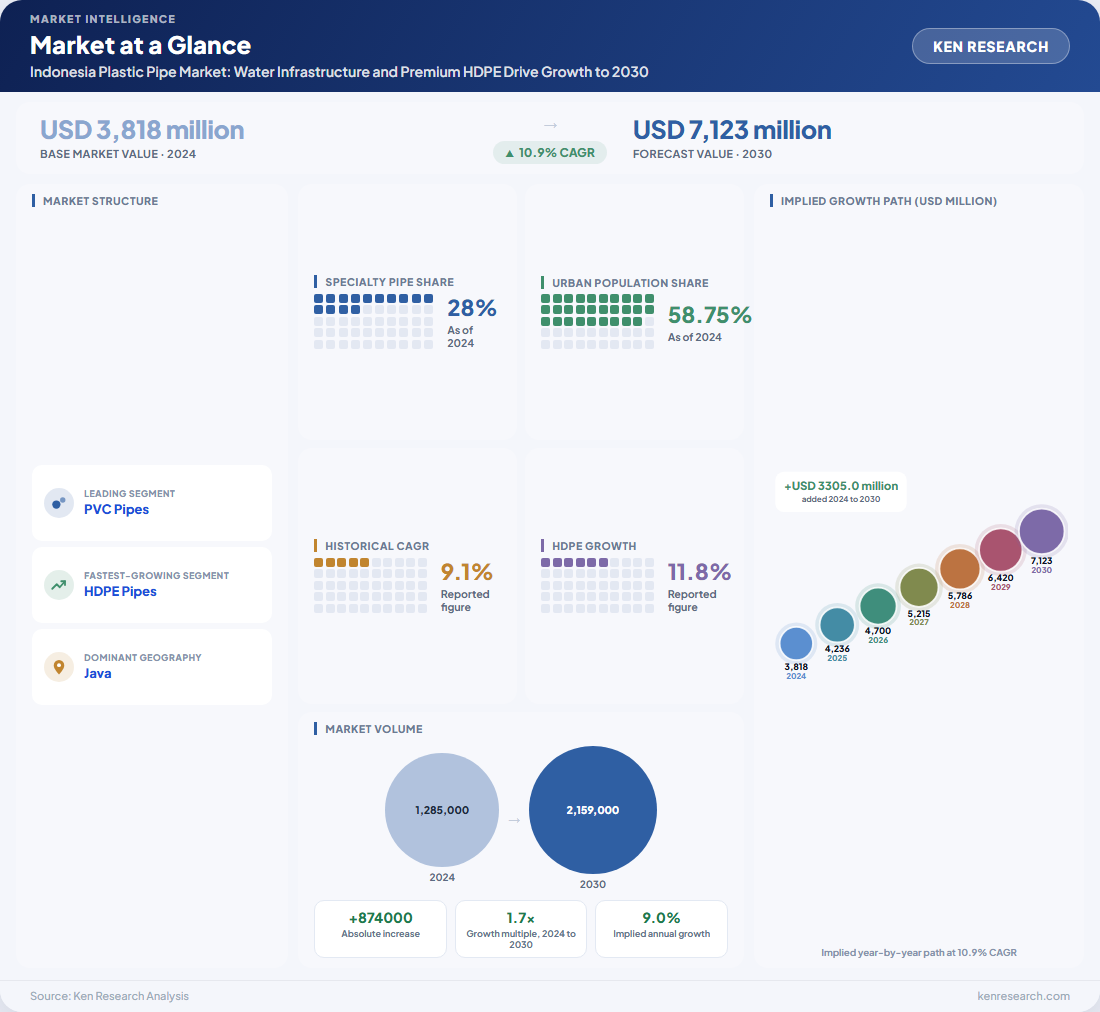
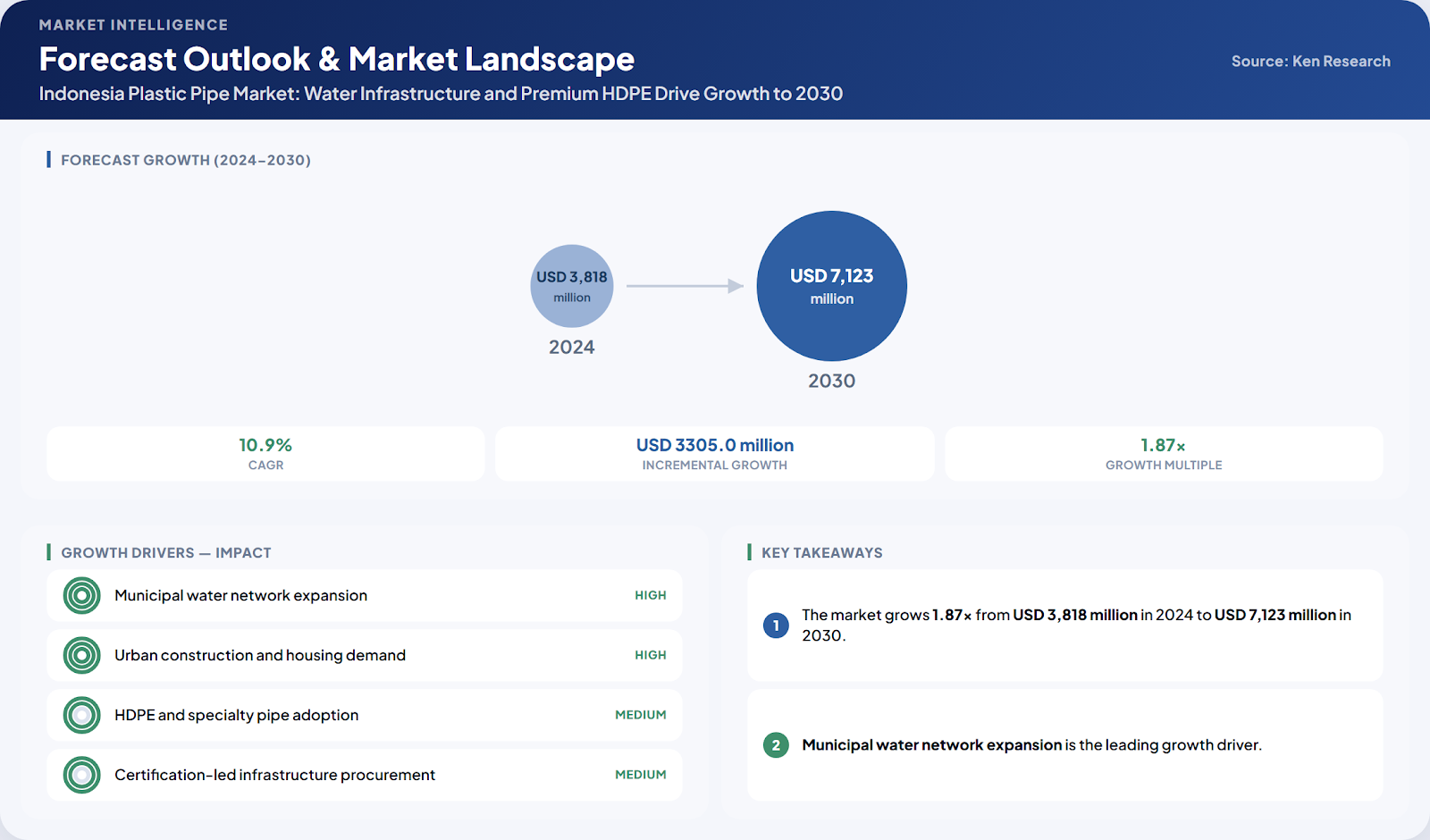
Indonesia's plastic pipe market is entering a more specification-driven expansion phase as public water infrastructure, urban construction and industrial projects reshape purchasing priorities. According to proprietary estimates from Ken Research, the market was valued at USD 3,818 million in 2024 and is projected to reach USD 7,123 million by 2030, with a forecast CAGR of 10.9% during 2025–2030. The opportunity increasingly depends on product performance, technical certification and project delivery capabilities.
Municipal water networks and higher-pressure applications are creating demand for engineered HDPE, PVC and specialty piping systems, while distributors continue serving cost-sensitive construction customers. The market covers plastic pipes used in water distribution, drainage, building plumbing, irrigation and utility conduits. However, imported resin exposure, uneven utility financing and regional logistics costs can weaken supplier margins. The adjacent Indonesia PVC Pipes Market illustrates the continued importance of established PVC applications alongside this broader product transition.
How Large Will Indonesia's Plastic Pipe Market Become by 2030?
Indonesia's plastic pipe market is projected to generate an additional USD 3,305 million in annual market value between 2024 and 2030, based on the published forecast endpoints. This represents approximately 86.6% cumulative growth, calculated from the proprietary market series rather than reported as a separate official statistic. The expansion reflects both greater physical demand and the increasing importance of higher-value pipe systems across infrastructure and building applications.
- USD 2,470 million in 2019: The historical market baseline demonstrates how construction activity and infrastructure demand supported the sector before pandemic-related disruption.
- USD 2,340 million in 2020: Market value declined during the disruption period, highlighting sensitivity to construction schedules and project execution.
- 14.5% growth in 2021: The recovery in manufacturer revenue marked a significant rebound as deferred construction activity resumed.
- USD 6,420 million in 2029: The intermediate forecast provides a useful checkpoint for evaluating whether infrastructure procurement and premium product adoption are progressing as modeled.
The forecast should therefore be assessed through order conversion, product mix and project realization rather than headline growth alone. Broader context from the Indonesia Construction Market shows why residential, commercial and infrastructure investment remain important demand foundations for building materials. For manufacturers, this suggests a staged capacity strategy linked to confirmed contracts, distributor replenishment and higher-specification production requirements. The next question is how infrastructure activity becomes actual pipe procurement.
Why Is Water Infrastructure Accelerating Indonesia's Plastic Pipe Demand?
Indonesia's municipal water infrastructure is creating a structural demand opportunity for plastic pipes because expanded distribution networks require transmission mains, service connections and reliable jointing systems. The Ministry of Public Works has documented regional water-supply investments that connect treatment facilities with residential consumers. Its SPAM Regional Wosusokas project announcement identifies planned service expansion across Central Java municipalities, illustrating how utility development generates requirements for transmission and distribution infrastructure.
Water-network investments also change supplier economics because pressure ratings, installation integrity and long-term performance influence product selection. Commodity PVC remains important for established applications, but municipal buyers may require engineered alternatives for specific pressure, diameter and joining conditions. This increases the value of certified manufacturing, technical documentation and contractor support. Suppliers that participate early in engineering specifications can improve their position before price-based tender competition begins.
- 10 million additional piped-water connections: The report identifies a 2025–2029 government target that could expand demand for distribution systems and service pipes.
- 24 million household connections: The report's 2029 clean-water connection target highlights the potential scale of utility-related purchasing requirements.
- 58.75% urban population share: Indonesia's estimated urbanization level in 2024 concentrates water, drainage and building-services demand.
- 11.8% HDPE CAGR: The forecast growth rate indicates that higher-performance polyethylene systems may expand faster than the overall pipe market.
Which Indonesia Plastic Pipe Segments Offer Stronger Procurement Economics?
Indonesia's plastic pipe market combines the scale advantages of established PVC products with faster expansion in HDPE and higher-specification applications. The primary report identifies PVC as the dominant material family and HDPE as the fastest-growing family, while uPVC pressure pipes remain a major revenue pool. This creates different commercial strategies for municipal contractors, building developers, agricultural buyers and distributors, with each group balancing purchase price, installation requirements, product availability and service life.
- 28.0% specialty product share: The report attributes this portion of 2024 market value to CPVC, PPR or PP, PE-RT or PEX, specialty ABS and multilayer systems, indicating a distinct premium product opportunity.
- 7 segmentation dimensions: Product type, application, end-use industry, customer type, sales channel, technology and geography provide separate lenses for pricing and market-entry decisions.
- 10.43% construction GDP contribution: Indonesia's construction sector accounted for this share of national GDP in the fourth quarter of 2024, according to the Badan Pusat Statistik construction indicators.
For procurement teams, material selection should begin with application requirements rather than a uniform price-per-length comparison. Pressure rating, jointing method, installation labor and the consequences of leakage can materially change lifecycle economics. Agricultural water distribution also creates a related demand channel, with the Indonesia Drip Irrigation Market providing additional context on irrigation components and water-management investment. The result is a market where customer-specific technical capability increasingly influences competitive positioning.
Who Competes in Indonesia's Plastic Pipe Industry and How?
Competition in Indonesia's plastic pipe industry is shaped by manufacturing capacity, distributor reach, certification capabilities and access to infrastructure projects. The primary report identifies PT Wahana Duta Jaya Rucika, PT Rusli Vinilon Sakti, PT Pralon, PT Maspion Kencana and PT Lesso Technology Indonesia among major participants. Its market description emphasizes fragmentation, so the named companies should not be interpreted as holding verified percentage shares or a definitive revenue ranking.
Java remains the dominant manufacturing and distribution hub because major construction markets, imported inputs, industrial processing and dealer networks are concentrated around the island. Companies competing beyond Java must weigh factory utilization against inventory positioning, delivery expenses and technical service availability. The Indonesia Plastic Market provides broader supply-chain context through its coverage of polymer processing, extrusion, raw materials and distribution channels. These overlapping operating requirements make supplier capability more important than capacity alone.
Don’t miss the next examines the infrastructure and specification opportunity shift. Ken Research continuously publishes new market intelligence, forecasts and industry analysis. Add Ken Research as a Preferred Source on Google to discover more of our research when your next market question comes up.
What Could Slow Indonesia's Plastic Pipe Growth and Supplier Margins?
Indonesia's plastic pipe growth could underperform expectations if imported polymer costs, infrastructure funding constraints and project delays weaken procurement execution. The report highlights substantial exposure to overseas resin supply, which complicates pricing when manufacturers commit to fixed-price contracts before securing input costs. This creates a risk that revenue growth may not translate into improved operating margins, especially for suppliers competing primarily through commodity pricing or carrying substantial inventories.
Water infrastructure presents another execution risk because announced projects do not automatically become immediate material purchases. Project preparation, financing arrangements, contractor selection and construction schedules can separate the investment pipeline from realized demand. The Ministry of Public Works' SPAM Regional Sinumbra project information illustrates the financing, tendering and development stages associated with a major water-supply scheme. Suppliers should therefore track procurement milestones instead of treating all proposed investment as confirmed orders.
- USD 1.14 billion polypropylene imports: The report cites this 2024 trade value as evidence of external feedstock exposure, relevant particularly to PP-linked product economics.
- USD 611.8 million HDPE imports: The reported 2024 import value highlights supply exposure for polyethylene product families despite favorable demand expectations.
- 46.61% of national import value: DKI Jakarta's reported 2024 import-unloading concentration creates logistical advantages for established Java-based supply chains.
- SNI-linked procurement standards: The report notes that compliance requirements across uPVC and PE categories raise the importance of testing, documentation and tender readiness for suppliers.
Where Should Investors Position for Indonesia's Plastic Pipe Opportunity Through 2030?
Indonesia's plastic pipe market is moving toward higher-value, infrastructure-linked demand, with the forecast expansion supported by municipal water systems, construction activity and engineered material adoption. The most attractive positioning combines certified pressure-pipe capability, dependable regional distribution and disciplined resin procurement. HDPE-focused suppliers, technically capable manufacturers and project-oriented distributors may benefit as utility specifications become more demanding. However, working-capital pressures, imported material volatility and delayed public procurement remain critical threats to forecast realization.
For manufacturers, investors and procurement leaders evaluating capacity expansion, product segmentation and competitive positioning, explore the Indonesia Plastic Pipe Market report for detailed market sizing, forecast assumptions, industry participants and strategic operating insights.


Comments
Post a Comment